
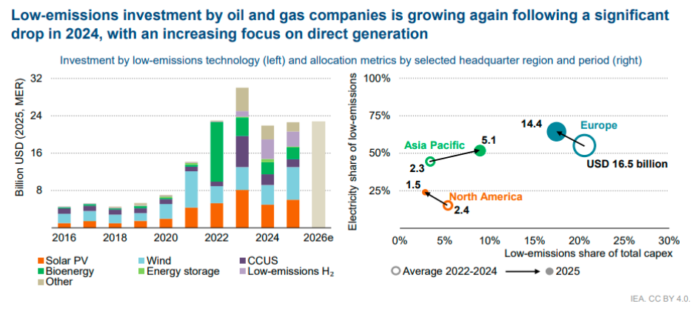
Global investments in clean energy, electrification and efficiency are accelerating in 2026, with the International Energy Agency (IEA) highlighting their growing impact on emissions reduction and energy security. According to the World Energy Investment 2026 report, global energy investment is expected to reach $3.4 trillion in 2026, up 5 percent from 2025. Around $2.2 trillion will be directed toward renewables, nuclear, grids, storage, low-emissions fuels, efficiency and electrification, nearly double the $1.2 trillion allocated to oil, gas and coal.
The IEA said electricity-related spending now accounts for nearly 60 percent of all global energy investment. Investments in electricity supply and infrastructure are expected to reach $1.6 trillion in 2026 and increase to $2 trillion when end-use electrification spending is included.
The report emphasized that investments in renewables, nuclear, electrification and efficiency during the past decade have significantly reduced emissions while improving energy security in major fuel-importing economies. These investments helped avoid around $260 billion in fossil fuel import costs in 2025 across China, the European Union, Japan and Korea, Southeast Asia, and India.
China generated the largest benefits, with avoided fossil fuel import costs estimated at around $110 billion, supported mainly by electrification initiatives. The IEA noted that around one-third of total import savings came from renewables including bioenergy, another one-third from efficiency improvements, around 20 percent from electrification, while the remainder resulted from nuclear investments.
Renewable energy investment remains the largest contributor to low-emissions energy spending. Global investment in renewable power projects is estimated at around $665 billion annually, including $365 billion allocated to solar projects alone, equivalent to nearly $1 billion per day. Wind investment stands at $200 billion, while hydropower investment reaches $75 billion. Renewables now represent around 70 percent of total power generation spending globally.
Solar power continues to dominate emissions-focused investment growth due to major cost reductions. The IEA report stated that the capital expenditure required to add 1 GW of solar PV capacity has declined by 80 percent during the past decade. In 2015, adding 1 GW of solar PV capacity required around $3 billion in investment, compared with approximately $0.7 billion in 2025. This decline supported a near ten-fold increase in annual solar capacity additions.
Battery storage and electric mobility are also contributing to lower emissions. Global spending on power-sector batteries is projected to exceed $100 billion in 2026, while EV sales continue to accelerate across emerging markets. EV sales in Southeast Asia doubled in 2025 to around half a million units, representing nearly 20 percent of vehicle sales in the region.
Nuclear energy investment is also expanding rapidly as countries seek reliable low-emissions electricity generation. Annual nuclear investment has surpassed $80 billion, with 78 GW of new nuclear capacity currently under construction across 15 countries. China alone accounts for nearly one-third of global nuclear investment.
Energy efficiency investments worldwide are estimated at around $350 billion annually. The IEA said approximately 20 countries have already introduced new energy-efficiency policies in response to the ongoing energy security crisis.
The report also highlighted the role of innovation in reducing clean energy costs and emissions. The IEA estimated that without cost reductions achieved over the past decade, the energy investments planned for 2026 would be nearly twice as expensive. Battery energy storage systems, solar PV and electric vehicles have all experienced cost declines of around 80 percent since 2015.
Despite growing clean energy momentum, fossil fuel investment remains substantial. Oil, natural gas and coal investment is expected to total around $1.2 trillion in 2026. Coal supply investment alone is projected to reach $180 billion, the highest level since 2012, with China accounting for nearly 70 percent of total coal spending.
The IEA warned that higher financing costs linked to geopolitical tensions could disproportionately affect low-emissions technologies because of their high upfront capital requirements. However, the agency said continued investments in renewables, electrification, storage and grids remain essential for reducing emissions, improving resilience and lowering long-term energy import dependence globally.
BABURAJAN KIZHAKEDATH
