
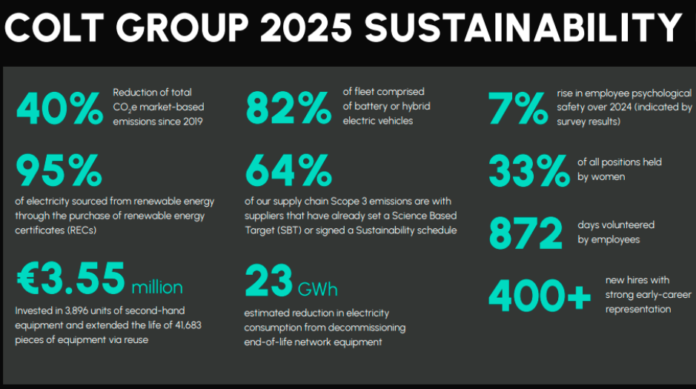
Colt Group is strengthening its sustainability strategy with a 2045 net-zero greenhouse gas emissions target across Scope 1, Scope 2 and Scope 3 emissions. The company aims to cut absolute emissions by 90 percent by 2045 from a 2019 baseline, while embedding carbon accountability into procurement, infrastructure development, data centre design and operational decision-making.
In 2025, Colt reported total market-based emissions of 492,914 tonnes of carbon dioxide equivalent, a 40 percent reduction from 2019. Scope 1 and Scope 2 market-based emissions fell to 6,783 tCO₂e, representing an 87 percent reduction versus 2019 and a 37 percent decline compared with 2024. Scope 1 emissions dropped 53 percent from 2019 and 17 percent from 2024, while Scope 2 market-based emissions declined 48 percent year on year.
Anthea van Scherpenzeel, Head of Environmental Sustainability at Colt Data Centre Services, said: “We are proud of the progress made in reducing absolute emissions in 2025 as we continue advancing towards our 2045 net zero target.”
Colt’s climate targets include a 47 percent absolute reduction in Scope 1 and Scope 2 emissions by 2030 from the 2019 baseline, aligned with a 1.5-degree Celsius pathway. The company also targets a 28 percent absolute reduction in Scope 3 emissions by 2030. Scope 3 emissions rose 14 percent in 2025 due to data centre expansion and higher capital investment, underlining the importance of supplier decarbonisation.
Renewable electricity is central to Colt’s low-carbon transition. In 2025, 95 percent of global electricity consumption came from renewable sources through Renewable Energy Certificates and Guarantees of Origin.
Colt Data Centre Services maintained 100 percent renewable electricity sourcing, backed by more than 70 GWh of renewable electricity certificates. Colt also targets 100 percent renewable Scope 2 electricity globally by 2030.
Energy efficiency also improved sharply. Global Scope 2 electricity consumption fell 25 percent from 246,538 MWh in 2024 to 184,662 MWh in 2025, compared with 251,934 MWh in 2023. Decommissioning end-of-life network equipment delivered estimated electricity savings of 23 GWh.
Colt DCS is expanding sustainable data centre capacity across major markets. The Paris campuses are planned to deliver 170 MW by 2031, while Tokyo Inzai 4 offers 4.8 MW initially and can scale to 20 MW. The 40.5 MW Keihanna data centre in Osaka has been completed, Frankfurt 3 adds 32.4 MW under construction, and new site acquisitions support 63 MW in Frankfurt and 54 MW in Berlin. The Hayes campus adds 160 MW, while an ESR partnership will develop a 90 MW hyperscale facility in Osaka.
The Paris 2 data centre highlights Colt’s sustainability design approach, with 40 MW of AI-ready capacity, 100 percent renewable electricity, 1,975 square metres of rooftop solar, zero-water-waste hybrid cooling and waste heat recovery. The report does not mention wind energy projects or wind capacity.
Colt’s Global Reference Design supports low-carbon data centre development through energy-efficient systems, lower embodied carbon materials, closed-loop liquid cooling, low global warming potential refrigerants and near-zero wastewater cooling. The framework targets Power Usage Effectiveness below 1.2, construction waste diversion of 75 percent and operational waste diversion of 90 percent. Colt’s current global PUE is 1.41.
Circular economy initiatives are also reducing resource use. Colt invested €3.55 million in 3,896 second-hand equipment units and extended the life of 41,683 pieces of equipment through reuse. The company recycled 290 tonnes of material, generated 754 tonnes of CO₂ savings through a recycling partnership, and has 10 Colt DCS sites progressing toward TRUE Zero Waste Certification.
Fleet decarbonisation is advancing, with 82 percent of Colt’s fleet made up of battery electric or hybrid vehicles. In 2025, 31 percent of the fleet was battery electric and 51 percent was hybrid. Colt targets a 75 percent pure electric fleet by 2030.
Supplier engagement remains critical because value-chain emissions account for nearly all of Colt’s footprint. Suppliers responsible for 70 percent of supply chain emissions are expected to implement 1.5-degree Celsius aligned transition plans within two years. In 2025, 64 percent of Scope 3 emissions were linked to suppliers that had Science Based Targets, had committed to setting them, or had signed a Sustainability Schedule.
Colt’s sustainability governance is supported by strong external ratings. The company holds an EcoVadis Platinum rating with a score of 86 out of 100, placing it in the top one percent of assessed companies. It also holds an A minus CDP climate disclosure rating and an A grade for supplier engagement.
Social sustainability performance also improved in 2025. Women represented 33 percent of Colt’s workforce and 44 percent of new hires. Employee psychological safety rose 7 percent year on year. Safety performance improved as Colt DCS reduced its Total Recordable Incident Rate from 0.52 to 0.18. Community investment reached €365,678, supported by 872 employee volunteer days.
Colt Group’s 2025 sustainability performance shows measurable progress across emissions reduction, renewable electricity, energy efficiency, circular economy, water-saving cooling, supplier decarbonisation and sustainable data centre growth. With a 2045 net-zero target, 95 percent renewable electricity sourcing, 40 percent emissions reduction since 2019 and expanding solar-backed, AI-ready data centre infrastructure, Colt is positioning sustainability as a core driver of responsible digital infrastructure growth.
SHAFANA FAZAL
