
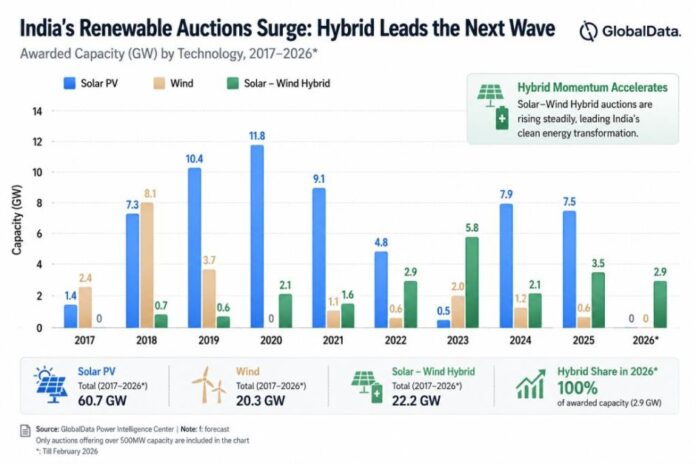
India is entering a new phase of renewable energy development as hybrid power projects combining solar photovoltaic (PV) generation with battery energy storage become central to the country’s clean energy strategy.
According to GlobalData, the period between 2027 and 2030 will be a defining phase for hybrid renewable investments, with utilities increasingly procuring integrated solar and storage projects to improve grid reliability and maximize renewable energy utilization.
Solar-plus-storage tenders are expanding, enabling electricity providers to supply power beyond daylight hours while reducing renewable energy curtailment and improving dispatchability, Attaurrahman Ojindaram Saibasan, Power Analyst at GlobalData, said.
In January 2026, Solar Energy Corporation of India (SECI) awarded a tender for 1.2 GW of solar generation integrated with 3.6 GWh of battery energy storage. The projects will operate under long-term power purchase agreements (PPAs), making it one of India’s largest hybrid renewable procurements to date.
Beyond SECI, NTPC Green Energy and NTPC Renewable Energy have announced several large hybrid solar projects during 2026, significantly expanding India’s pipeline of storage-backed renewable capacity.
One of the key projects is NTPC Green Energy’s 100 MW solar photovoltaic project integrated with a 200 MWh battery energy storage system in Jhansi, Uttar Pradesh. The EPC tender aims to enhance grid reliability while enabling greater utilization of renewable energy.
In Rajasthan, NTPC Renewable Energy issued an EPC tender for a 550 MW ISTS-connected solar project at Shimbhoo Ka Burj, paired with a 2,200 MWh battery energy storage system. The four-hour storage facility will allow solar power generated during the day to be supplied during evening peak demand.
NTPC Renewable Energy has also announced a 240 MW solar project at Devikot integrated with a 960 MWh battery energy storage system, further strengthening Rajasthan’s position as a major hub for utility-scale renewable energy.
Another major project is the 300 MW solar photovoltaic plant at Nokhra, Rajasthan, which will include a 1,200 MWh battery energy storage system to provide dispatchable renewable electricity and improve grid stability.
Together with SECI’s January award, these projects represent 2.39 GW of solar generation capacity integrated with approximately 8.16 GWh of battery energy storage announced or awarded during 2026, highlighting the rapid evolution of India’s hybrid renewable energy market.
In addition to integrated solar-plus-storage projects, India has continued issuing standalone battery storage tenders to strengthen grid infrastructure.
NTPC Renewable Energy launched an 800 MW / 3,200 MWh standalone battery energy storage tender at Khavda, while the West Bengal Department of Power floated a 500 MW / 2,000 MWh standalone BESS tender to support renewable energy integration.
Hybrid projects are becoming increasingly attractive because they reduce revenue uncertainty, enhance grid flexibility, and provide more reliable electricity during evening demand peaks when solar generation declines.
India’s electricity demand is expected to surge from approximately 1,418 TWh in 2025 to nearly 1,945 TWh by 2030, driven by rising industrial activity, growing cooling requirements, and accelerating electric vehicle (EV) adoption. Hybrid renewable systems are expected to play a critical role in balancing this growing demand while supporting states with strong solar resources but limited transmission infrastructure.
Growth in Indian renewable energy market will depend on improvements in auction design, battery storage compensation mechanisms, grid connectivity, regulatory certainty, and battery performance standards. As India expands renewable capacity by hundreds of gigawatts, hybrid power projects are expected to become a key investment opportunity for developers, utilities, and financiers seeking stable long-term returns while supporting the country’s energy transition.
BABURAJAN KIZHAKEDATH
