
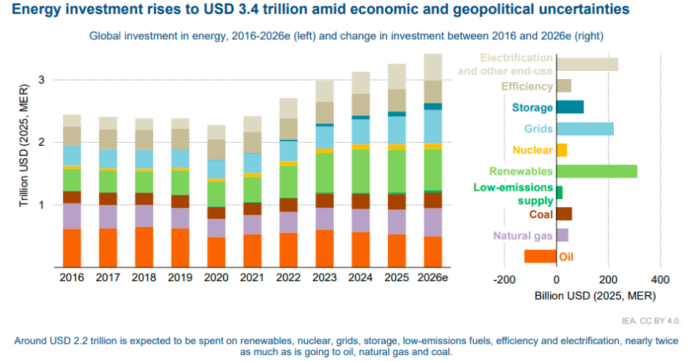
Global energy investment is projected to rise 5 percent year-on-year to $3.4 trillion in 2026 despite the destabilizing impact of the Middle East conflict, according to the International Energy Agency’s latest World Energy Investment report. The report highlights how the world’s largest energy security crisis is accelerating investment diversification, electricity infrastructure expansion, and domestic energy development strategies.
Here are the 10 key points shaping global energy investment trends in 2026:
Global energy investment to hit $3.4 trillion in 2026
The IEA expects worldwide energy investment to increase to $3.4 trillion in 2026. Around $2.2 trillion will be allocated to renewables, nuclear, electricity grids, battery storage, low-emissions fuels, efficiency, and electrification technologies, while approximately $1.2 trillion will go into oil, natural gas, and coal investments.
Strait of Hormuz disruptions trigger global energy security concerns
The conflict has significantly undermined confidence in the Strait of Hormuz, a critical route for global energy trade. Asia had previously received 80 percent to 90 percent of Gulf energy exports, making the region especially vulnerable to disruptions. The crisis is reinforcing energy security and diversification strategies among both importers and exporters.
More than 30 Middle East energy facilities damaged
The conflict has already damaged more than 30 energy facilities across the Middle East, including refineries, petrochemical plants, oil and gas production sites, and two of the 14 liquefaction trains at Qatar’s Ras Laffan LNG complex. Around 20 oil tankers have also been hit by missiles or drones. Repair costs are expected to run into tens of billions of dollars.
Oil investment falls below $500 billion despite higher crude prices
Global oil supply investment is projected to decline for the third consecutive year to below $500 billion in 2026. Investment cuts in the Middle East, project delays, offshore bottlenecks, and uncertainty over oil price sustainability are limiting spending growth despite stronger producer revenues.
Natural gas investment rises to highest level in a decade
Investment in natural gas supply is expected to climb to $330 billion in 2026, marking the highest level in ten years. More than 100 billion cubic metres of new LNG export capacity was approved in 2025, with nearly 90 percent of these approvals located in the United States.
Renewable energy investment reaches $665 billion
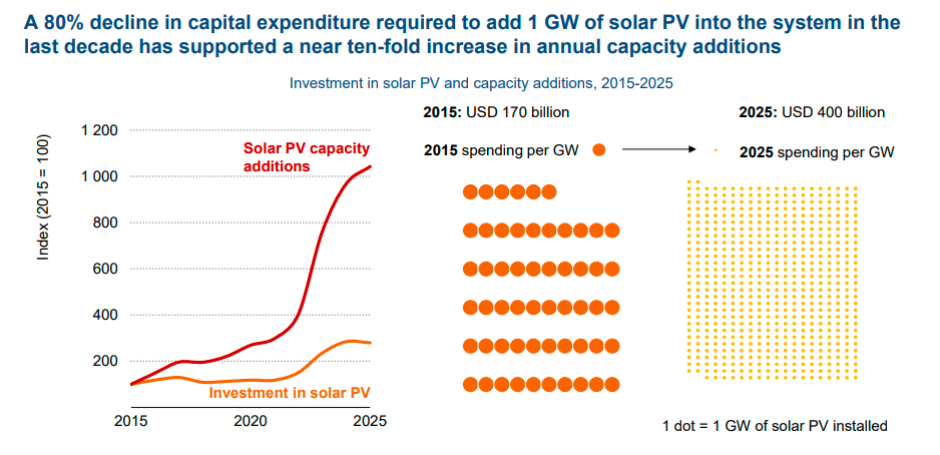
Global renewable power project investment is expected to total around $665 billion in 2026. Solar alone will attract $365 billion, equivalent to nearly $1 billion per day. Wind energy investment will reach $200 billion, while hydropower projects are expected to receive around $75 billion.
Nuclear investment surpasses $80 billion with 78 GW under construction
Annual nuclear energy investment has exceeded $80 billion globally. Around 78 gigawatts of new nuclear capacity are currently under construction across 15 countries. China accounts for nearly one-third of total nuclear investment worldwide.
Coal investment climbs to highest level since 2012
Global coal supply investment is forecast to reach $180 billion in 2026, the highest level since 2012. China represents nearly 70 percent of global coal investment and remains responsible for most approvals of new coal-fired power plants. India’s coal investment has tripled over the past decade.
Electricity investment dominates global energy spending
Electricity-related investment now represents nearly 60 percent of total global energy spending. Investment in electricity supply and infrastructure is projected to reach $1.6 trillion in 2026 and rise to $2 trillion when electrification spending is included. Grid investment is expected to approach $550 billion, up nearly 20 percent year-on-year, while battery storage investment will exceed $100 billion.
AI and data centres reshape power investment trends
Artificial intelligence and data centre growth are becoming major drivers of global energy investment. Orders for new gas-fired power plants surged to 130 GW in 2025, the highest level in 25 years. Global investment linked to data centre energy infrastructure exceeded $100 billion in 2025, including spending on power equipment, electricity generation, and grid upgrades.
The IEA said investments in renewables, nuclear, efficiency, and electrification have already helped major fuel-importing regions avoid approximately $260 billion in fossil fuel import costs during 2025. China alone accounted for nearly $110 billion of those savings, highlighting how energy diversification strategies are reshaping the global energy landscape.
BABURAJAN KIZHAKEDATH
