
Sustainability has become a central pillar of Ericsson’s long-term growth strategy, as outlined in its Annual Report 2025. The company is aligning its “Global Communications Platform” vision with aggressive climate action, combining operational decarbonization with the transformative potential of 5G to reduce emissions across industries.
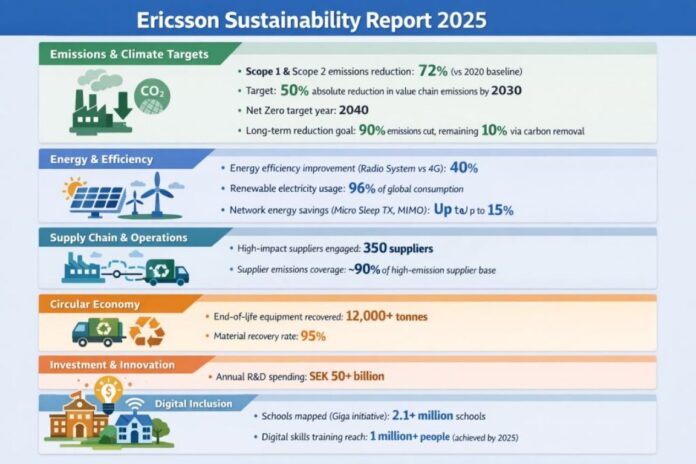
Ericsson, in its sustainability report, said it has delivered significant progress against its 2020 baseline targets, reinforcing its leadership in sustainable telecom infrastructure. The company achieved a 72 percent reduction in Scope 1 and Scope 2 greenhouse gas emissions, highlighting strong execution in lowering its operational carbon footprint.
At the same time, Ericsson improved the energy efficiency of its Radio System portfolio by 40 percent compared to legacy 4G systems, enabling telecom operators to handle rising data demand without proportional increases in energy consumption.
Renewable energy adoption remains a cornerstone of Ericsson’s sustainability efforts, with 96 percent of its global electricity consumption sourced from renewables, including key manufacturing hubs in Estonia, China, and the United States. In its supply chain, the company has engaged 350 high-impact suppliers to adopt science-based targets aligned with the 1.5°C pathway, covering about 90 percent of its high-emission supplier base.
Ericsson is also advancing circular economy initiatives, recovering more than 12,000 tonnes of end-of-life equipment through its Global Product Take-Back Program, achieving a material recovery rate of 95 percent. These efforts underline the company’s commitment to minimizing waste and extending product lifecycles.
Investment in innovation continues to play a critical role in Ericsson’s sustainability agenda. A substantial portion of its annual R&D spending exceeding SEK 50 billion is directed toward Sustainable AI and energy-efficient network technologies. Features such as Micro Sleep TX and MIMO sleep mode are designed to reduce network energy consumption by up to 15 percent during periods of low traffic, delivering both environmental and cost benefits to operators.
Ericsson’s 5G Smart Factory in Texas stands as a flagship example of sustainable manufacturing. The facility is LEED Gold certified and operates with zero waste to landfill, supported by onsite solar generation and real-time energy monitoring enabled by 5G connectivity. This model demonstrates how advanced connectivity and automation can drive both efficiency and sustainability in industrial operations.
Beyond its own operations, Ericsson is expanding its impact through digital inclusion initiatives. Through the Giga partnership with UNICEF and ITU, the company has helped map more than 2.1 million schools worldwide, accelerating efforts to connect underserved communities and bridge the digital divide.
The company’s sustainability strategy is structured around three core pillars: achieving Net Zero across its operations and value chain, enhancing energy performance of its products, and enabling emissions reductions in other sectors. Ericsson has deployed tools such as a Sustainable Supply Chain dashboard for real-time carbon tracking and rolled out its “Breaking the Energy Curve” software to more than 100 telecom operators globally.
Looking ahead, Ericsson is targeting a 50 percent absolute reduction in value chain emissions by 2030, covering Scope 1, Scope 2, and Scope 3 emissions. Its long-term ambition is to reach Net Zero by 2040, with a 90 percent emissions reduction and the remaining 10 percent addressed through high-quality carbon removal solutions. The company has also surpassed its social goal of reaching 1 million people through digital skills training programs by 2025.
BABURAJAN KIZHAKEDATH
