
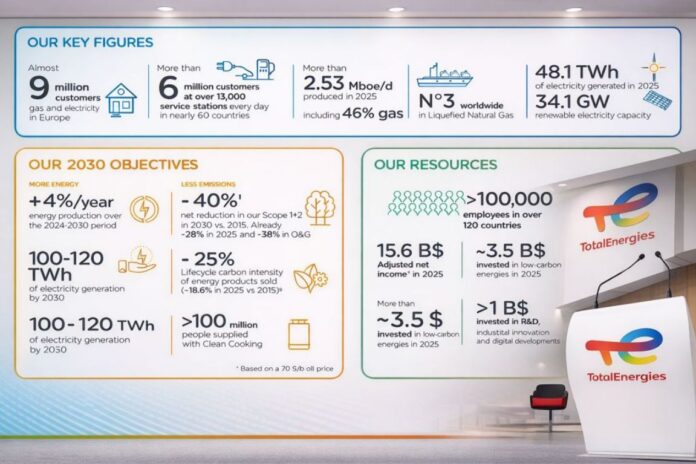
TotalEnergies has accelerated its sustainability and climate execution in 2025, supported by tangible emissions reductions, disciplined investment, and rapid expansion in electricity and low carbon energy. The company’s Sustainability and Climate – 2026 Progress Report outlines how its transition framework is translating into measurable outcomes while aligning future disclosures with CSRD requirements through its Universal Registration Document.
TotalEnergies is advancing a low emissions and cost efficient upstream strategy by prioritizing oil and gas projects with reduced carbon intensity and competitive break even levels. New projects commissioned in Brazil and the United States in 2025 have lowered average emissions intensity to below 16 kg CO₂ per barrel of oil equivalent, setting a stricter benchmark for future developments compared to earlier levels below 17 kg CO₂e per boe.
The company’s expansion is also supported by the acquisition of SapuraOMV in 2024, which has strengthened its position in Malaysia by establishing a low emission gas hub and enabling entry into 12 new exploration blocks in 2025. Alongside portfolio growth, TotalEnergies has delivered operational efficiency gains through its 2023 to 2025 energy efficiency plan, cutting emissions by 2 Mt CO₂e annually while generating over $200 million in yearly savings. Building on this progress, a new $1 billion efficiency program has been launched for the 2026 to 2028 period to further enhance performance.
“One of our priorities remains methane reduction, with the ambition of achieving nearzero methane emissions by 2030. In 2025, we exceeded its target of reducing methane emissions by 60 percent compared to 2020, achieving a reduction of 65 percent,” TotalEnergies Chairman & CEO Patrick Pouyanne said in the Sustainability and Climate – 2026 Progress Report.
TotalEnergies is targeting a 70 percent reduction by 2026 and is well on track to achieve its goal of an 80 percent reduction by 2030 or sooner, thanks in particular to the roll-out in 2025 of continuous methane emissions monitoring across all operated Upstream assets.
In 2025, TotalEnergies reduced operated Scope 1 and 2 emissions to 33.1 Mt CO₂e, significantly below its earlier ceiling and down sharply from 2015 levels, reflecting structural improvements in asset efficiency and emissions management. Methane reduction remained a standout achievement, with emissions cut by 65 percent versus 2020, outperforming the company’s initial target and reinforcing progress toward deeper reductions by 2030. Emissions from operated oil and gas facilities declined by 38 percent compared to 2015, highlighting sustained decarbonization across upstream operations.
Project execution played a critical role in improving performance metrics. New developments in key markets such as Brazil and the United States contributed to lowering average upstream emissions intensity to below 16 kg CO₂e per barrel of oil equivalent, establishing a new benchmark for future projects. This improvement reflects the company’s focus on deploying lower emission technologies and optimizing production processes across its portfolio.
At the same time, TotalEnergies is scaling its second growth engine through integrated power. Net electricity generation reached 48 TWh in 2025, accounting for roughly 10 percent of hydrocarbon output and reinforcing the company’s gradual shift toward a more diversified energy mix. This expansion supported a 18.6 percent reduction in lifecycle carbon intensity of energy products compared to 2015, surpassing its stated target and demonstrating the growing impact of electricity and renewables within the portfolio.
Investment remains central to this transition. TotalEnergies continues to allocate $4 billion to $5 billion annually toward low carbon energy, enabling steady growth in renewables and electricity while maintaining resilient hydrocarbon operations. The company also leverages liquefied natural gas as a transition solution, contributing to significant avoided emissions for end users.
Looking forward, TotalEnergies is targeting a 40 percent reduction in Scope 1 and 2 emissions by 2030 versus 2015, alongside further declines in product carbon intensity and continued control of Scope 3 emissions. Its energy mix is expected to evolve with petroleum products declining to around 30 percent of sales by the end of the decade, as electricity and renewable energy capacity expand at scale.
With a long term ambition of achieving net zero emissions by 2050, TotalEnergies is maintaining a flexible and adaptive strategy that responds to policy, technology, and market dynamics. This approach enables the company to advance decarbonization while preserving financial strength and competitiveness in a complex global energy landscape.
BABURAJAN KIZHAKEDATH
