
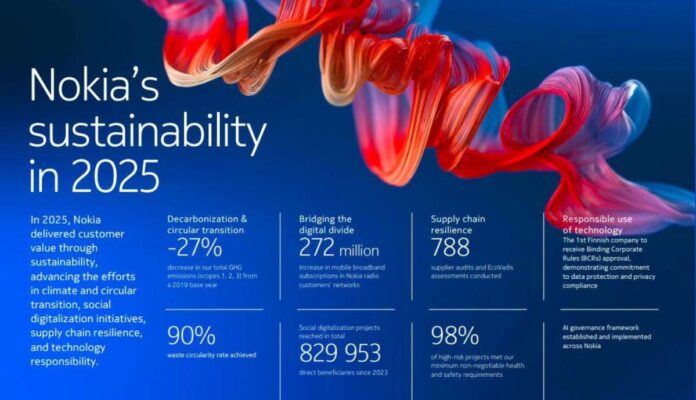
Nokia is advancing a data-driven sustainability transformation by aligning AI-native infrastructure investments with aggressive decarbonization targets, as highlighted in its 2025 Integrated Annual Report. The company is strategically positioning itself to decouple exponential network traffic growth from energy consumption while capturing opportunities from the industrial AI supercycle through high-efficiency connectivity and silicon innovation.
The company has committed to achieving net zero greenhouse gas emissions across Scope 1, 2, and 3 by 2040, supported by a science-based target to reduce total emissions by 50 percent by 2030 compared to a 2019 baseline.
In 2025, Nokia reported a 27 percent cut in total greenhouse gas emissions versus the baseline year, alongside a 36 percent decline over five years, reflecting sustained progress in its decarbonization roadmap, Nokia Sustainability report for 2025 indicated.
Emissions from final assembly suppliers decreased by 56 percent, significantly outpacing overall reductions, while emissions from products in use declined by 30 percent, highlighting improvements in energy-efficient network design.
The company is also targeting an 83 percent reduction in Scope 1 and 2 emissions and an approximately 90 percent reduction across its total value chain by 2040.
“We are committed to cutting 50 percent of our absolute scope 1, 2 and 3 greenhouse gas emissions by 2030. We are also committed to overall net-zero by 2040 across our value chain. In 2025, we reached a 100 percent share of renewable electricity in our own factories. We have increased recycled content in mechanical parts and aim to reach at least 50 percent recycled aluminum, copper, steel, and polymerics by 2030,” Nokia CEO Justin Hotard said.
Energy transition remains a central pillar of Nokia’s sustainability execution, with 96 percent of electricity consumed across its global operations now sourced from renewable energy. This near-complete shift is complemented by ongoing innovation in product energy efficiency, which is critical given that product usage accounts for 94 percent of the company’s total carbon footprint.
In parallel, Nokia is accelerating its circular economy strategy to reduce resource intensity and industrial waste. The company achieved a 90 percent waste circularity rate in 2025 across offices, laboratories, and manufacturing sites, significantly minimizing landfill dependency through reuse and recycling initiatives. Material innovation is also advancing, with 52 percent of cast aluminum used in equipment mechanical parts now sourced from recycled inputs, reinforcing efforts to reduce reliance on virgin raw materials and extend product lifecycle sustainability across 5G and emerging 6G portfolios.
AI-driven infrastructure is emerging as a key lever for both growth and sustainability. Nokia generated €2.4 billion in orders from AI and cloud customers in 2025, underlining strong commercial traction for its high-efficiency technology portfolio. Strategic moves such as the Infinera acquisition and a $1 billion partnership with NVIDIA are designed to accelerate AI-native optical and mobile network deployments. These initiatives support Nokia’s ambition to break the traditional energy-capacity curve by enabling industries to scale digitalization without proportionally increasing energy consumption.
Sustainability is also embedded into Nokia’s financial and governance frameworks. The company renewed its €1.5 billion revolving credit facility, directly linking financing conditions to greenhouse gas reduction targets, ensuring that sustainability performance influences capital allocation and cost of funding. Oversight is reinforced at the highest levels through the Board of Directors and dedicated ESG governance structures, integrating climate risk and sustainability incentives into executive decision-making.
Beyond environmental metrics, Nokia continues to expand its social impact through digital inclusion initiatives. In 2025, the company enabled more than 1 million service interactions through its Smartpur centers in rural India, supporting access to essential digital services. Since 2021, mobile broadband subscriptions across Nokia-powered networks have increased by 1,393 million, while fiber-to-the-home deployments have connected 61 million subscribers since 2023. These efforts align with Nokia’s target of helping customers connect the next 2 billion people by 2030.
External validation further strengthens Nokia’s sustainability positioning, with a CDP Climate Score of A, a CDP Supplier Engagement rating of A-, and an ISS ESG Prime rating of B. These benchmarks reflect strong performance in environmental management, supply chain engagement, and governance practices.
Overall, Nokia’s 2025 performance demonstrates measurable progress across emissions reduction, renewable energy adoption, circularity, and digital inclusion, while reinforcing the strategic role of AI and advanced network technologies in enabling a low-carbon digital economy.
FASNA SHABEER
