
Repsol’s 2025 Sustainability Report signals a structural shift in capital allocation as the company leverages strong upstream cash flows to fund the expansion of renewable fuels and low carbon power generation. This transition is supported by the integration of carbon capture, circular economy processes, and advanced industrial efficiency, reinforcing its long term ambition to achieve net zero emissions by 2050 while maintaining financial discipline.
Repsol, under the leadership of CEO Josu Jon Imaz, has set a clear decarbonization trajectory anchored in its Carbon Intensity Indicator (CII), targeting a 15 percent reduction by 2025 compared with 2016 levels. This pathway extends to a 25 percent (±1 percent) reduction by 2030, 55 percent by 2040, and full decarbonization by 2050.
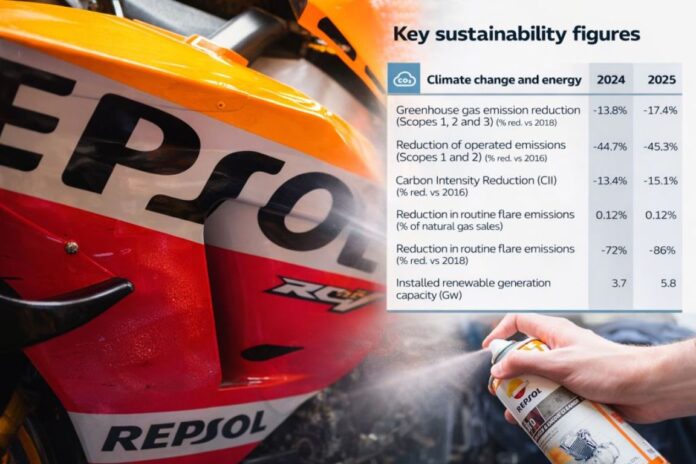
Operational performance already reflects measurable gains, with greenhouse gas emission reduction reaching 17.4 percent in 2025 versus 2018, compared with 13.8 percent in 2024. Emissions from operated assets under Scope 1 and 2 declined by 45.3 percent versus 2016, improving from 44.7 percent a year earlier, while carbon intensity reduction reached 15.1 percent compared with 13.4 percent in 2024.
Repsol’s emissions strategy addresses methane and flaring efficiency. Routine flare emissions as a percentage of natural gas sales remained stable at 0.12 percent, while absolute reductions versus 2018 accelerated to 86 percent in 2025 from 72 percent in 2024. These results highlight the company’s ability to combine operational discipline with emissions abatement across upstream and industrial activities.
Investment alignment remains a central pillar of the transition strategy. Under its 2024-2027 Strategic Plan, 35 percent of total capital expenditure is directed toward low carbon projects, ensuring that financial flows directly support emissions reduction targets. This capital discipline is reinforced through governance mechanisms linking executive remuneration to greenhouse gas performance and low carbon portfolio expansion, as well as through the Green Finance Framework that enables sustainable bond issuance.
Repsol’s renewable fuels platform has reached industrial scale with the Cartagena advanced biofuels facility delivering 250,000 tons of annual production capacity. This facility alone enables the avoidance of 900,000 tons of CO2 emissions per year, positioning the company as a key supplier of low carbon fuels for aviation and heavy transport. The development of synthetic fuels using renewable hydrogen and captured CO2 further strengthens its multi energy offering in hard to abate sectors.
In power generation, Repsol has accelerated renewable deployment to 4,500 MW of installed capacity by the end of 2025, with assets spanning solar and wind projects across Spain, Portugal, and the United States. The company is targeting 9,000 MW by 2027, underlining a rapid scale up of low carbon electricity. At the same time, installed renewable generation capacity reached 5.8 GW in 2025, up from 3.7 GW in 2024, demonstrating strong year on year expansion.
Circular economy initiatives are also advancing at scale. Repsol is increasing the use of recycled plastic waste as feedstock and targeting 100,000 tons of circular polymer production annually. Chemical recycling technologies are enabling the conversion of non recyclable waste into high value materials, reducing dependence on virgin resources and improving efficiency across industrial operations.
Repsol’s climate strategy is aligned with the Paris Agreement objective to limit global warming to below 2 °C and pursue efforts toward 1.5 °C. The company aims to reduce direct emissions by 55 percent by 2030 compared with 2016, while cutting total emissions by 20 percent versus 2018, including Scope 3 category 11 emissions, which account for more than 90 percent of its value chain footprint. These targets are consistent with IPCC C1 scenarios, which indicate a greater than 50 percent probability of limiting warming to 1.5 °C by 2100, with a median oil and gas emissions reduction of 14 percent by 2030 compared with 2019 levels.
In parallel, Repsol is advancing circular economy initiatives within its industrial operations by increasing the use of recycled plastic waste as feedstock and targeting the production of 100,000 tons of circular polymers annually. The deployment of chemical recycling technologies enables the conversion of non recyclable waste into high value raw materials, reducing dependence on virgin resources and improving overall material efficiency.
Sustainability is now embedded into Repsol’s governance and financial structure, with executive remuneration tied to greenhouse gas reduction targets and the expansion of its low carbon portfolio. Through its Green Finance Framework, the company is able to issue sustainable bonds to fund transition projects, linking its environmental performance directly to capital access and cost of funding. This integrated approach positions Repsol as a key player in the global energy transition, combining measurable emissions reductions, scalable renewable capacity, and disciplined capital allocation to deliver long term sustainable growth.
FASNA SHABEER
