
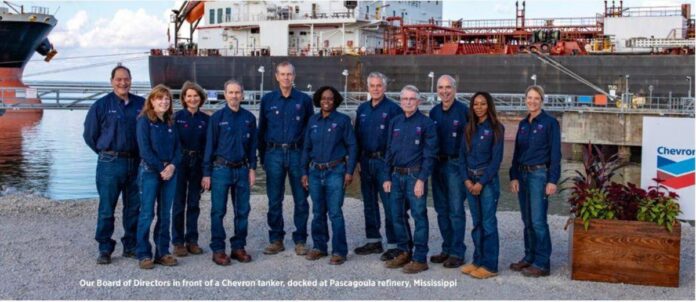
Chevron is strengthening its sustainability strategy through a capital-intensive, technology-driven approach that balances growth in oil and gas with a steady reduction in carbon intensity. The company’s “higher returns, lower carbon” framework underpins its transition, combining operational efficiency, emissions reduction, and targeted investments in new energy businesses.
Chevron has reported tangible progress in sustainability performance between 2021 and 2025, supported by significant financial commitments. The company completed projects capable of abating 1.2 million tonnes of CO2e annually between 2021 and 2024, with more than $600 million invested in 2024 alone to accelerate these efforts.
Methane reduction has been a key focus area, with over 250 facility retrofits in Colorado replacing pneumatic devices with nitrogen systems, eliminating an estimated 5,000 tonnes of methane emissions each year. At the same time, upstream methane intensity declined to 1.7 kg CO2e per barrel of oil equivalent in 2024 from 2.0 previously, placing Chevron ahead of its 2028 target trajectory.
Operational electrification is also gaining traction, with nearly 40 percent of the drilling fleet in the Permian Basin powered by grid electricity in 2024, significantly lowering direct combustion emissions.
Investment remains central to Chevron’s sustainability roadmap, with the company committing $10 billion to lower-carbon initiatives through 2028. By the end of 2024, $7.7 billion of this total had already been deployed, reflecting steady execution against its long-term plan.
For 2025, Chevron has earmarked $1.5 billion of its $15.5 billion organic capital expenditure specifically for lowering carbon intensity and expanding its New Energies portfolio. This is complemented by the launch of a $500 million Future Energy Fund III in 2025, targeting breakthrough technologies such as hydrogen and fusion.
Earlier commitments included $8 billion for lower-carbon investments between 2021 and 2028 and $2 billion for carbon reduction projects, while overall annual capital expenditure remains in the range of $13 billion to $15 billion, underscoring that traditional energy continues to dominate spending even as low-carbon investments scale.
Chevron’s sustainability strategy is anchored in four key New Energies pillars: carbon capture, renewable fuels, hydrogen, and power solutions. In carbon capture, the Bayou Bend project is advancing toward commercial-scale storage in the Gulf of Mexico, while the company’s $45 million investment in ION Clean Energy is aimed at scaling next-generation carbon capture technology capable of removing more than 95 percent of CO2 emissions at lower cost. In renewable fuels, Chevron has taken a final investment decision on an oilseed processing facility in Louisiana through its joint venture with Bunge, which will supply feedstocks for renewable diesel production.
Hydrogen is emerging as a major growth vector, highlighted by the ACES Delta project in Utah, where Chevron is developing one of the world’s largest green hydrogen hubs. The project includes 220 MW of electrolyzers and underground salt cavern storage capable of holding 300 GWh of energy per cavern. The hydrogen produced will initially fuel an 840 MW power plant operated by the Intermountain Power Agency, starting with a 30 percent hydrogen blend in 2025 and targeting a transition to 100 percent hydrogen by 2045. In parallel, Chevron is exploring power solutions for data centers, including natural gas-fired turbines integrated with carbon capture to address rising electricity demand.
Chevron’s sustainability targets remain focused on emissions intensity rather than absolute reductions. By 2028, the company aims to achieve a portfolio carbon intensity of 71 gCO2e per megajoule, upstream carbon intensity of 24 kg CO2e per barrel of oil equivalent, and refining intensity of 36 kg CO2e per barrel of oil equivalent.
It is also targeting a 35 percent reduction in oil and gas carbon intensity compared with 2016 levels, alongside methane intensity reductions of around 50 percent and flaring intensity reductions of about 65 percent. The company is further working toward eliminating routine flaring by 2030, while already outperforming its methane intensity target with a 2024 level of 1.7 kg CO2e per barrel of oil equivalent against a 2028 target of 2.0.
Overall, Chevron’s sustainability positioning reflects an incremental but financially backed transition strategy. The company is prioritizing carbon intensity reduction, operational efficiency, and selective expansion into low-carbon businesses, while continuing to invest heavily in its core oil and gas operations. With billions of dollars committed, measurable emissions reductions achieved, and large-scale projects underway, Chevron is pursuing a pragmatic path that integrates sustainability into its existing business model rather than replacing it.
BABURAJAN KIZHAKEDATH
