
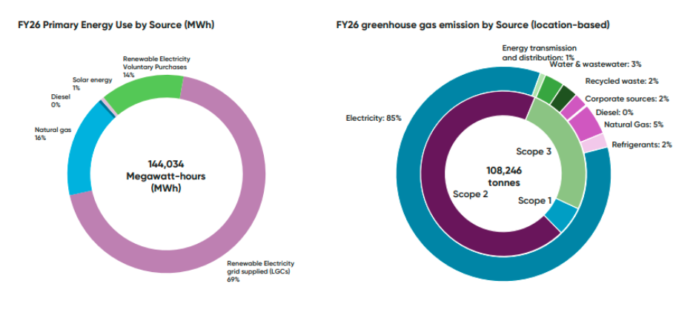
Dexus has strengthened its sustainability performance with renewable sources supplying 83 percent of total net energy consumption, while its latest greenhouse gas inventory shows that deeper decarbonization will depend on energy efficiency, lower natural gas use and reductions in Scope 3 emissions.
The company consumed 119,684 MWh of renewable energy from total net energy consumption of 144,034 MWh, or 518,521 GJ, and maintained 100 percent renewable electricity sourcing for the fourth consecutive year.
At the same time, combined Scope 1, Scope 2 and Scope 3 greenhouse gas emissions reached 108,246 tonnes of CO2-e, highlighting the opportunity to translate renewable-energy procurement into further absolute emissions reductions.
Dexus GHG Emissions Reach 108,246 Tonnes CO2-e
Dexus sustainability report 2025 indicated that it reported 7,215 tonnes of Scope 1 emissions, 74,086 tonnes of location-based Scope 2 emissions and 26,945 tonnes of Scope 3 emissions.
Electricity accounted for 85 percent of the emissions profile, while natural gas represented 5 percent. Energy transmission and distribution and wastewater contributed 3 percent, while recycled waste, corporate sources and refrigerants each represented 2 percent.
Scope 2 remains the largest component of the reported footprint despite Dexus sourcing 100 percent renewable electricity because the disclosed figure is calculated on a location-based basis.
Further improvements will therefore depend on reducing total asset energy demand, increasing operational efficiency and replacing fossil-fuel consumption through electrification.
Waste Generates 17,507 Tonnes of Scope 3 Emissions
Operational waste is the biggest contributor to Dexus’s disclosed Scope 3 footprint.
Waste generated 17,507 tonnes of CO2-e, equivalent to approximately 65 percent of the company’s 26,945 tonnes of Scope 3 emissions.
Fuel- and energy-related activities contributed another 7,443 tonnes, followed by business travel at 956 tonnes, employee commuting at 630 tonnes, and purchased goods and services at 409 tonnes.
The concentration of Scope 3 emissions in waste makes recycling, material recovery, waste prevention and circular-economy strategies important elements of Dexus’s future decarbonization efforts.
Renewable Energy Supplies 83 Percent of Dexus Consumption
Renewable energy reached 119,684 MWh, representing 83 percent of Dexus’s 144,034 MWh of net energy consumption.
Grid renewable electricity and Large-scale Generation Certificates accounted for 69 percent of total energy consumption. This included 19,764 MWh of mandatory LGCs and 99,070 MWh of voluntary LGCs.
Onsite solar consumed by Dexus assets generated another 851 MWh, while 4,301 MWh of additional voluntary LGCs were retired.
Non-renewable energy consumption totaled 24,350 MWh, comprising 23,649 MWh of natural gas and 701 MWh of diesel.
With renewable electricity already at 100 percent for four consecutive years, natural gas represents one of the clearest remaining opportunities for operational decarbonization.
Dexus Advances 118 Energy and Asset-Efficiency Projects
Energy efficiency remains central to reducing the company’s underlying electricity requirements.
Dexus completed 31 energy and asset-efficiency initiatives and was progressing another 87 projects, representing 118 completed or active initiatives.
Office properties consumed 101,601 MWh, with renewable energy representing 82 percent of consumption. Energy intensity reached 78 kWh per square meter.
Office assets achieved a 53 percent reduction in energy consumption and 65 percent reduction in GHG emissions against the relevant baseline.
Retail assets consumed 30,487 MWh, with renewables supplying 89 percent. Energy intensity stood at 62 kWh per square meter, while energy consumption declined 55 percent and GHG emissions fell 65 percent.
Industrial properties recorded the strongest efficiency performance. Energy consumption totaled 5,959 MWh, renewables reached 91 percent, and energy intensity was just 4 kWh per square meter. Industrial energy consumption decreased 70 percent, while GHG emissions dropped 78 percent against the relevant baseline.
Dexus Expands Solar and Wind Energy Infrastructure
Dexus’s sustainability strategy also extends to large-scale renewable infrastructure.
The 420 MW Macarthur Wind Farm in Victoria operates 140 Vestas V112 wind turbines across approximately 5,500 hectares. The project can generate enough renewable electricity to supply approximately 180,000 homes.
At the asset level, Horizon 3023 in Ravenhall includes 6 MW of solar capacity.
Dexus has also installed a 396 kW rooftop solar system combined with a 200 kWh battery at 162 Momentum Way, integrating renewable generation with energy storage.
These investments complement renewable-electricity procurement by expanding physical clean-energy generation capacity.
Dexus Water Consumption Reaches 1.46 Million kL
Dexus consumed 1,459,366 kL of water, including 1,457,085 kL of potable water and 2,281 kL of onsite greywater.
Office water intensity declined 40 percent to 0.54 kL per square meter.
Retail properties reduced water intensity 27 percent to 0.94 kL per square meter, while industrial properties achieved a 25 percent reduction to 0.18 kL per square meter.
The improvements indicate that resource efficiency is extending beyond energy consumption into asset-level water management.
Waste Diversion Rate Reaches 42 Percent
Dexus generated 16,273 tonnes of waste, comprising 6,789 tonnes recycled and 9,484 tonnes sent to landfill.
The resulting waste-diversion rate was 42 percent.
Improving this figure could have a direct climate impact because operational waste currently represents the largest component of Dexus’s Scope 3 emissions.
Reducing landfill volumes and expanding recycling and material recovery could therefore contribute simultaneously to waste-management and emissions-reduction targets.
Dexus Reports A$6.455 Million in Community Contributions
Dexus reported 820 full-time-equivalent employees, with women representing 56 percent of the workforce and 41.4 percent of senior management and executive positions.
Employee engagement reached 71 percent, while key-talent retention stood at 94 percent.
The company provided 7,954 training hours, while 100 percent of employees received performance reviews.
Community contributions totaled A$6.455 million, including A$2.276 million for community programs and A$2.757 million of in-kind support. Employees contributed 1,340 volunteering hours, while Dexus reported creating 126,000 local social connections.
Dexus Decarbonization Focus Shifts to Gas, Waste and Energy Efficiency
Dexus has established a strong renewable-energy foundation, with renewables supplying 83 percent of total net energy consumption and renewable electricity remaining at 100 percent for four consecutive years.
Its asset portfolio has also recorded energy reductions ranging from 53 percent for offices to 70 percent for industrial properties, while corresponding GHG reductions range from 65 percent to 78 percent.
The next challenge is reducing the remaining 108,246 tonnes of CO2-e across Scope 1, Scope 2 and Scope 3.
Key areas include the 23,649 MWh of natural gas consumption, 74,086 tonnes of location-based Scope 2 emissions and 26,945 tonnes of Scope 3 emissions, including 17,507 tonnes associated with operational waste. With 31 efficiency projects completed and another 87 underway, Dexus’s next phase of sustainability performance will depend on converting renewable-energy leadership into deeper reductions in fossil-fuel consumption, waste and absolute greenhouse gas emissions.
SHAFANA FAZAL
