AMD is accelerating its sustainability strategy through lower operational greenhouse gas emissions, increased renewable electricity use, improved supply-chain carbon efficiency and major gains in AI computing energy efficiency.
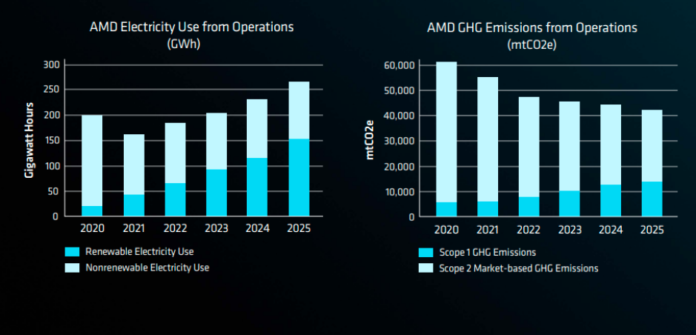
AMD reduced absolute Scope 1 and Scope 2 greenhouse gas emissions by approximately 30 percent between 2020 and 2025, lowering market-based operational emissions from 61,754 metric tons of CO2e in 2020 to 42,972 metric tons in 2025.
The semiconductor company is targeting a 50 percent reduction in operational Scope 1 and Scope 2 emissions by 2030 from the 2020 baseline, which would bring emissions down to approximately 30,877 metric tons of CO2e, AMD sustainability report 2025 indicated.
AMD’s climate targets are aligned with a 1.5°C scenario. However, continued business expansion is increasing energy requirements: operational energy consumption rose 13 percent year on year in 2025, primarily due to new product-testing laboratories.
AMD Renewable Electricity Share Reaches 58%
Renewable electricity accounted for 58 percent of AMD’s global facility electricity consumption in 2025. AMD sourced 153 GWh of renewable electricity from total facility electricity consumption of approximately 262 GWh.
AMD aims to source 100 percent renewable electricity by 2030, making clean-energy procurement an important component of its strategy for achieving its operational emissions target.
Major renewable electricity consumption included 45 GWh in Austin, Texas; 30 GWh across San Jose and Santa Clara, California; 26 GWh in Hyderabad, India; and 17 GWh in Bengaluru, India.
AMD’s San Jose campus also features a 1.4 MW solar installation with 3,600 panels covering 500 employee parking spaces, supplemented by 600 kW of rooftop solar capacity. A 1 MWh battery energy-storage system can store surplus solar electricity.
Around 40 energy-conservation projects implemented since 2022 generated approximately 3,589 MWh of energy savings in 2025, supported by equipment upgrades, lighting retrofits and other efficiency measures.
AMD Targets 25% Reduction in Supply-Chain Carbon Intensity
AMD is extending its climate strategy beyond its own operations with a goal to reduce manufacturing supply-chain GHG emissions intensity by 25 percent between 2024 and 2030.
The company estimates that manufacturing-supplier carbon intensity declined 8 percent between 2024 and 2025, falling from 98.3 metric tons of CO2e per US$1 million of AMD net revenue to approximately 90 metric tons.
Absolute estimated manufacturing-supplier emissions nevertheless increased from 2.533 million metric tons of CO2e in 2024 to 3.115 million metric tons in 2025, reflecting AMD’s rapid business growth. AMD net revenue increased from US$25.785 billion to US$34.639 billion over the same period. The 2025 supplier-emissions estimate remains preliminary.
Wafer fabrication is the largest contributor to AMD’s Scope 3 Category 1 emissions. Approximately 60 percent of wafer-foundry emissions are associated with electricity consumption, 30 percent with upstream raw materials and 10 percent with direct foundry emissions.
The challenge of controlling supply-chain emissions is becoming increasingly important as AMD’s manufacturing supply chain expanded 44 percent between 2020 and 2025.
100% of AMD Manufacturing Suppliers Have GHG Targets
AMD achieved its goal of having 100 percent of manufacturing suppliers establish public GHG-reduction targets by 2025.
Renewable-energy adoption among manufacturing suppliers reached 82 percent, exceeding AMD’s 80 percent target. In addition, 88 percent of manufacturing supplier spending was associated with suppliers participating in sustainability capacity-building activities, above the 80 percent goal.
AMD reported that 99 percent of manufacturing supplier factories have undergone social and environmental audits since 2020.
TSMC, which manufactures most AMD wafers, reported 810 GWh of annual energy savings from 1,177 energy-saving measures in 2024. TSMC targets 60 percent renewable electricity by 2030, 100 percent by 2040 and net-zero emissions by 2050.
AMD AI Energy Efficiency Improves 38x
Energy-efficient computing represents another major element of AMD’s sustainability strategy. AMD achieved a 38x improvement in node-level energy efficiency for AI training and high-performance computing between 2020 and 2025, surpassing its original 30×25 goal.
AMD has now set a target to deliver a 20x improvement in rack-scale AI training and inference energy efficiency between 2024 and 2030. By mid-2026, AMD estimated that progress had reached approximately 4x, supported by rack-scale technologies including the AMD Helios system.
Reaching the 20x target could dramatically reduce the infrastructure and electricity required for AI workloads. AMD estimates that training a representative AI model could require more than 550 server racks using 2025 technology, compared with potentially two racks if its 2030 efficiency objective is achieved.
Such improvements could reduce associated electricity consumption and carbon emissions by 95 percent or more, potentially making computing efficiency an increasingly important tool for managing the environmental impact of expanding AI infrastructure.
AMD Powers 194 Systems on Green500 List
AMD’s energy-efficiency gains are also reflected in supercomputing. AMD-powered systems accounted for 194 systems on the June 2026 Green500 list, compared with only 11 systems in June 2020.
AMD technology powered more than half of the world’s 50 most energy-efficient supercomputers, highlighting the growing importance of performance-per-watt improvements as AI and high-performance computing workloads expand.
AMD Targets 35% Reduction in Product Carbon Footprint
AMD expects the average cradle-to-gate carbon footprint of comparable server, client and embedded products manufactured in 2028 to be approximately 35 percent lower than comparable products launched and manufactured in 2024.
The company expanded its product sustainability database by adding approximately 120 product carbon footprint assessments in 2025, helping AMD quantify emissions associated with semiconductor manufacturing and product development.
AMD Circular Economy Program Processes 768,000 Units
AMD’s circular takeback initiatives refurbished, repaired or recycled more than 768,000 units, representing over 91 metric tons of equipment.
The program supports product-life extension, material recovery and recycling while reducing the amount of electronic equipment potentially entering waste streams.
AMD Social Impact Programs Reach 104.8 Million People
AMD also exceeded its social-impact objective, with STEM education, scientific research and workforce-development programs reaching 104.8 million people globally, above its 100 million-person goal.
The company committed US$150 million to expand AI education and classroom integration across the United States.
Employee programs also contributed to AMD’s social-impact activities. About 8,050 employees completed more than 34,700 volunteer hours, while 67 percent of employees participated in employee resource groups and/or inclusion initiatives.
Justin Murrill, Chief Sustainability Officer at AMD, said the company’s responsibility strategy focuses on advancing high-performance and energy-efficient computing while building an innovative and inclusive workforce.
AMD Sustainability Strategy Faces Growth Challenge
AMD’s sustainability performance shows significant progress in reducing the environmental intensity of its operations and computing technologies. Operational Scope 1 and Scope 2 emissions have fallen 30 percent since 2020, renewable electricity has reached 58 percent, and AI and HPC energy efficiency improved 38x between 2020 and 2025.
At the same time, AMD’s rapid expansion demonstrates the difficulty of translating efficiency improvements into absolute value-chain emissions reductions. Estimated manufacturing-supplier emissions increased to 3.115 million metric tons of CO2e in 2025, even as supplier carbon intensity declined 8 percent.
AMD’s next major sustainability benchmarks include achieving a 50 percent reduction in operational emissions by 2030, sourcing 100 percent renewable electricity by 2030, cutting manufacturing-supplier carbon intensity 25 percent by 2030, and delivering a 20x improvement in rack-scale AI energy efficiency.
AMD does not appear to have disclosed a company-wide net-zero target in these sustainability metrics. The 2050 net-zero commitment relates to TSMC, while AMD’s stated climate goals focus on operational emissions, renewable electricity and supply-chain carbon-intensity reductions through 2030.
SHAFANA FAZAL