
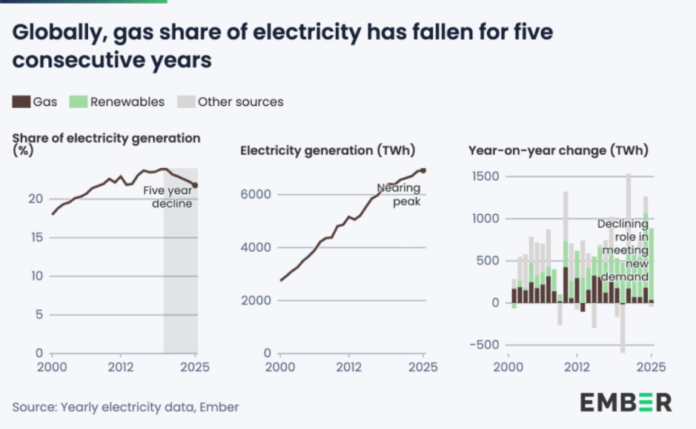
Global gas-fired electricity generation is steadily losing ground to renewable energy, with solar power emerging as the dominant source of new electricity supply worldwide, according to a new report from Ember.
The analysis reveals that the share of gas in the global electricity mix declined for the fifth consecutive year, falling from 23.9 percent in 2020 to 21.8 percent in 2025. Although gas generation increased slightly in absolute terms, its growth rate has slowed significantly as solar and wind power increasingly satisfy rising electricity demand.
A major finding of the report is that 61 out of 124 economies generating electricity from gas have already passed peak gas generation. These include four G7 nations – United Kingdom, Germany, Italy and Japan – highlighting a structural shift away from gas in advanced economies.
Solar Growth Far Outpaces Gas
Solar power was the clear winner in 2025, adding 636 TWh of electricity generation globally. This was 17 times higher than gas generation growth, which increased by only 38 TWh during the year, Malgorzata Wiatros-Motyka, Senior Electricity Analyst at Ember, said.
Solar accounted for around 75 percent of new global electricity demand growth in 2025, while gas contributed only about 5 percent. The report also notes that gas generation growth between 2021 and 2025 was roughly half the rate recorded during 2016-2020, underscoring the declining role of gas in meeting future electricity demand.
Energy Security Concerns Accelerate Renewable Adoption
Recent geopolitical disruptions have further weakened the position of gas as a transition fuel. The report highlights that Russia’s invasion of Ukraine in 2022 triggered supply disruptions and price volatility, prompting faster renewable energy deployment across Europe and Asia. More recently, LNG market disruptions linked to the 2026 Middle East conflict reinforced concerns about the risks associated with imported fossil fuels.
Countries are increasingly favoring domestically produced renewable electricity because it offers greater price stability, improved energy security, and faster deployment compared with gas infrastructure.
Gas Growth Concentrated in the United States
The report shows that gas generation growth is becoming increasingly concentrated geographically. The United States accounted for 26 percent of global gas-fired electricity generation in 2025 and remained the largest contributor to gas growth over the past decade.
Among G7 economies, gas generation declined by 50 TWh in 2025, while renewable electricity output increased by 123 TWh. Renewables generated nearly as much electricity as gas across the G7 during the year, helping clean power overtake fossil-fuel generation overall.
China, India and Brazil Expand Power Supply with Limited Gas Use
The world’s largest emerging electricity markets continue to expand power generation without significant dependence on gas. China, India and Brazil together accounted for approximately 42 percent of global electricity demand in 2025, yet maintained relatively low gas usage in their power systems.
India’s gas share in the electricity mix fell sharply from 12.6 percent in 2010 to just 2.3 percent in 2025. Brazil’s gas share peaked at 13.7 percent in 2014 and declined to 7.3 percent in 2025. China maintained a gas share of around 3 percent despite rapid growth in electricity demand.
The findings indicate that nearly half of the world’s gas-generating economies have already moved beyond peak gas power generation. As renewable technologies continue to scale rapidly and governments prioritize energy security, affordability and industrial competitiveness, the global power sector appears to be moving closer to a long-term peak in gas-fired electricity generation.
BABURAJAN KIZHAKEDATH
