
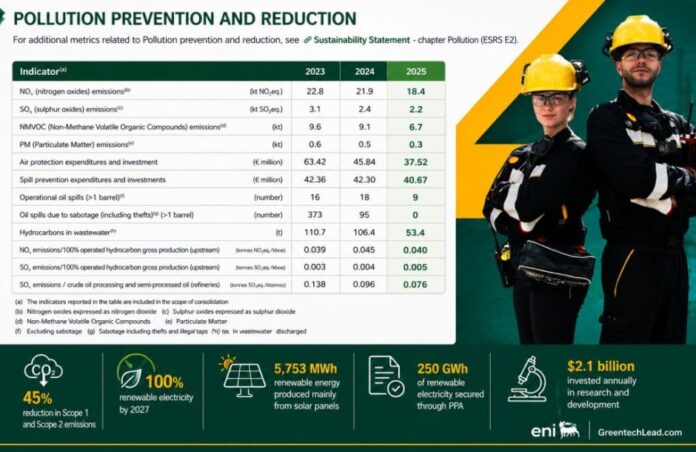
Eni’s Sustainability Report 2025 outlines the company’s progress in advancing its Just Transition strategy through emissions reduction, renewable energy expansion, biofuel development, carbon capture initiatives, and social sustainability programs.
The energy major has set climate targets, aiming to achieve net-zero Scope 1 and Scope 2 emissions from upstream operations by 2030, net-zero Scope 1 and Scope 2 emissions across the entire group by 2035, and net-zero emissions across Scope 1, Scope 2, and Scope 3 by 2050. Eni has also maintained upstream methane intensity below 0.2 percent, reinforcing its focus on reducing high-impact greenhouse gas emissions.
During 2025, Eni reduced upstream greenhouse gas emissions by 31 percent year-on-year and by 68 percent compared with 2018 levels. Methane emissions declined by 97 percent, while methane intensity reached 0.09 percent. The company also achieved zero routine flaring across its upstream operations, marking a significant milestone in operational decarbonization.
Eni increased its commitment to innovation and decarbonization in 2025 by investing more than €460 million in technology and innovation activities, representing an 18 percent increase compared with 2024. The investment included €207 million in research and development, with 80 percent directed toward technologies that support the company’s decarbonization objectives. Eni also expanded investments in innovation-driven sectors such as advanced mobility solutions, high-performance computing (HPC) systems, frontier technologies, and digital transformation initiatives, reinforcing the role of technology and innovation as key drivers of its energy transition strategy.
Renewable energy growth remained a key driver of Eni’s transition strategy. Through its Plenitude business, installed renewable energy capacity reached 5.8 GW, representing 41 percent annual growth. Eni plans to expand renewable capacity to 15 GW by 2030 through investments in solar, wind, and energy storage projects across Europe and North America. The company is also deploying Battery Energy Storage Systems, including 200 MW-scale installations, to improve grid reliability and support renewable energy integration.
Biofuels continue to play a major role in Eni’s decarbonization roadmap. Through its Enilive platform, the company aims to exceed 5 million tonnes per year of biogenic feedstock processing capacity by 2030 and develop more than 2 million tonnes of annual Sustainable Aviation Fuel production potential. Current biofuel production capacity stands at 1.65 million tonnes per year. Eni supports sustainable mobility through approximately 1,700 service stations across Europe and integrated logistics infrastructure at ports including Ravenna, Genoa, and Venice.
Eni is also expanding carbon capture and storage projects to help decarbonize hard-to-abate industries. These projects combine carbon capture, transportation, and permanent storage technologies to reduce residual emissions while leveraging advanced subsurface modeling and digital technologies to ensure long-term storage integrity.
Circular economy initiatives are transforming the company’s industrial operations. Eni continues converting conventional refining assets into biorefineries using its Ecofining technology to produce renewable fuels from waste-based feedstocks. The company is also deploying Hoop chemical recycling technology to convert plastic waste into reusable chemical feedstocks, supporting more sustainable petrochemical production.
Innovation remains central to Eni’s energy transition strategy. The company invests more than €460 million annually in innovation and digital transformation activities, including €207 million dedicated to research and development. Around 80 percent of R&D expenditure is focused on decarbonization, renewable energy, and circular economy technologies. Eni’s innovation portfolio includes 9,520 active patents, with half of all new patent filings linked to energy transition solutions.
Beyond environmental initiatives, Eni continues to invest in social development. The company allocated €81 million to social programs, reaching approximately 3 million people worldwide. It also distributed around 440,000 clean cookstoves across African communities, improving access to cleaner energy while reducing dependence on traditional biomass fuels.
Eni has strengthened ESG governance and workforce inclusion through gender equality certification under UNI PdR 125:2022 standards. Employee participation in company share ownership programs exceeds 70 percent globally, reflecting strong workforce engagement and alignment with long-term sustainability objectives.
The Sustainability Report 2025 demonstrates Eni’s integrated approach to energy transition, combining renewable energy growth, emissions reduction, sustainable fuels, carbon capture technologies, circular economy solutions, innovation investments, and social impact initiatives as part of its pathway toward achieving net-zero emissions by 2050.
SHAFANA FAZAL
