
STMicroelectronics is strengthening its position as a leader in sustainable semiconductor manufacturing through climate targets, renewable energy investments, circular economy initiatives, and responsible technology innovation.
The semiconductor company has established a comprehensive decarbonization roadmap focused on reducing greenhouse gas emissions across its operations and supply chain. STMicroelectronics aims to achieve net-zero Scope 1 and Scope 2 emissions while targeting a 20 percent absolute reduction in these emissions by 2030 compared with its 2024 baseline.
The company also plans to cut upstream Scope 3 emissions by 10 percent by 2030 and 20 percent by 2035. To further reduce its environmental footprint, STMicroelectronics is working to destroy 90 percent of climate-relevant process gases by 2030 and maintains an annual operational carbon cap of 930 kilotonnes of CO₂.
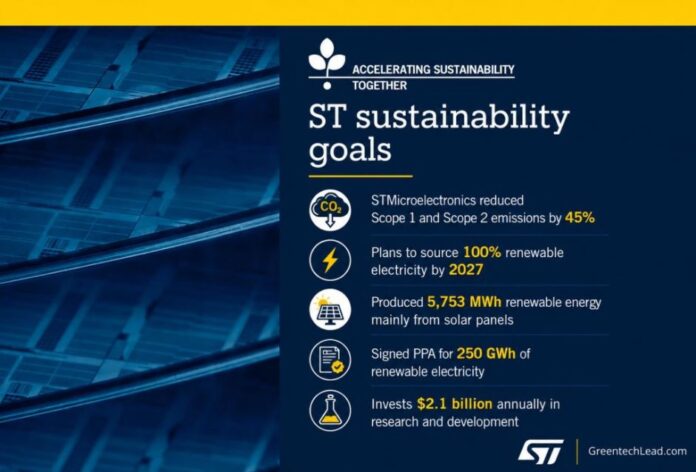
The company has already delivered significant progress, reducing Scope 1 and Scope 2 emissions by 45 percent compared with its 2018 baseline, highlighting the effectiveness of its long-term industrial decarbonization strategy, STMicroelectronics Sustainability Report 2025 indicated.
Renewable energy remains central to STMicroelectronics’ sustainability agenda. The company has committed to sourcing 100 percent renewable electricity by 2027 and has already achieved 86 percent renewable electricity usage across its global operations. STMicroelectronics produced renewable energy for a total of 5,753 MWh — mainly from the installation of solar panels.
Long-term power purchase agreements secure 250 GWh of renewable electricity annually, supporting the transition to low-carbon semiconductor manufacturing. In parallel, STMicroelectronics aims to achieve 100 GWh of cumulative energy savings by 2035 through efficiency improvements and operational optimization.
STMicroelectronics has strengthened its renewable energy and decarbonization strategy through major infrastructure partnerships in France and Singapore. The company signed a 15-year Power Purchase Agreement with TSE, a leading French solar and agrivoltaics developer, to supply renewable electricity from solar parks to its manufacturing sites in France, supporting its transition to cleaner energy sources.
In Singapore, STMicroelectronics and SP Group launched the country’s largest industrial district cooling system at the Ang Mo Kio TechnoPark. The energy-efficient facility is expected to reduce carbon emissions by up to 120,000 tonnes annually while lowering cooling-related electricity consumption by 20 percent. The project supports STMicroelectronics’ target of achieving carbon neutrality by 2027 and has received Green Mark Platinum certification for sustainability and design excellence.
STMicroelectronics is accelerating efforts to reduce climate-active process gas (CAPG) emissions across its semiconductor manufacturing operations. The company aims to abate at least 90 percent of CAPG-related greenhouse gas emissions by 2030 compared with its 2024 baseline through the deployment of point-of-use CAPG abatement systems at production facilities. In 2025, STMicroelectronics achieved an 83 percent abatement rate of CAPG-related emissions, up from 76 percent in 2024. The emissions reduction program now covers the company’s fourteen main manufacturing sites, three major research and development facilities, and one EWS site, highlighting continued progress toward its long-term decarbonization and net-zero objectives.
Water stewardship is another strategic priority. The company is expanding recycling and reuse programs to reduce dependence on freshwater resources across manufacturing sites. STMicroelectronics targets 60 percent water recycling and reuse by 2035 and has already achieved a 54 percent recycling rate. It also plans to save 6 million cubic meters of water by 2035 while pursuing 100 percent certification under the Alliance for Water Stewardship across major production facilities.
Circular economy initiatives continue to deliver strong results. STMicroelectronics aims to recover, reuse, or recycle 95 percent of waste generated across operations while limiting landfill disposal to less than 5 percent. The company has already achieved a 97 percent waste diversion rate from landfill through expanded material recovery and recycling programs.
Innovation remains a key enabler of sustainability performance. STMicroelectronics invests $2.1 billion annually in research and development and employs more than 9,500 researchers focused on energy-efficient semiconductor technologies. The company is expanding its portfolio of Silicon Carbide and Gallium Nitride solutions, with Silicon Carbide revenue increasing by 60 percent. Between 69 percent and 77 percent of newly introduced products qualify as responsible products, demonstrating the integration of sustainability principles into product development.
The company also maintains strong social sustainability performance. Its Total Recordable Case Rate stands at 0.47, significantly below the 0.75 benchmark threshold. STMicroelectronics aims to achieve 25 percent female representation in leadership positions by 2035 and reports a gender pay gap of negative 1.8 percent. Its WISE employee network has grown to more than 1,400 members, supporting diversity, inclusion, and professional development initiatives. All operations comply with Responsible Business Alliance standards.
Sustainability governance is embedded throughout the organization. The Sustainability Council, chaired by Rajita D’Souza, President of Human Resources and Corporate Social Responsibility, oversees implementation of sustainability objectives. The governance framework links 10 percent of short-term executive compensation and 33.3 percent of long-term incentives to sustainability performance. STMicroelectronics operates with 24 sustainability objectives and incorporates feedback from more than 300 stakeholders into its materiality assessments. Reporting aligns with leading global standards, including GRI, SASB, TCFD, and SBTi.
Through measurable climate action, renewable energy adoption, water conservation, circular economy initiatives, and responsible semiconductor innovation, STMicroelectronics continues to advance its long-term vision of sustainable manufacturing while supporting the transition to a low-carbon digital economy.
SHAFANA FAZAL
