
Cambodia has emerged as one of Southeast Asia’s fastest-growing renewable energy markets, rapidly expanding its solar power capacity and surpassing government deployment targets years ahead of schedule. However, a new report from the Institute for Energy Economics and Financial Analysis (IEEFA) warns that restrictions on rooftop solar installations could increase electricity costs for businesses, weaken industrial competitiveness, and slow the country’s clean energy transition.
Cambodia’s installed solar capacity reached approximately 1,476 MW in 2025, exceeding the country’s original solar targets of 705 MW for 2025, 1 GW for 2030, and 1.3 GW for 2035. The country’s utility-scale solar sector has become the primary driver of renewable energy growth, positioning Cambodia among the leading solar markets in Southeast Asia.
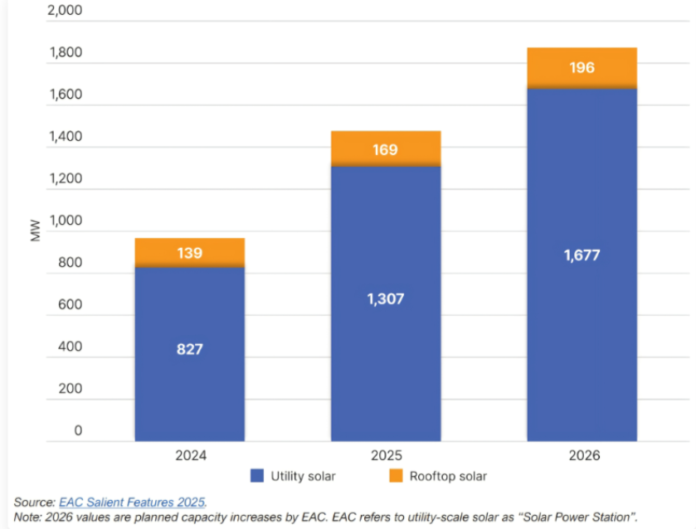
Utility-scale solar capacity is projected to increase from 827 MW in 2024 to 1,307 MW in 2025 and further to 1,677 MW in 2026. Additional projects scheduled for completion in 2026 are expected to contribute another 397 MW of solar capacity. A major milestone will be the commissioning of the 930 MW Chheu Tom Solar Complex, which is set to become one of Southeast Asia’s largest solar projects and could push Cambodia’s total solar capacity closer to 3 GW, approaching the Power Development Plan 2040 target of 3.155 GW.
Despite this rapid expansion, rooftop solar remains a relatively small segment of the market. Rooftop solar capacity is forecast to rise from 139 MW in 2024 to 169 MW in 2025 and 196 MW in 2026. According to IEEFA, regulatory restrictions have limited annual rooftop solar additions to roughly 30 MW, preventing businesses and households from fully benefiting from low-cost renewable electricity.
A key concern is Cambodia’s compensation tariff system introduced in 2025, which requires larger rooftop solar operators to pay fees on electricity generated. Industry groups argue these charges exceed actual grid integration costs by three to four times. IEEFA estimates that the tariff can extend rooftop solar payback periods by nearly two years, reducing investment attractiveness for commercial and industrial users.
The government also maintains a national quota of 30 MW annually for grid-connected rooftop solar installations. Applications exceeding provincial allocations can be rejected, creating uncertainty for investors. Restrictions on exporting excess electricity to the grid and periodic tariff reviews further complicate long-term project planning.
Cambodia’s manufacturing sector, particularly garment, footwear, textile, and travel goods producers, has become increasingly concerned about limited access to renewable electricity. These industries account for roughly half of Cambodia’s exports and face growing pressure from global buyers to decarbonize supply chains. Manufacturers argue that affordable rooftop solar can reduce operating costs, improve sustainability performance, and strengthen Cambodia’s position as a regional manufacturing hub.
Energy costs could become an even bigger issue as Cambodia prepares to commission its first large-scale LNG-to-power project. The 900 MW LNG facility being developed by Royal Group is expected to begin phased operations in late 2026 and 2027 and could eventually supply around 23 percent of the country’s electricity demand.
IEEFA estimates electricity generated from the LNG plant could cost about $0.12 per kWh under current gas price assumptions and rise to $0.16 per kWh if LNG prices increase. Including transmission and distribution costs, end-user electricity prices could range from $0.19 to $0.25 per kWh. In comparison, rooftop solar systems can generate electricity at an estimated cost of $0.046 to $0.074 per kWh.
Cambodia already has some of Southeast Asia’s highest electricity tariffs, with commercial and industrial users paying between $0.117 and $0.177 per kWh, while some residential customers face rates close to $0.18 per kWh. Greater dependence on imported LNG could expose consumers and businesses to global fuel price volatility, supply disruptions, and geopolitical risks.
Meanwhile, investment activity in Cambodia’s renewable energy sector continues to accelerate. Renewable energy developer SchneiTec partnered with Huawei Digital Power in June 2025 to launch Cambodia’s first TÜV SÜD-certified grid-forming energy storage project. The installation includes a 12 MWh battery energy storage system and a 2 MWh testing facility designed to improve grid stability and renewable energy integration.
The growing deployment of utility-scale solar projects, battery storage systems, and renewable energy infrastructure demonstrates Cambodia’s commitment to achieving renewable energy capacity targets of 70 percent by 2030 and between 72 percent and 80 percent by 2035. The government has also eliminated import duties on solar equipment and battery energy storage systems from April 2026, reducing costs and encouraging additional investment.
IEEFA concludes that while Cambodia has successfully accelerated utility-scale solar deployment, removing barriers to rooftop solar adoption will be critical to lowering electricity costs, improving energy security, supporting manufacturing growth, and strengthening the country’s long-term competitiveness in global supply chains. Greater access to distributed solar generation could help shield businesses from future fossil fuel price shocks while reinforcing Cambodia’s position as a renewable energy leader in Southeast Asia.
FASNA SHABEER
