
South Korea is accelerating its transition toward renewable energy as it seeks to reduce reliance on imported fossil fuels and strengthen long-term energy security. According to the Institute for Energy Economics and Financial Analysis (IEEFA), renewables are becoming a structural pillar of South Korea’s energy and industrial strategy.
The government aims to expand renewable energy capacity to nearly 100 gigawatts by 2030 and raise its share of electricity generation to more than 20 percent, marking a significant structural shift in the country’s energy system, IEEFA’s Grant Hauber and Paige Nguyen said in the report.
Geopolitical Shock Exposes Structural Energy Risks
Geopolitical tensions involving Iran have highlighted South Korea’s vulnerability as an import-dependent energy economy. Oil prices surged by nearly 50 percent, while LNG prices nearly doubled, according to IEEFA analysis.
South Korea imports around 97 percent of its total energy needs, making it highly exposed to global price volatility and supply disruptions.
LNG Cost Crisis Reshaping Energy Economics
LNG-based power generation costs have risen sharply, doubling from approximately USD 0.075 per kilowatt-hour to around USD 0.15 per kilowatt-hour.
In many cases, LNG fuel costs are now close to retail electricity tariffs, increasing pressure on utilities and industrial consumers and reinforcing the need for renewable energy expansion.
Key Measures in South Korea’s Renewable Energy Strategy
South Korea is targeting rapid expansion of solar and wind capacity to nearly 100 gigawatts by 2030. Offshore wind is expected to play a leading role due to land constraints and strong coastal wind potential.
Programs such as the Sunlight Income Village initiative and RE100 industrial complexes are being developed to expand distributed renewable generation and attract global manufacturers seeking low-carbon energy supply chains.
Leading Renewable Energy Companies in South Korea and Recent Investment Activity
South Korea’s renewable energy transformation is being driven by a combination of state utilities, industrial conglomerates, and emerging clean energy developers.
Korea Electric Power Corporation remains the central player in the country’s energy transition. The company is investing heavily in offshore wind development, smart grid infrastructure, and large-scale energy storage systems. KEPCO has also been expanding its participation in green hydrogen pilot projects and grid modernization programs to support higher renewable penetration.
Hanwha Group has significantly expanded its clean energy footprint through its solar manufacturing and renewable project development businesses. The group is investing in next-generation solar technologies and scaling its global solar supply chain, positioning itself as a key player in the international solar market.
SK ecoplant is transitioning from a traditional construction-focused business into a green infrastructure and renewable energy developer. The company has increased investments in solar, waste-to-energy projects, and environmental infrastructure, while expanding its role in sustainable urban development.
Doosan Enerbility is strengthening its position in offshore wind and hydrogen technologies. The company is actively involved in supplying wind turbine components and developing hydrogen-based power generation solutions, aligning with South Korea’s long-term decarbonization roadmap.
POSCO Holdings is also expanding into hydrogen and renewable-linked steel production. The company is investing in green hydrogen projects and low-carbon steel manufacturing, integrating renewable energy into its industrial decarbonization strategy.
International collaboration is also expanding, with Masdar partnering with Korean utilities on offshore wind and hydrogen projects, highlighting growing cross-border capital flows into South Korea’s clean energy market.
Rising Competition from Global Energy Players
Global renewable energy companies are increasingly active in South Korea.
RWE has entered the offshore wind sector in South Korea, securing development rights and signaling growing European interest in Asian renewable markets.
Ingka Group is also exploring renewable energy investments in the region, particularly in offshore wind, as part of its global decarbonization strategy.
This growing competition is expected to accelerate technology transfer and improve project execution efficiency.
Renewables vs LNG: Cost Competitiveness Reaching a Turning Point
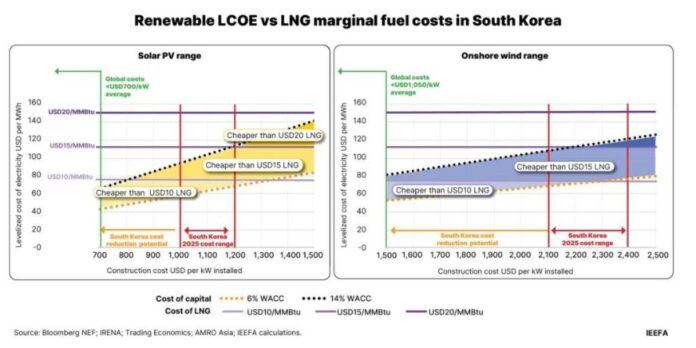
Solar and wind power are increasingly competitive with LNG-based electricity generation. According to IEEFA, renewable energy is already cost-competitive in several scenarios, particularly when LNG prices range between USD 10 and USD 20 per MMBtu.
However, structural cost gaps remain, with solar and wind installations in South Korea still significantly above global benchmarks due to permitting delays, supply chain inefficiencies, and land constraints.
Investment Trends: Capital Flowing Into Clean Energy
Global capital is increasingly shifting toward renewable energy, with institutional investors prioritizing ESG-aligned assets.
South Korea is seeing rising interest in offshore wind, battery storage, and grid modernization projects. Green bonds and sustainability-linked financing are becoming key funding mechanisms for large-scale infrastructure development.
Policy Reforms to Unlock Renewable Growth
South Korea is reforming its Renewable Portfolio Standard system, introducing competitive auctions and long-term contracts to improve investment predictability.
Regulatory reforms are also targeting faster permitting, especially for rooftop solar and offshore wind developments.
Grid Modernization, Storage, and Digitalization
South Korea is investing in smart grids, advanced transmission networks, and battery storage systems to support renewable integration. Digital energy management and AI-based grid optimization are also being deployed.
Heating Transition and Electrification
Gas still accounts for about 46 percent of heating demand in South Korea. The government is promoting heat pumps and renewable-based district heating systems to reduce fossil fuel dependence.
Industrial Competitiveness and Energy Security
Reliable and affordable electricity is critical for South Korea’s semiconductor, manufacturing, and digital economy sectors. Renewable energy is expected to stabilize costs and reduce exposure to global fuel volatility.
Outlook: A Critical Decade for Energy Transition
South Korea’s success will depend on scaling infrastructure, reducing renewable costs, and attracting sustained private investment. The next decade will determine whether it can close the gap with global clean energy leaders.
South Korea’s renewable energy transition has become a structural economic necessity driven by geopolitical risk, fossil fuel volatility, and global investment shifts. With rising participation from domestic champions and global investors, the country is entering a decisive phase of energy transformation.
FASNA SHABEER
