
Bangladesh’s nearly decade-long push to improve energy efficiency is delivering strong economic and environmental dividends, putting the country on course to meet its national targets ahead of schedule, according to a new report by the Institute for Energy Economics and Financial Analysis (IEEFA).
The report, Bangladesh’s energy efficiency goals within reach, authored by Shafiqul Alam, Lead Energy Analyst for Bangladesh at IEEFA South Asia, highlights how sustained policy action since 2016 has significantly reduced fossil fuel consumption and import costs while strengthening energy security.
Billions saved through energy efficiency gains
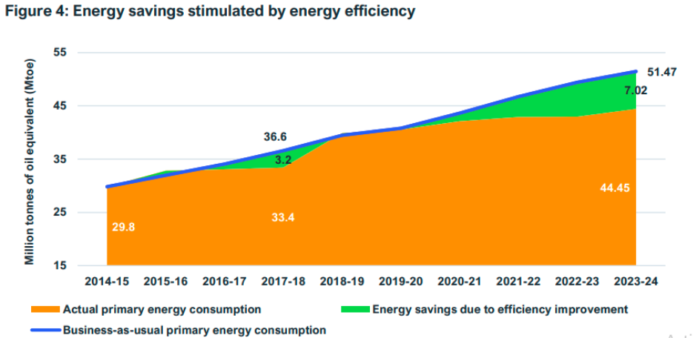
IEEFA’s analysis of Bangladesh’s primary energy consumption and gross domestic product trends over the past decade shows that energy efficiency improvements have already generated substantial savings. Between fiscal year 2014-15 and fiscal year 2023-24, Bangladesh achieved a 13.64 percent increase in energy efficiency, against a national target of 20 percent by 2030.
In fiscal year 2023-24 alone, energy efficiency gains helped the country reduce fossil fuel consumption by 7.02 million tonnes of oil equivalent. This translated into avoided import costs of approximately USD 3.34 billion, underscoring the economic value of efficiency-focused policies.
Energy security concerns accelerated progress
Progress on energy efficiency was initially uneven, but the global energy price shock and supply disruptions during fiscal year 2021-2022 turned efficiency into an urgent national priority. Bangladesh was able to respond effectively because of the Energy Efficiency and Conservation Master Plan developed in 2016, which laid a strong policy foundation.
Since then, a mix of regulations, low-cost financing mechanisms and supporting programmes has accelerated implementation across key sectors. As a result, Bangladesh’s average annual energy efficiency improvement rate stands at around 1.52 percent. According to IEEFA, this trajectory is sufficient for the country to achieve its 2030 energy efficiency goal at least one year ahead of schedule.
The study also notes that Bangladesh’s updated Nationally Determined Contributions include an energy efficiency target of 19.2 percent by 2035 compared with 2022 levels. Current trends suggest this target could also be reached a year earlier than planned.
Households and industry hold the key
The report finds that even greater efficiency gains are possible by focusing on households and industry, which together account for roughly two-thirds of Bangladesh’s total energy consumption.
A major contributor to recent progress has been the widespread shift from compact fluorescent lamps and incandescent bulbs to energy-efficient light-emitting diode lighting across residential, commercial and industrial sectors. Consumers are also increasingly adopting energy-efficient air conditioners, driven by rising awareness and operating cost savings.
IEEFA emphasizes the importance of clear energy efficiency labels to address information gaps around minimum energy performance standards. Better labelling can accelerate adoption of efficient appliances in a market where consumers are highly price-sensitive.
In the industrial sector, the report calls for prioritising efficiency improvements in motors, motor-driven systems and captive power generators, along with a transition from gas-fired boilers to electric alternatives. For commercial buildings, energy efficiency labels, passive design and better cooling management are identified as critical measures to curb rising electricity demand.
Call for lower import duties on efficient technologies
Despite strong momentum, the report highlights policy barriers that could slow further adoption. Import duties on components for LED lights remain as high as 62 percent, while compressors with inverters face elevated minimum import duties. IEEFA recommends reducing these levies to make energy-efficient appliances more affordable and accessible.
By lowering costs and strengthening targeted measures, Bangladesh has the opportunity not only to meet but surpass its energy efficiency goals, reinforcing economic resilience while cutting emissions and dependence on imported fossil fuels, IEEFA said.
