
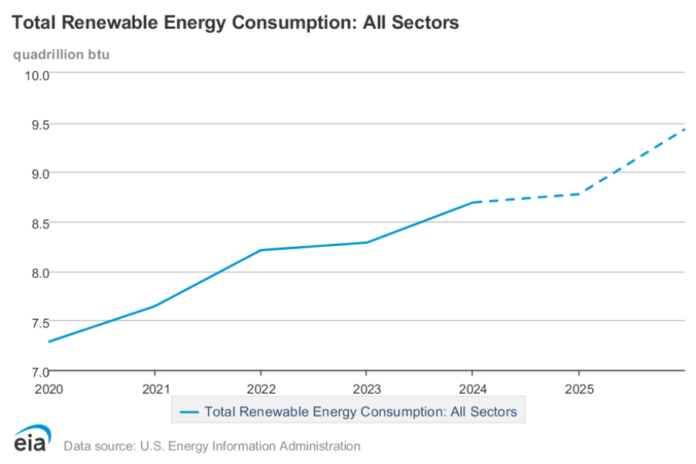
The US power sector is poised for a landmark transition in 2026, with all net new generating capacity expected to come exclusively from renewable energy and battery storage, according to forecasts from the US Energy Information Administration. The outlook builds on strong trends seen throughout 2025 year to date and signals an acceleration in the shift away from fossil fuels and nuclear power.
EIA projects that utility-scale renewable energy and battery storage capacity will rise by 68,528.0 megawatts over the coming 12-month period. While the agency does not publish a forecast for small-scale solar, the SUN DAY Campaign estimates rooftop and other distributed systems will contribute an additional 7,200.0 megawatts.
In contrast, natural gas capacity is expected to see only a modest net increase of 4,167.4 megawatts, which will be more than offset by a 4,287.0 megawatt decline in coal-fired capacity. Petroleum and other gas-based generation are projected to fall by 42.2 megawatts, while nuclear power is forecast to see no new capacity growth at all.
If these projections materialize, renewables and battery storage will account for 100 percent of net new capacity additions in 2026. By October 31, 2026, total renewable capacity, including small-scale solar, is expected to reach 504,634.6 megawatts, nearly matching natural gas capacity of 514,018.2 megawatts. Renewables would then represent more than 36 percent of total US generating capacity.
Solar power is set to play a defining role in this expansion. Combined utility-scale and small-scale solar capacity is projected to reach 244,308.6 megawatts, surpassing wind capacity of 166,260.3 megawatts. Solar capacity would also exceed that of coal at 166,649.5 megawatts and more than double nuclear capacity of 98,437.2 megawatts, although coal and nuclear plants would continue to operate with higher capacity factors.
EIA’s latest Electric Power Monthly report, covering data through October 31, 2025, reinforces solar’s position as the fastest-growing major source of electricity in the United States. In October, utility-scale solar generation rose by 23.3 percent compared to the same month in 2024, while estimated small-scale solar output increased by 12.6 percent. Combined solar generation grew by 20.6 percent year on year and supplied 9.1 percent of total US electricity during the month, up from 7.8 percent a year earlier.
During the first ten months of 2025, utility-scale solar thermal and photovoltaic generation expanded by 34.5 percent, while small-scale solar rose by 11.3 percent compared with the same period in 2024. Together, solar generation increased by 28.1 percent and accounted for just over 9.0 percent of total US electricity output from January to October, compared with 7.2 percent a year earlier.
Solar electricity production has also outpaced hydropower by a wide margin. Year to date, solar output exceeded hydropower generation by more than 67 percent. In October alone, solar generation was nearly double that of hydropower. Across both October and the year-to-date period, solar produced significantly more electricity than hydropower, biomass, and geothermal combined.
Wind energy continues to lead among renewable sources in terms of electricity generation. Wind turbines generated 9.9 percent of US electricity during the first ten months of 2025, representing a 1.1 percent increase compared with the same period last year and producing 84 percent more electricity than hydropower.
Together, wind and solar are approaching one-fifth of total US electricity generation. From January to October 2025, combined wind and solar output rose by 12.4 percent and supplied 18.9 percent of total US electricity, up from 17.3 percent a year earlier. This combined output was 16.6 percent higher than coal generation and 10.8 percent higher than nuclear generation over the same period, while nuclear power recorded zero growth.
All renewable sources combined, including wind, solar, hydropower, biomass, and geothermal, generated 25.7 percent of total US electricity during the first ten months of 2025, up from 24.3 percent a year earlier. Renewable electricity output increased by 8.6 percent year on year, second only to natural gas, whose generation actually declined by 3.6 percent during the period.
On the capacity front, solar and battery storage dominated additions in 2025, supported by steady growth in wind. Between January 1 and October 31, 2025, utility-scale solar capacity expanded by 19,477.6 megawatts, with small-scale solar adding another 4,837.7 megawatts. EIA forecasts even stronger momentum ahead, with 36,071.9 megawatts of new utility-scale solar capacity expected over the next twelve months.
Battery storage saw particularly rapid growth, with installed capacity rising by 45.0 percent since the start of the year and adding 12,150.3 megawatts. Planned battery additions for the coming year total 21,940.4 megawatatts, representing a further increase of 56 percent. Wind capacity also grew by 3,796.0 megawatts in 2025 to date, with planned additions of 9,567.0 megawatts of onshore wind and 800.0 megawatts of offshore wind over the next year.
By contrast, natural gas capacity increased by only 3,479.6 megawatts during the past ten months, while nuclear power added just 46.0 megawatts. Coal capacity fell sharply by 3,241.1 megawatts, and petroleum-based capacity declined by 476.3 megawatts.
Overall, since January 1, 2025, renewable energy capacity, including battery storage, small-scale solar, hydropower, geothermal, and biomass, expanded by 40,174.4 megawatts. Over the same period, the combined capacity of fossil fuels and nuclear power declined by 218.0 megawatts, underscoring the scale and speed of the US power sector’s transition toward clean energy.
BABURAJAN KIZHAKEDATH
