
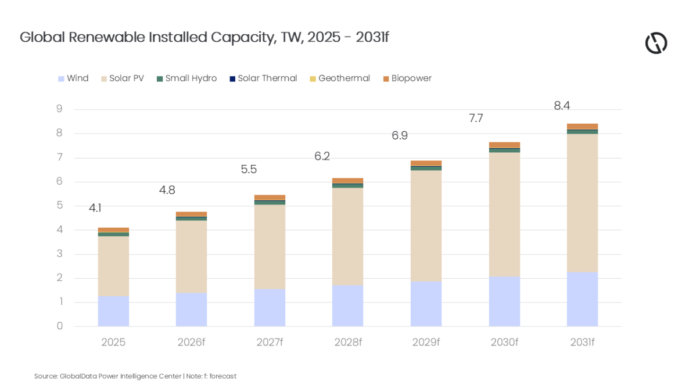
Global renewable energy installed capacity is projected to expand rapidly over the next five years, fueled by the scalability of solar photovoltaic (PV) systems, falling technology costs, and strong policy support worldwide. According to a new report from GlobalData, global renewable energy capacity is expected to grow from 4.1 terawatts (TW) in 2025 to 8.4 TW by 2031, representing a compound annual growth rate of 13 percent.
Asia-Pacific Leads Global Renewable Capacity Expansion
The report, titled Renewable Energy: Strategic Intelligence, highlights that renewable energy installations reached record levels in 2025. The Asia-Pacific region continues to dominate the sector, particularly in wind and solar power deployment.
Wind installations in the region reached 699.5 gigawatts (GW), while solar PV capacity climbed to 1,550 GW. Much of this growth is driven by large-scale projects in China, which continues to lead the global renewable energy transition.
In contrast, the United States is experiencing a more challenging environment marked by higher project costs, market volatility, and slower delivery of renewable projects.
Solar PV Surpasses Wind in Global Electricity Generation
According to Rehaan Aleem Shiledar, Power Analyst at GlobalData, solar PV and wind energy remain the backbone of the global energy transition.
Solar PV became the largest renewable electricity source in 2025, overtaking wind generation for the first time. Global wind output reached 2,770 terawatt-hours (TWh), while solar PV generation slightly surpassed it at 2,800 TWh.
China’s solar expansion has been particularly significant, driven by ambitious carbon neutrality goals, extensive supply-chain investment, and declining equipment costs. The country produced approximately 1,150 TWh of solar electricity in 2025, accounting for about 41 percent of global solar PV output.
The United States and India followed with solar generation of 486 TWh and 189 TWh respectively. Both countries are experiencing rapid solar growth due to falling technology costs, supportive policies, and national decarbonization targets. In the US, the Inflation Reduction Act has provided strong incentives for renewable energy development, while India continues to scale projects under its flagship solar missions.
Solar Dominates Global Renewable Capacity Mix
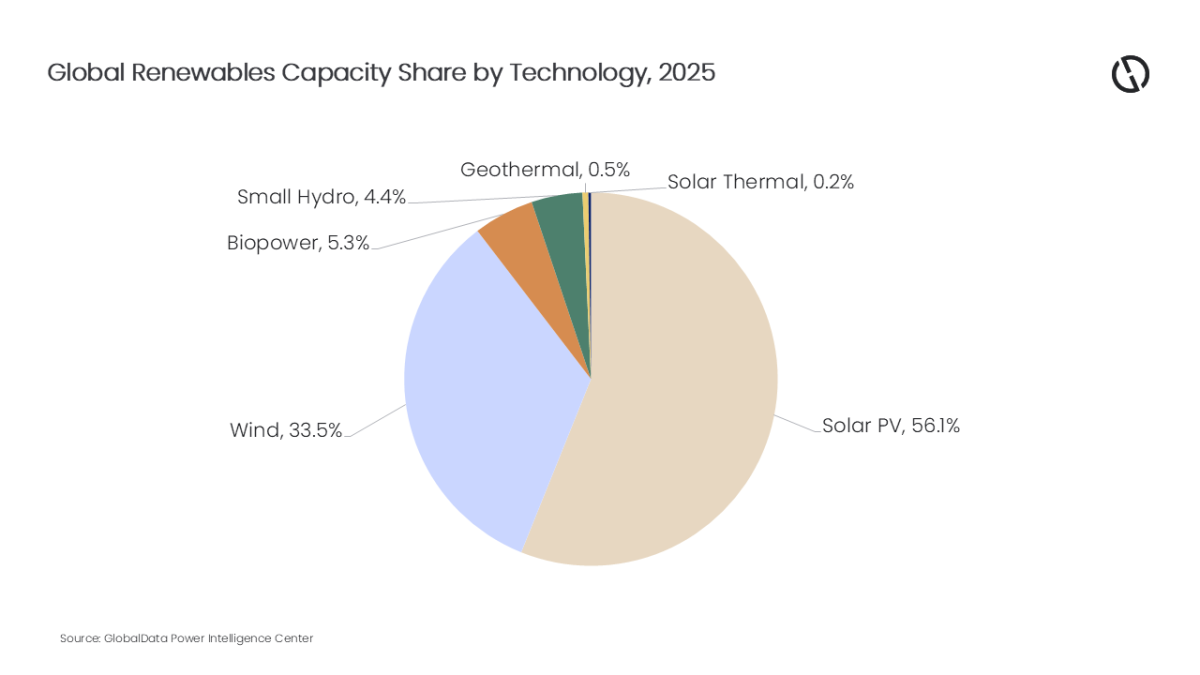
Solar PV accounted for approximately 56.1 percent of total renewable energy capacity in 2025, making it the dominant technology globally. Wind power followed with a 33.5 percent share, while biopower represented around 5.3 percent of installed renewable capacity.
The rapid scaling of solar installations, combined with ongoing improvements in efficiency and declining costs, continues to reinforce its leading role in global energy systems.
Artificial Intelligence Enhancing Renewable Energy Systems
Artificial Intelligence is emerging as a major catalyst in the renewable energy ecosystem, helping optimize grid performance and improve operational efficiency.
Because wind and solar generation depend on variable weather conditions, AI systems are increasingly used to analyze large volumes of data to forecast power generation, manage energy storage, and coordinate smart-grid operations. By enabling real-time balancing of electricity supply and demand, AI reduces energy curtailment, lowers operating costs, and strengthens grid resilience.
Industry players such as Vestas, ENERCON, JinkoSolar, and First Solar are already deploying AI-driven solutions to enhance performance and reliability across renewable energy assets.
AI Data Centers Driving Renewable Power Demand
The rapid growth of artificial intelligence workloads is also driving significant new demand for renewable energy. Large-scale data centers are emerging as a key factor in global electricity consumption, prompting hyperscalers and colocation operators to accelerate investments in clean energy.
Major technology companies are partnering with utilities and energy developers to secure renewable power for their data center operations. For example, Google partnered with NextEra Energy in December 2025 to develop gigawatt-scale AI data centers powered by clean energy. Meanwhile, Equinix collaborated with CleanMax on a 33 megawatt captive renewable power project.
Renewable Expansion Diverges Across Global Markets
Policy changes in the United States have created what analysts describe as a “two-speed” renewable energy transition. Following policy shifts under Donald Trump, federal support has moved toward fossil fuels, slowing renewable deployment and increasing costs in the US market.
Meanwhile, China’s clean-energy economy is accelerating. In 2025, clean energy accounted for more than 90 percent of incremental investment growth in the country. Renewable manufacturing and installations also contributed more than one-third of China’s overall economic expansion.
BABURAJAN KIZHAKEDATH
