
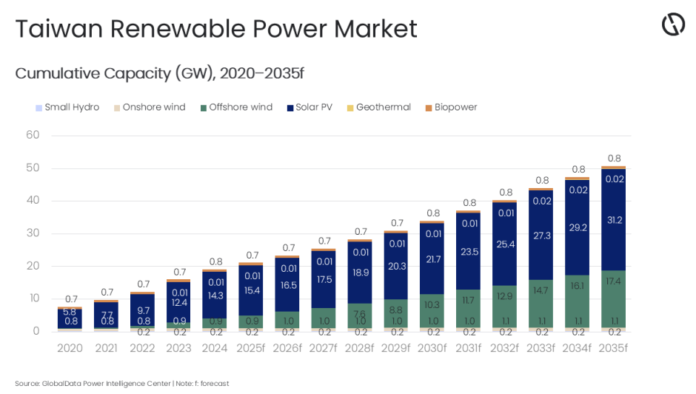
Taiwan’s renewable power capacity is projected to nearly triple to 50.7GW by 2035, up from about 19.1GW in 2024, as the island accelerates its clean energy transition following the completion of its nuclear power phase-out in May 2025, according to GlobalData.
The shutdown of Taiwan’s last operating nuclear reactor has marked a turning point for the country’s power sector. With nuclear energy no longer part of the generation mix, the government has intensified its focus on expanding renewable energy and gas-fired power while steadily reducing dependence on coal. This transition is taking place within an isolated and import-dependent power system, making energy security and system reliability central policy priorities.
GlobalData’s report, Taiwan Power Market Trends and Analysis by Capacity, Generation, Transmission, Distribution, Regulations, Key Players and Forecast to 2035, highlights that renewable energy has become a cornerstone of Taiwan’s long-term capacity planning, emissions reduction strategy, and energy security goals. Sustained investment under the Renewable Energy Development Act, combined with grid reinforcement programs led by state-owned utility Taipower, is supporting higher levels of renewable penetration across the power system.
Solar PV and offshore wind drive renewable growth
Solar photovoltaic and offshore wind power are expected to account for the bulk of renewable capacity additions over the forecast period. Solar PV capacity is projected to rise from around 14.3GW in 2024 to approximately 31.2GW by 2035. Growth is being supported by large-scale rooftop solar programs, floating solar installations, and utility-scale projects across suitable regions.
Offshore wind capacity is forecast to expand significantly, increasing from about 3.0GW in 2024 to roughly 17.4GW by 2035. This growth is driven by phased offshore wind development programs, long-term power purchase agreements, and continued investment in grid connection and transmission infrastructure. Onshore wind and other renewable technologies are expected to play a smaller role due to land availability constraints and permitting challenges.
Mohammed Ziauddin, Power Analyst at GlobalData, said Taiwan’s renewable expansion is underpinned by legally anchored climate commitments. Climate targets under the Climate Change Response Act, together with implementation frameworks under the Renewable Energy Development Act, have gained added urgency following the nuclear exit. Policy focus has intensified on offshore wind, solar PV, energy storage, and grid upgrades to maintain reliability while meeting rising electricity demand from Taiwan’s industrial sector.
Natural gas remains critical for system reliability
Despite rapid renewable growth, natural gas will continue to play a central role in Taiwan’s power system. The loss of nuclear baseload capacity has increased reliance on liquefied natural gas-backed generation to provide both baseload and balancing power as renewable penetration rises.
Gas-fired power capacity is projected to grow from around 20.1GW in 2024 to approximately 40.9GW by 2035. This expansion is supported by new LNG import terminals, increased regasification capacity, and the deployment of high-efficiency combined-cycle gas turbines. Gas-fired generation remains essential for maintaining reserve margins, operational flexibility, and supply security in a system that is fully isolated and heavily dependent on imported fuels.
Taiwan’s power sector is evolving toward a gas and renewables-based system following the nuclear phase-out. Offshore wind and solar PV are reshaping the generation mix, while gas continues to underpin reliability and flexibility. This balanced pathway, he said, supports Taiwan’s net-zero ambitions while safeguarding power system resilience through 2035.
Major players in Taiwan’s renewable power market
Taiwan’s renewable power market is being shaped by a mix of global offshore wind leaders, local developers, and large corporate energy buyers, as investment accelerates following the country’s nuclear power phase-out. Orsted remains one of the most prominent players, with a strong offshore wind portfolio including the Greater Changhua projects. The Danish company has continued to recycle capital in Taiwan by selling partial stakes to local institutional investors while securing multi-billion-dollar financing to advance construction and operations, underlining its long-term commitment to the market despite a broader global portfolio rebalancing.
Copenhagen Infrastructure Partners is another key driver of offshore wind growth in Taiwan. The infrastructure fund has reached financial close on its Fengmiao I offshore wind project and secured long-term corporate power purchase agreements, including a landmark deal with Google. These agreements reflect a shift toward corporate-backed offtake models as government-backed feed-in tariffs are gradually phased out. CIP continues to position Taiwan as a core Asian market, supported by strong wind resources, maturing regulation, and rising demand for clean power from technology and manufacturing companies.
EDF Power Solutions has strengthened its presence through large-scale offshore wind investments, most notably the Wei Lan Hai Changhua project. The company has signed long-term corporate power purchase agreements that extend well beyond traditional contract durations, signaling confidence in Taiwan’s regulatory stability and the depth of corporate demand for renewable electricity. Such deals are helping offshore wind developers manage price risk and secure financing in a more market-driven environment.
Local companies are also playing an increasingly important role. Shinfox Energy, through its renewable subsidiaries, is expanding across onshore and offshore wind projects and has secured development rights for large-capacity offshore wind sites under Taiwan’s latest auction rounds. Taiwanese engineering and renewable firms such as J and V Energy, through vehicles like Pine Wind Power, are moving into ownership of operating offshore wind assets, including minority stakes in major projects such as Formosa 2, reflecting a growing appetite for stable, long-term renewable returns among domestic investors.
On the demand side, major Taiwanese industrial groups and utilities are forming joint ventures to improve access to green power. A recently approved green electricity trading venture backed by companies such as China Steel, CPC Corporation, Chunghwa Telecom, United Microelectronics, ASE, and Tung Ho Steel aims to aggregate offshore wind power and redistribute it to a broader range of corporate buyers. At the same time, global technology companies such as Google are deepening their involvement as both power purchasers and investors, supporting offshore wind and solar projects to meet their sustainability targets and growing electricity needs in Taiwan.
BABURAJAN KIZHAKEDATH
