
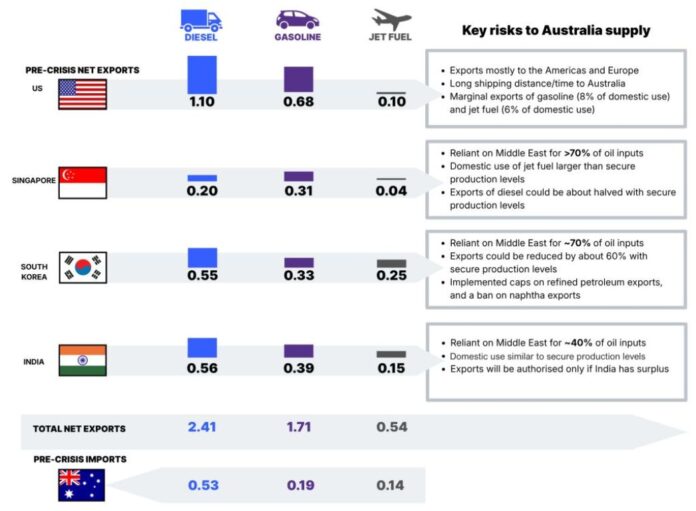
Australia’s growing reliance on imported oil is emerging as a critical energy security challenge, as declining domestic production, reduced refining capacity, and limited fuel reserves leave the country increasingly exposed to global supply disruptions, according to a report from the Institute for Energy Economics and Financial Analysis. The issue is structural rather than temporary, reflecting long-term shifts in the country’s energy system and a deepening dependence on global supply chains for diesel, gasoline, and jet fuel.
Structural decline in domestic oil capacity
Australia’s domestic oil production now accounts for only about 5.6 percent of national demand, while local refining capacity meets roughly 17 percent. This marks a sharp decline from earlier decades when the country maintained a stronger refining base.
The closure of multiple refineries has reduced the ability to process crude domestically, transforming Australia into one of the most import-dependent fuel markets among advanced economies. As a result, the country has become the world’s largest importer of diesel and holds a significant trade deficit in refined petroleum products, increasing exposure to global price volatility and supply disruptions.
Rising dependence on global supply chains
Australia’s fuel security is increasingly tied to a small group of international suppliers, including the United States, Singapore, South Korea, and India. These countries play a central role in supplying refined fuels to global markets.
Pre-crisis import levels highlight the scale of dependence, with around 0.53 million barrels per day of diesel, 0.19 million barrels per day of gasoline, and 0.14 million barrels per day of jet fuel sourced externally. However, these supply relationships are not guaranteed, as exporting nations may prioritize domestic demand or impose restrictions during periods of global stress.
Supply chain vulnerabilities and geopolitical risks
Global oil supply chains are increasingly shaped by geopolitical tensions and logistical constraints. Many of Australia’s suppliers depend on crude imports from the Middle East, exposing them to upstream disruptions.
Shipping routes spanning long distances add another layer of risk. Any disruption in maritime transport, whether due to conflict or bottlenecks, can delay or restrict fuel deliveries. Policy interventions such as export controls further increase uncertainty, underscoring the fragility of reliance on global supply networks.
Limited fuel reserves amplify exposure
Australia’s relatively low fuel reserves significantly heighten its vulnerability. As a member of the International Energy Agency, the country is expected to maintain strategic stockpiles, yet current reserves cover only around 30 days of diesel and jet fuel demand and about 39 days of gasoline consumption, Amandine Denis-Ryan, CEO of IEEFA Australia, said.
Compared with other advanced economies that maintain higher reserve levels, Australia’s limited запас provides only a short-term buffer, leaving the economy exposed to prolonged disruptions.
Policy gaps and demand-side challenges
The report highlights a lack of strong demand-side policy measures as a key weakness. While temporary steps such as fuel tax adjustments can ease consumer pressure, they do not address structural dependence on oil.
Examples from other markets show that demand-reduction strategies such as fuel rationing, reduced transport usage, and energy conservation can play a critical role during supply crises. Without similar measures, Australia remains heavily exposed to external shocks.
Energy transition and electrification trends
Global trends identified by the International Energy Agency point to a steady shift toward electrification. Electric vehicle adoption is accelerating, supported by policy incentives, infrastructure expansion, and technological progress.
At the same time, investment is flowing into renewable energy, battery storage, and grid modernization. These developments are gradually reducing oil demand growth in transport, historically one of the largest consumers of petroleum products.
Investment strategies of leading Australian energy companies
Australia’s energy sector is led by companies such as Woodside Energy, Santos, Origin Energy, and AGL Energy, which are shaping the investment landscape amid these challenges.
Woodside Energy continues to invest in large-scale LNG projects such as Scarborough while exploring low-carbon fuels, maintaining its position in global gas markets. Santos is expanding LNG capacity through projects like Barossa and investing in carbon capture and storage alongside domestic gas supply, The Australian reported.
Origin Energy and AGL Energy are accelerating investments in renewables, grid-scale batteries, and energy transition infrastructure, balancing cleaner generation with gas-fired reliability. Meanwhile, emerging players such as Tamboran Energy and Beach Energy are raising capital to expand domestic gas production, particularly in shale basins.
How companies are responding to the Iran conflict
The ongoing tensions involving Iran have intensified volatility in global energy markets, reshaping strategies for Australian energy firms.
Higher oil and LNG prices during supply disruptions have boosted revenues for exporters, but companies are also managing sharp price swings as geopolitical conditions shift. The crisis has reinforced Australia’s position as a reliable LNG supplier to Asia, while prompting renewed focus on domestic gas development to strengthen energy security.
At the same time, companies are adopting more flexible investment strategies and hedging mechanisms to navigate uncertainty. Government-industry coordination, including fuel security measures and supply chain adjustments, is also playing a critical role in managing risks.
Outlook
Australia’s energy system is at a turning point. Structural dependence on imported oil, combined with geopolitical uncertainty and limited reserves, presents a significant long-term challenge.
The findings from the Institute for Energy Economics and Financial Analysis highlight the need for a coordinated strategy that includes reducing oil demand, strengthening policy frameworks, and accelerating electrification.
As global investment shifts toward clean energy and electrification, aligning with these trends will be essential for Australia to enhance resilience, reduce exposure to external shocks, and secure a more sustainable energy future.
FASNA SHABEER
