
A report from International Energy Agency said the Middle East conflict has removed nearly 20 percent of global LNG supply, sharply disrupting gas market fundamentals and altering the medium-term outlook.
Global LNG production fell 8 percent year-on-year, or 4 bcm, in March, with loadings from Qatar and the UAE dropping by 9.5 bcm. LNG deliveries declined 2 percent in March and more than 10 percent, or over 3 bcm, in the first 20 days of April. Each month of disruption at the Strait of Hormuz results in around 10 bcm of lost LNG supply.
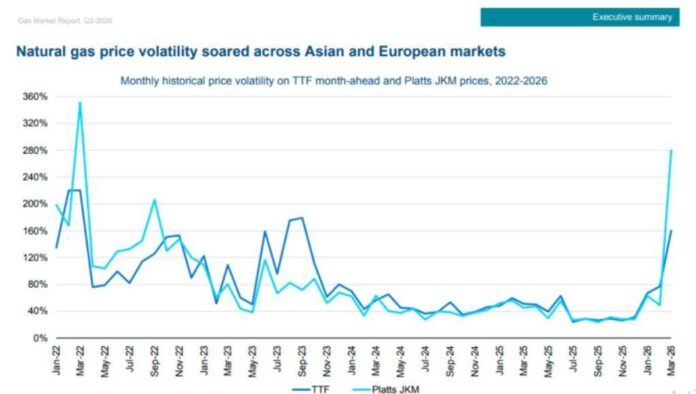
Prices surged, with Europe’s TTF averaging $18 per MBtu and Asia’s JKM nearly $21 per MBtu in March. Volatility spiked to 160 percent for TTF and nearly 300 percent for JKM. The price spread shifted from a European premium of $0.9 per MBtu to an Asian premium of $2.8 per MBtu.
Before the crisis, LNG trade had risen 12 percent year-on-year, or 29 bcm, supported by new supply such as the Plaquemines LNG project. Prices had fallen 24 percent in Europe and 27 percent in Asia during early 2026.
Asia’s gas demand increased 2 percent, while Europe’s demand declined nearly 1 percent and fell 4 percent, or 2 bcm, in March.
The IEA estimates LNG supply losses of 20 bcm during March-April, with an additional 10 bcm reduction due to delayed plant restarts. Qatar’s output could fall by nearly 70 bcm by 2030, while delays to North Field East may cut 20 bcm between 2026 and 2030.
Cumulative LNG supply losses could reach 120 bcm during 2026-2030, around 15 percent of expected supply, delaying the global LNG growth wave by at least two years.
The International Energy Agency highlights that the Middle East conflict has triggered sharp price volatility and is reshaping investment priorities across global gas and LNG markets.
Price Trends
Natural gas prices surged significantly following the disruption. Europe’s TTF prices rose to an average of $18 per MBtu in March, while Asia’s JKM prices reached about $20.7–$21 per MBtu, both hitting their highest levels since the 2022–2023 energy crisis. Prices had earlier declined by 23–27 percent in January-February due to strong LNG supply, but jumped sharply after the Strait of Hormuz disruption, with Asian prices rising 55 percent year-on-year in March. Volatility escalated, with TTF at 160 percent and JKM near 300 percent.
In the United States, Henry Hub prices spiked to an all-time high of $30.72 per MBtu during Winter Storm Fern, before easing to an average of $3.3 per MBtu later in Q1.
Investment and Supply Response
The crisis underscores the need for sustained investments across LNG infrastructure and supply chains. New LNG projects, especially in North America, previously drove 12 percent growth in global LNG trade (29 bcm), helping stabilize prices before the disruption.
In response to supply shocks, the United States approved export capacity increases at Plaquemines LNG by 13 percent (4.6 bcm per year) and Elba Island LNG by 22 percent (0.8 bcm). However, infrastructure damage and delays are expected to reduce future supply growth, including potential losses of nearly 70 bcm from Qatar by 2030 and 20 bcm from delayed expansion projects.
BABURAJAN KIZHAKEDATH
