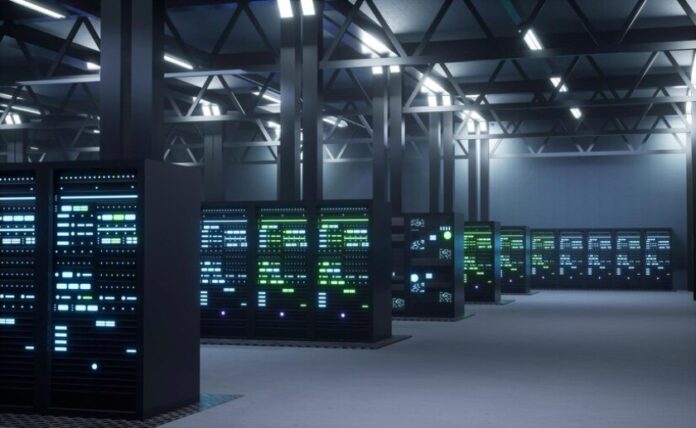
India’s artificial intelligence data-centre boom is emerging as a major new source of electricity demand, creating significant opportunities for renewable energy, battery storage, transmission networks, transformers and other power infrastructure, Wood Mackenzie report said.
Operational data-centre capacity is forecast to increase from 2.2 GW in 2025 to 12 GW by 2030, representing approximately 40 percent CAGR. Within this market, AI-dedicated capacity is projected to rise almost 24-fold from 275 MW to 6,546 MW.
The latest Wood Mackenzie report prepared by Souhardya Pal and Rashika Gupta said the bigger impact will be on India’s electricity system. Data-centre electricity consumption is forecast to surge from 10 TWh in 2025 to 191 TWh by 2040, a nearly 20-fold increase that could represent approximately 7 percent of India’s total electricity demand.
The additional 181 TWh of annual electricity consumption translates into approximately 20.7 GW of continuous average power demand, illustrating the enormous generation requirement behind India’s AI infrastructure expansion.
AI Data Centres Could Become Major Renewable Energy Buyers
The forecast 191 TWh of annual electricity demand by 2040 could create a large new market for solar, wind, hybrid renewable projects and energy storage.
If renewable energy supplied 25 percent of this electricity requirement, Indian data centres would need approximately 47.8 TWh of renewable power annually.
At a 50 percent renewable share, demand would increase to approximately 95.5 TWh, while a 75 percent renewable share would require around 143.3 TWh per year.
These are analytical scenarios rather than Wood Mackenzie forecasts, but they demonstrate the potential scale of renewable generation required if hyperscalers and data-centre operators progressively decarbonise their electricity consumption.
This could make AI data centres important long-term customers for renewable developers, particularly through captive generation and long-term power purchase agreements.
Firm Power Becomes Critical for 12 GW Data Centre Expansion
Electricity availability could become one of the biggest constraints on India’s ability to expand operational data-centre capacity from 2.2 GW to 12 GW by 2030.
AI computing requires much higher power density than conventional workloads. Data centres also need electricity continuously, meaning installed renewable capacity alone cannot guarantee the reliability required by hyperscale AI infrastructure.
Developers will increasingly need a combination of grid electricity, solar and wind generation, battery storage, backup generation and intelligent energy-management systems.
This could shift competition between data-centre locations toward access to firm, round-the-clock power at competitive prices.
Maharashtra and Tamil Nadu currently represent approximately 65 percent of installed IT load, but Andhra Pradesh, Telangana, Uttar Pradesh and Karnataka are expected to gain importance as the industry searches for new locations offering land, power, renewable resources and grid connectivity.
Adani’s 2.6 GW Pipeline Highlights Energy-to-Compute Model
AdaniConneX has a 2.6 GW data-centre development pipeline, making the Adani group an important example of how data-centre development could increasingly converge with electricity infrastructure.
Adani’s broader presence across renewable generation, power infrastructure, telecommunications, land and industrial development provides an opportunity to integrate energy supply with data-centre capacity.
For a pipeline of this scale, the key issue will not simply be constructing data-centre buildings but securing enough reliable electricity to turn announced MW into operational IT load.
This could make vertically integrated energy-to-compute infrastructure increasingly valuable as India’s AI power requirements accelerate.
Meta Targets Nearly 1 GW Renewable Energy in India
Meta’s partnership with Reliance provides another indication of how hyperscalers are linking AI infrastructure directly with renewable-energy procurement.
Meta has agreed to lease a 168 MW AI-enabled data centre being developed by Reliance in Jamnagar. The project is designed around renewable electricity and desalinated seawater for cooling.
Meta is separately pursuing nearly 1 GW of renewable-energy procurement in India.
The combination demonstrates how renewable electricity, water and cooling infrastructure are becoming part of the fundamental design of large AI data-centre projects rather than separate sustainability initiatives.
CtrlS Eyes Up to 2 GW Renewable Energy
Indian data-centre operators are also increasing their focus on clean electricity.
CtrlS is pursuing renewable-energy integration through its relationship with NTPC Green Energy, involving potential renewable capacity of up to 2 GW.
Yotta’s NM1 facility in Navi Mumbai already provides 52 MW of IT load, while Sify and AWS are among the other operators expanding infrastructure serving hyperscale, AI and enterprise workloads.
Nxtra by Airtel has approximately 300 MW of data-centre capacity and plans to expand toward 1 GW.
The growth of these platforms will add to electricity requirements alongside projects from global hyperscalers.
Google and Microsoft Investments Add to Future Power Demand
Google’s planned Visakhapatnam AI infrastructure forms part of an approximately US$15 billion India programme.
Gigawatt-scale AI development could create significant incremental requirements for electricity generation, renewable energy, substations, transmission capacity and supporting power infrastructure in Andhra Pradesh.
Microsoft has separately committed US$17.5 billion to India between 2026 and 2029 as it expands cloud and AI infrastructure.
In August 2026, Microsoft launched its India South Central cloud region in Hyderabad, taking its Indian cloud-region presence to four locations — Hyderabad, Pune, Chennai and Mumbai.
As hyperscalers expand across India, their ability to secure reliable electricity could increasingly determine project locations and commissioning schedules.
Battery Storage to Support 24/7 Renewable Power
The rapid increase in AI electricity consumption also creates an opportunity for battery energy storage systems.
Solar and wind generation are variable, while AI data centres operate continuously. Battery storage can help manage renewable intermittency, peak electricity demand, short-duration resilience and power quality.
Large data-centre campuses could therefore emerge as important customers for combinations of solar, wind, battery storage and grid power.
Hybrid renewable projects combining solar and wind could provide a better generation profile, while storage can further increase the number of hours during which clean electricity is available.
Long-term renewable PPAs could also provide data-centre operators with greater electricity-cost predictability, an important consideration because power can represent approximately 40-60 percent of data-centre operating costs.
Transformers and Grid Infrastructure Become AI Investment Opportunity
The rise toward 12 GW of operational capacity by 2030 will require major investment in the infrastructure connecting data centres to India’s electricity system.
AI campuses need high-capacity substations, transformers, switchgear, UPS systems, power-distribution equipment and transmission connections.
This means India’s AI boom could benefit not only renewable-energy developers but also transmission companies and manufacturers of transformers, switchgear, power electronics and energy-management systems.
The geographical concentration of large data-centre loads could create additional challenges. The national electricity system may have sufficient generation capacity while individual locations still face shortages of transmission capacity or delays in obtaining grid connections.
For developers, therefore, secured MW could become more valuable than announced MW.
191 TWh Forecast Turns AI Boom Into Energy Investment Story
India’s AI infrastructure expansion is increasingly becoming a power-sector investment story.
Data-centre capacity is forecast to jump from 2.2 GW in 2025 to 12 GW in 2030, while AI-specific capacity rises from 275 MW to 6,546 MW. Electricity consumption could climb from just 10 TWh to 191 TWh between 2025 and 2040, adding 181 TWh of annual demand.
Meanwhile, Meta is pursuing nearly 1 GW of renewable energy, CtrlS has a potential renewable relationship covering up to 2 GW, AdaniConneX has a 2.6 GW data-centre pipeline, Nxtra aims to expand from 300 MW toward 1 GW, and Reliance is developing the 168 MW AI facility to be leased by Meta.
The opportunity therefore extends far beyond data-centre operators. Solar and wind developers, battery-storage providers, utilities, transmission companies, transformer manufacturers and power-management technology suppliers could all benefit from AI’s rapidly expanding electricity requirements.
With power consumption potentially reaching 191 TWh and around 7 percent of India’s electricity demand by 2040, access to reliable, competitively priced and increasingly renewable electricity could become one of the most important factors determining the winners of India’s AI data-centre boom.
SHAFANA FAZAL