The global EV charging industry is entering a more demanding phase in 2026. Installing thousands of chargers is no longer enough. Charging companies increasingly need to demonstrate that their networks are reliable, heavily used, strategically located and capable of generating attractive returns on infrastructure investment.
That shift is changing how EV charging companies compete. Electricity throughput, charging sessions, utilization, charging speed, uptime and recurring software revenue are becoming as important as the number of plugs installed. Battery energy storage systems (BESS), artificial intelligence, roaming agreements and energy-management software are also emerging as competitive advantages.
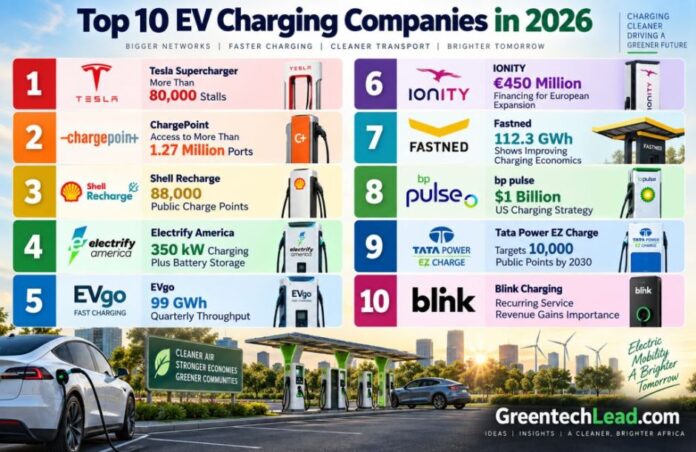
Tesla, ChargePoint, Shell Recharge, Electrify America, EVgo, IONITY, Fastned, bp pulse, Tata Power EZ Charge and Blink Charging illustrate the different business models competing for leadership in 2026.
1. Tesla Supercharger — More Than 80,000 Stalls
Tesla remains the global benchmark for large-scale fast charging.
Its Supercharger network exceeded 80,000 stalls and delivered 6.7 TWh of electricity during 2025, according to Tesla.
That electricity figure is particularly important because it measures actual network use rather than installed infrastructure.
Tesla’s biggest advantage is vertical integration. The company controls vehicles, chargers, software, payments and much of the charging experience. This allows it to optimize infrastructure around its vehicle ecosystem while progressively extending charging access to vehicles from other manufacturers.
The combination of scale, utilization and vertical integration keeps Tesla at the top of the EV charging industry in 2026.
2. ChargePoint — Access to More Than 1.27 Million Ports
ChargePoint operates a fundamentally different business model.
Rather than owning all the infrastructure connected to its platform, ChargePoint sells charging hardware, network software and services while supporting extensive roaming.
The company says drivers have access to approximately 375,000 public and private ports directly managed by ChargePoint, plus more than 900,000 roaming ports. Charging sessions on its network increased 34 percent in 2025, while approximately 190,000 additional ports became available to drivers.
That makes the ChargePoint charging ecosystem particularly important for understanding the transition of EV charging from a hardware market toward a software, services and energy-management business.
Recurring network subscriptions and fleet-management services could become increasingly important as companies seek revenue without owning every charging asset themselves.
3. Shell Recharge — 88,000 Public Charge Points
Shell Recharge benefits from the financial strength, energy expertise and retail footprint of one of the world’s largest energy companies.
Shell reported approximately 88,000 public EV charge points at the end of 2025.
Its strategy extends beyond highway fast charging to destination, fleet, workplace and urban charging.
The larger opportunity for Shell is integration. EV charging can be combined with electricity supply, convenience retail, fleet services and other mobility products.
For traditional oil companies, EV charging therefore represents more than diversification. It provides a potential route to retain mobility customers as transportation gradually shifts from liquid fuels toward electricity.
4. Electrify America — 350 kW Charging Plus Battery Storage
Electrify America remains one of the most important high-power charging networks in the United States.
Its infrastructure supports charging speeds of up to 350 kW, while the network is preparing for broader NACS/J3400 compatibility.
One particularly important element of Electrify America’s strategy is energy storage. More than 170 charging stations feature BESS, helping the company deploy higher-power charging at locations where grid capacity is constrained.
Electrify America’s experience shows why the next charging battle will involve not only chargers but also grid connections, batteries and energy management.
5. EVgo — 99 GWh Quarterly Throughput
EVgo provides one of the clearest examples of the industry’s shift from charger counts toward utilization and electricity sales.
EVgo ended Q2 2026 with 5,380 stalls in operation, up 24 percent year over year. Its charging-network revenue increased 19 percent to $61 million, while quarterly network throughput reached 99 GWh, up 13 percent.
The company had more than 1.8 million customer accounts and operated 240 NACS connectors as of July 31.
EVgo expects to add 1,350–1,625 stalls during 2026 and forecasts full-year revenue of $400 million–$430 million.
These figures illustrate an important change in the charging business. The most valuable network may not necessarily have the largest number of chargers. Electricity sold per charger and revenue generated per location increasingly determine network economics.
6. IONITY — €450 Million Financing for European Expansion
IONITY has established itself as one of Europe’s leading high-power charging specialists.
The network has more than 5,000 charging points and currently supports charging speeds of up to 400 kW. Next-generation technology is moving toward 600 kW.
IONITY secured €450 million in committed green loan facilities, with an option to increase financing by another €150 million, potentially taking the facility to €600 million.
The money supports a major expansion program targeting more than 1,300 locations and approximately 13,000 charging points by 2030.
The IONITY high-power charging network demonstrates the importance of concentrating infrastructure along heavily travelled European corridors where utilization can support large charging investments.
7. Fastned — 112.3 GWh Shows Improving Charging Economics
Fastned stands out because its 2026 financial results provide unusually clear evidence of improving charging-station economics.
The Netherlands-based company reached 434 operational stations across nine countries at the end of June after opening 28 stations during the first half of 2026.
Fastned delivered 112.3 GWh of renewable electricity, up 38 percent, while charging sessions increased 34 percent to 4.1 million. Charging-related revenue rose 40 percent to €75.1 million.
More importantly, charging gross profit jumped 61 percent to €66 million, while operational EBITDA increased 109 percent to €37.4 million.
The Fastned charging network demonstrates why investors are increasingly watching electricity throughput, charging sessions and station profitability rather than simply network size.
8. bp pulse — $1 Billion US Charging Strategy
bp pulse is using bp’s energy, retail and property partnerships to build an ultra-fast charging business.
bp has outlined a $1 billion US EV charging investment through 2030, including approximately $500 million approved for investment over a multi-year period.
Its partnership with Simon Property Group covers more than 900 ultra-fast charging bays at 75 locations across the United States.
bp pulse is also bringing chargers to selected Waffle House locations. Each site is expected to feature six 400 kW chargers, supporting CCS and NACS connections.
The strategy highlights the growing importance of location economics. Shopping centers, restaurants and travel hubs combine charging demand with customer dwell time, potentially creating revenue for both charging operators and host locations.
9. Tata Power EZ Charge — India Charging Network Targets 10,000 Public Points
Tata Power has created one of India’s broadest integrated EV charging ecosystems.
The latest company figures show more than 6,700 public and captive charging points, 250,000 home chargers and 1,200 bus charging points across more than 690 cities and towns.
By 2030, Tata Power is targeting 10,000 public charging points and 750,000 home chargers.
Its advantage is diversification. Tata Power serves home charging, public infrastructure, commercial fleets, electric buses and highway charging rather than relying exclusively on one segment.
The Tata Power EZ Charge network also benefits from Tata Power’s broader electricity and renewable-energy businesses, providing opportunities to combine charging infrastructure with clean power and energy management.
10. Blink Charging — Recurring Service Revenue Gains Importance
Blink Charging is repositioning around owner-operated DC fast charging and recurring services.
During Q1 2026, Blink had 27 DC fast-charging sites approved or under construction, representing 136 planned stalls.
Its financial results demonstrate why recurring revenue matters.
Blink generated $20.8 million in Q1 2026 revenue, while service revenue increased 25 percent to $13.3 million.
EV Charging Investment Shifts Toward Utilization
The investment race remains significant, but capital expenditure alone no longer identifies the strongest EV charging companies.
IONITY has €450 million in committed green financing with the potential to reach €600 million, while bp has outlined a $1 billion US charging investment through 2030. Electrify America is combining high-power chargers with BESS, and Fastned continues to invest in new European stations.
The critical question is increasingly what happens after chargers are installed.
EVgo’s 99 GWh quarterly throughput and Fastned’s 112.3 GWh half-year electricity delivery provide useful indicators of network activity. Tesla’s 6.7 TWh annual Supercharger electricity delivery demonstrates the potential economics of a network operating at enormous scale.
EV Charging Prices in 2026: Speed Versus Cost
Price remains one of the most difficult metrics for comparing EV charging companies.
Charging tariffs vary by country, electricity market, time, station and membership plan. Operators can also charge by kWh, minute or session depending on local regulations.
Consequently, there is no single “cheapest EV charging network” globally.
Subscription programs can reduce per-kWh costs for frequent users, while occasional drivers may accept higher prices in exchange for ultra-fast charging at convenient highway locations.
The real consumer calculation is increasingly price + charging speed + reliability + location.
A cheaper 150 kW charger may not necessarily offer better value than a more expensive 350–400 kW charger if the vehicle can accept high charging rates and the faster station substantially reduces travel time.
What Will Define EV Charging Winners Through 2030?
Charging power will continue increasing toward 400–600 kW for passenger vehicles and potentially much higher levels for commercial vehicles. But simply installing faster chargers will create another problem: electricity demand.
Battery storage can help reduce peak loads and enable high-power stations where grid connections are limited. Solar generation, dynamic energy pricing and smart charging could further improve station economics.
AI is also likely to play a larger role in predicting demand, optimizing electricity purchases, balancing loads and identifying charger failures before they disrupt customers.
Meanwhile, NACS/J3400, CCS, Plug & Charge, roaming and digital-payment integration will make interoperability an increasingly important competitive factor.
The EV charging company of the future will therefore look less like a conventional filling-station operator and more like a combination of an energy company, infrastructure operator and software platform.
EV Charging Market Outlook
The EV charging industry in 2026 is becoming more commercially disciplined.
Tesla leads in dedicated fast-charging scale and vertical integration. ChargePoint has created a huge managed-and-roaming ecosystem. Shell Recharge and bp pulse can leverage global energy and retail infrastructure, while Electrify America and EVgo remain important forces in US fast charging.
IONITY and Fastned are strengthening Europe’s high-power corridors. Tata Power is building a diversified charging ecosystem across India, while Blink is emphasizing owner-operated infrastructure and recurring service revenue.
By 2030, however, charger count alone is unlikely to determine leadership.
Utilization, electricity throughput, strategic locations, charging speed, reliability and capital efficiency will decide which networks create sustainable businesses.
The defining question is no longer who can install the most EV chargers. It is who can turn those chargers into a scalable and profitable energy network.
SHAFANA FAZAL