Global sales of new energy vehicles (NEVs) — including battery electric vehicles, plug-in hybrid electric vehicles and fuel-cell vehicles — reached 5.37 million units in the second quarter of 2026, increasing 10.4 percent year over year, according to TrendForce.
When conventional hybrid electric vehicles are included, the four electrified powertrain categories represented a record 33.2 percent of worldwide vehicle sales. The figures show that electrification continues to gain ground despite weaker demand in China and growing trade barriers in major automotive markets.
TrendForce forecasts global NEV sales will reach approximately 23.4 million units in 2026, representing 14 percent annual growth. However, competition is becoming more fragmented as Chinese automakers expand overseas and established Japanese, European, Korean and US manufacturers introduce new electric models.
China’s Share of Global NEV Sales Falls from 66 Percent to 56 Percent
China remained the world’s largest NEV market in 2Q26, but its share of global sales dropped from 66 percent in 2Q25 to 56 percent. The 10-percentage-point decline reflects weaker Chinese domestic demand and faster electrification growth in other markets.
China also represented approximately 66 percent of worldwide NEV sales for the full year of 2025. However, its annual growth slowed to 24 percent because of a high comparison base and changing government incentives.
Western Europe has emerged as an important alternative growth market. Regional NEV sales increased almost 30 percent in 2025, the fastest growth recorded since 2022.
The changing geographic mix means Chinese automakers can no longer depend entirely on domestic scale. Export volumes, overseas factories, local distribution, product adaptation and international partnerships are becoming critical measures of long-term competitiveness.
BYD Regains Global BEV Leadership and Retains PHEV Lead
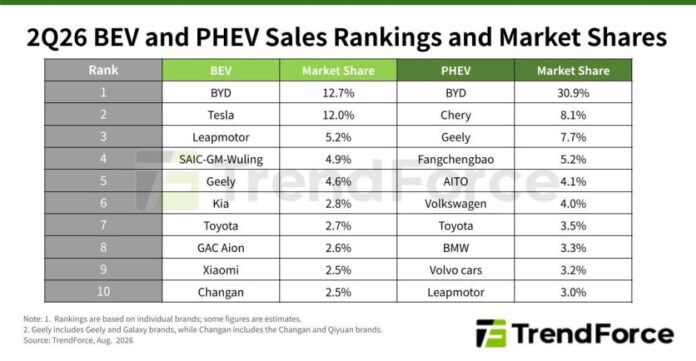
BYD reclaimed first place in global battery electric vehicle sales during 2Q26, although its BEV volume remained below the previous year. The year-over-year decline was nevertheless substantially narrower than in the first quarter.
BYD retained its leading position in the global PHEV market and increased the market-share gap over competing brands. Its presence in both BEVs and PHEVs provides a broader product and pricing strategy than manufacturers concentrated primarily on fully electric vehicles.
BYD’s export-to-production ratio reached 44 percent during the first half of 2026, demonstrating the growing contribution of international markets. BYD exported 170,897 passenger NEVs from China in June alone, increasing 98.8 percent year over year and 9.6 percent month over month. It captured approximately 34.2 percent of China’s passenger NEV exports during the month.
BYD’s international growth is increasingly central to its strategy as competition and pricing pressure intensify in China.
Tesla BEV Sales Increase 25 Percent but Company Falls to Second Place
Tesla dropped to second place in the global BEV ranking despite recording 25 percent sales growth during 2Q26. The result followed Tesla’s return to first place in the opening quarter of 2026, illustrating the close and rapidly changing competition between Tesla and BYD.
Tesla retains major advantages in brand recognition, software, charging infrastructure and global manufacturing. However, its comparatively limited product portfolio exposes the company to growing competition from manufacturers offering electric cars across more price segments and body styles.
BYD’s return to first place demonstrates that BEV leadership is no longer determined solely by early technology advantages. Product variety, battery costs, manufacturing efficiency, regional pricing and the ability to expand rapidly across overseas markets have become equally important.
Leapmotor Enters Global BEV Top Three for the First Time
Leapmotor climbed to third place in quarterly global BEV sales for the first time in 2Q26. Its sales remain concentrated in China, but its partnership with Stellantis gives the company access to established production, distribution and marketing infrastructure in Europe.
Stellantis is a major shareholder in Leapmotor and supports the Chinese automaker’s international expansion through the Leapmotor International joint venture. This structure allows Leapmotor to combine competitively priced Chinese EV technology with the overseas experience of a global automotive group.
The company’s rise shows how alliances can accelerate international expansion without requiring a Chinese manufacturer to build every element of its overseas operations independently. Similar partnerships could become more important as automakers respond to tariffs, localisation requirements and the cost of building international sales networks.
Toyota BEV Sales Jump 143 Percent as Volkswagen Drops from Top 10
Toyota ranked seventh in global BEV sales during 2Q26 after recording a 143 percent increase — the highest growth rate highlighted among the leading manufacturers by TrendForce.
The company used its extensive global sales and distribution network to introduce new electric models across multiple markets. Toyota’s electrification portfolio also includes hybrids, PHEVs and fuel-cell vehicles, allowing it to address different consumer requirements and regional infrastructure conditions.
Volkswagen, by comparison, dropped out of the global BEV top 10 for the first time. The result highlights the pressure facing European automakers from Tesla, rapidly expanding Chinese brands and Japanese manufacturers accelerating their BEV launches.
Manufacturing scale alone is no longer enough to protect market position. Pricing, battery efficiency, software quality, new-model frequency and the ability to respond to regional demand are increasingly determining BEV rankings.
Chinese Brands Capture Nearly 30 Percent of Western European PHEV Market
Chinese brands, excluding Volvo Cars, captured nearly 30 percent of Western European PHEV sales in 2Q26. Competition below market leader BYD was particularly close, with the market-share differences among most brands remaining below 1 percentage point.
The figures demonstrate that Chinese manufacturers are challenging European automakers in plug-in hybrids as well as fully electric vehicles. PHEVs remain attractive to customers seeking electric urban driving without depending entirely on public charging infrastructure for longer journeys.
Europe has also become strategically important because Chinese domestic PHEV sales are weakening. Unlike China-made BEVs, which can face additional European Union duties, Chinese-built PHEVs were not covered by the additional tariffs referenced in the TrendForce assessment.
Chinese brands captured around 14.2 percent of Western European BEV sales during the first five months of 2026. Their 171,800 BEV registrations represented an increase of almost 5 percentage points in market share compared with the same period of 2025.
Chery Strengthens European Presence with UK R&D and Production Plans
Chery plans to open a research and development centre at UTAC Millbrook in Bedfordshire during late autumn 2026. The facility will initially focus on chassis development, vehicle handling and driver-assistance systems adapted to British roads, with future work expected to cover autonomous driving and artificial intelligence.
The company has also signed a non-binding agreement with Nissan to examine contract manufacturing of Chery passenger vehicles at Nissan’s Sunderland plant from fiscal 2027. Nissan will retain ownership of the factory, which employs approximately 6,000 people.
Chinese-owned brands represented around 15 percent of new UK vehicle registrations in 2026, up from approximately 10 percent a year earlier. Chery’s Omoda and Jaecoo brands increased their combined UK market share from around 3 percent to nearly 8 percent by July.
Chery exported approximately 202,000 of the 280,000 vehicles it sold globally in July, with exports increasing 70 percent year over year.
Geely, Chery and SAIC Expand China’s NEV Export Competition
BYD is not the only Chinese automaker recording rapid export growth. Chery exported 73,819 NEVs from China in June 2026, increasing 177.8 percent year over year and 18.3 percent month over month. The company captured 14.8 percent of China’s passenger NEV exports.
Geely’s NEV exports reached 61,550 units during June, surging 713.2 percent year over year and 54.6 percent from May. Geely accounted for 12.3 percent of the export market.
Together, BYD, Chery and Geely controlled approximately 61.3 percent of China’s passenger NEV exports in June. SAIC’s MG brand is also strengthening its position in Europe and other overseas markets.
Chinese manufacturers are moving beyond vehicle exports toward local engineering, distribution partnerships and manufacturing. This localisation can reduce transport costs, improve product adaptation and limit exposure to trade restrictions.
International Scale Will Decide the Next NEV Market Leaders
The 5.37 million NEVs sold in 2Q26 and the record 33.2 percent electrified share of global vehicle sales confirm that automotive electrification continues to expand. However, the competitive centre of the market is shifting from domestic Chinese scale toward international execution.
BYD has reclaimed BEV leadership, maintained its PHEV advantage and raised its export-to-production ratio to 44 percent. Tesla remains a major competitor with 25 percent growth, Leapmotor has entered the global top three, and Toyota has increased BEV sales by 143 percent. Volkswagen’s departure from the top 10 illustrates how quickly established positions can weaken.
China’s share of global NEV sales falling from 66 percent to 56 percent does not necessarily indicate declining Chinese influence. Instead, Chinese automakers are becoming more international, capturing nearly 30 percent of Western European PHEV sales and expanding through exports, partnerships, R&D centres and potential overseas production.
SHAFANA FAZAL