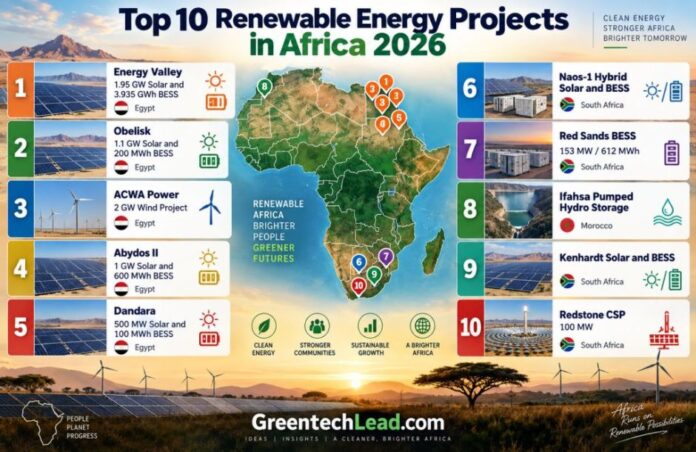
Africa’s renewable energy market is entering a more investment-intensive phase in 2026 as large solar, wind and storage projects move closer to construction, financing and grid connection.
The strongest projects are no longer based on generation capacity alone. Developers are combining solar and wind with battery storage, long-term power purchase agreements, industrial offtake, electricity wheeling and grid infrastructure.
Egypt is emerging as one of Africa’s largest renewable-energy hubs, particularly for gigawatt-scale solar, wind and BESS. South Africa is developing a different model around corporate PPAs, mining demand and private electricity supply, while Morocco is investing in long-duration storage.
Africa still receives less than 2 percent of global clean-energy investment despite holding around 60 percent of the world’s best solar resources, highlighting both the financing gap and the scale of the opportunity.
This ranking focuses on capacity, storage, investment, financing progress, 2026 milestones and strategic importance.
1. Energy Valley — 1.95 GW Solar and 3.935 GWh BESS, Egypt
Scatec’s Energy Valley is one of Africa’s largest integrated renewable-energy developments.
The project combines 1.95 GW of solar PV with approximately 3.935 GWh of battery storage under a 25-year, US dollar-denominated power purchase agreement with the Egyptian Electricity Transmission Company.
The solar facilities are expected to generate approximately 6,000 GWh annually.
The Scatec Energy Valley project is Scatec’s largest investment and one of Africa’s biggest solar-plus-storage developments. Financial close is targeted for the second half of 2026.
Its scale also demonstrates how Egypt is moving from standalone solar toward renewable systems capable of supplying power more predictably.
2. Obelisk — 1.1 GW Solar and 200 MWh BESS, Egypt
Scatec’s Obelisk project combines 1.1 GW of solar PV with a 100 MW/200 MWh battery system.
The project carries estimated capital expenditure of around $590 million and is backed by a 25-year PPA with EETC.
Obelisk is important because it demonstrates how battery storage can become part of the commercial structure of large solar projects rather than being treated as a separate grid investment.
Its financing also provides a template for other African solar-plus-storage projects seeking development-bank and commercial capital.
3. ACWA Power — 2 GW Wind Project, Egypt
ACWA Power is developing a 2 GW wind farm in Egypt with an estimated investment of approximately $2.3 billion.
The project is supported by a 25-year PPA with EETC and is expected to become Egypt’s largest wind facility. Financial close is targeted for 2026.
The ACWA Power Egypt wind project strengthens the company’s existing presence in the country, where it already operates solar assets.
The 2 GW wind project is particularly valuable for Egypt because wind generation can complement its rapidly expanding solar capacity and improve the diversity of renewable supply.
4. Abydos II — 1 GW Solar and 600 MWh BESS, Egypt
AMEA Power’s Abydos II combines 1 GW of solar PV with 600 MWh of battery storage, making it one of Africa’s largest integrated renewable projects.
A key 2026 milestone was the successful completion of reverse power transmission through the project’s 500 kV substation, supporting trial operation and full grid connection.
The BESS allows electricity generated during high-output solar periods to be shifted to times of stronger demand.
Abydos II also strengthens AMEA Power’s growing African portfolio, which includes renewable projects across Egypt, South Africa, Togo and Côte d’Ivoire.
5. Dandara — 500 MW Solar and 100 MWh BESS, Egypt
Dandara stands out because it links renewable generation directly with industrial electricity demand.
The first phase comprises 500 MW of solar and 100 MWh of battery storage in Qena. Total project cost is expected to exceed $290 million.
The African Development Bank approved financing of up to $66 million, including $46 million from its own resources and $20 million from the Clean Technology Fund.
The African Development Bank financing for Dandara highlights the important role of development finance in African renewable projects.
EgyptAlum will be the sole offtaker under a 25-year PPA. Dandara is expected to generate around 1,373 GWh annually and avoid approximately 0.5 million tonnes of CO2 emissions each year.
6. Naos-1 Hybrid Solar and BESS — South Africa
SOLA’s Naos-1 represents South Africa’s rapidly expanding private renewable-energy market.
The project combines approximately 435 MWp of solar PV with large-scale battery storage and around 300 MW of peak electrical output.
Financial close was achieved in February 2026, with Sasol and Air Liquide among the principal customers.
Naos-1 is structured around private electricity supply and wheeling rather than conventional utility procurement.
This model is gaining momentum in South Africa as mining and industrial companies seek lower-cost and lower-carbon electricity through long-term corporate PPAs.
7. Red Sands BESS — 153 MW / 612 MWh, South Africa
Red Sands shows why battery storage is becoming a major infrastructure category of its own.
The project is designed with approximately 153 MW of power capacity and 612 MWh of storage.
Unlike solar-plus-storage facilities, Red Sands is primarily intended to provide grid flexibility, balancing, frequency response and renewable integration.
As South Africa installs more wind and solar capacity, large standalone batteries can absorb excess renewable generation and shift electricity into higher-demand periods.
Projects such as Red Sands could therefore become critical to maintaining grid stability as renewable penetration rises.
8. Ifahsa Pumped Hydro Storage — Morocco
Morocco’s Ifahsa project brings long-duration storage into Africa’s renewable investment mix.
The World Bank approved $265 million in financing in July 2026 to support the pumped-hydropower project and strengthen Morocco’s power-system flexibility.
The World Bank’s Ifahsa hydropower financing highlights the growing importance of storage technologies beyond lithium-ion batteries.
Pumped hydro can shift electricity over much longer periods than conventional BESS and can help grids absorb larger quantities of variable solar and wind power.
9. Kenhardt Solar and BESS — South Africa
Scatec’s Kenhardt complex remains one of Africa’s most important operating benchmarks for dispatchable solar energy.
The development combines 540 MW of solar with 225 MW/1,140 MWh of BESS and was designed to supply up to 150 MW of dispatchable electricity for extended periods each day.
Kenhardt represents approximately $1 billion in investment and operates under a 20-year PPA with Eskom.
Although it was developed before 2026, its operational performance remains highly relevant because it demonstrates how large batteries can transform intermittent solar generation into a more predictable electricity product.
10. Redstone CSP — 100 MW, South Africa
ACWA Power’s Redstone project provides another model for long-duration renewable power.
The 100 MW concentrated solar power facility uses molten-salt thermal storage capable of approximately 12 hours of full-load energy storage.
Unlike conventional solar PV paired with batteries, CSP stores solar energy as heat and can continue generating electricity after sunset.
Redstone therefore adds technological diversity to Africa’s storage market alongside lithium-ion BESS and pumped hydropower.
Egypt and South Africa Lead Africa’s Renewable Investment
The Top 10 projects reveal two very different renewable-energy investment models.
Egypt is increasingly focused on gigawatt-scale solar, wind and BESS, supported by long-term utility PPAs and development finance.
South Africa is moving faster toward corporate PPAs, electricity wheeling, mining demand and standalone batteries.
Morocco, meanwhile, is emphasizing long-duration storage to support greater renewable penetration.
The leading developers — including Scatec, ACWA Power, AMEA Power, Masdar, Infinity Power and EDF Renewables — are increasingly competing not only on generation capacity but also on financing, storage, grid access and quality of offtake.
Renewable Power Is Becoming Industrial Infrastructure
One of the biggest changes in Africa’s renewable market is the growing link between clean electricity and industrial demand.
Dandara is tied directly to aluminum production. Naos-1 is backed by large industrial customers. Mining companies across South Africa are developing renewable portfolios to reduce electricity costs and carbon emissions.
Renewable power is also becoming important for green hydrogen, desalination, data centers, mineral processing and manufacturing.
That means Africa’s renewable opportunity is moving beyond replacing fossil-fuel generation. Clean power is increasingly becoming part of the continent’s industrial-development strategy.
Africa Renewable Energy Outlook to 2030
Africa’s most valuable renewable-energy projects are likely to become more integrated through the end of the decade.
Large solar and wind developments will increasingly need battery storage, long-duration storage, transmission capacity, credible offtakers and industrial demand to reach financial close.
The strongest projects in 2026 already show this transition.
Energy Valley combines almost 2 GW of solar with nearly 4 GWh of battery storage. Dandara links clean electricity directly to industry. Naos-1 demonstrates the growth of private power procurement, while Red Sands and Ifahsa highlight the need for grid-scale flexibility.
Africa’s renewable-energy story is therefore evolving from a race to install megawatts into a broader competition to build bankable, dispatchable and commercially useful clean-energy infrastructure.
SHAFANA FAZAL