
Japan can significantly reduce its dependence on imported oil and strengthen long-term energy security by accelerating electric vehicle (EV) adoption, according to a new report from the Institute for Energy Economics and Financial Analysis (IEEFA). The report argues that reducing oil demand through transport electrification offers a more sustainable solution to energy security challenges than relying solely on crude oil supply diversification.
The analysis comes as Japan faces renewed concerns over global oil supply disruptions linked to tensions in the Middle East and the closure of the Strait of Hormuz, one of the world’s most critical oil shipping routes. While Japan has responded through strategic petroleum reserve releases, alternative crude sourcing, and gasoline subsidies, IEEFA believes the country remains highly exposed to global oil market volatility.
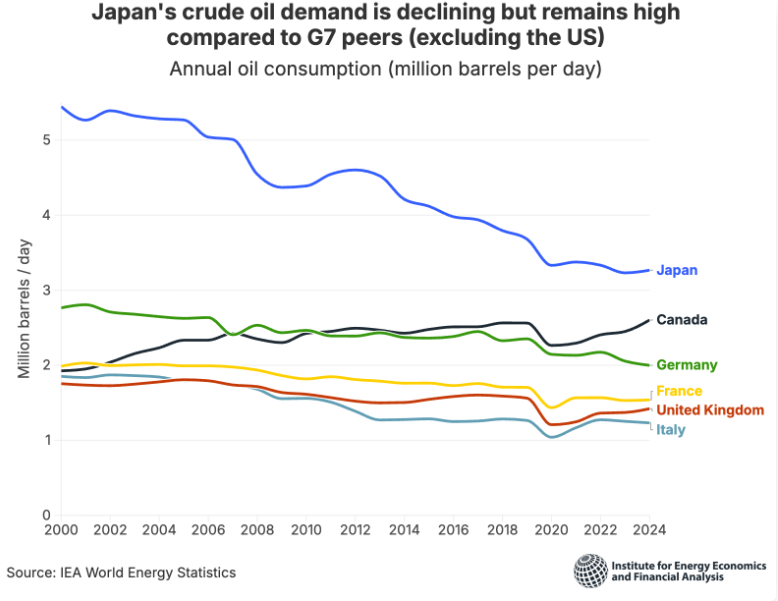
Despite a significant reduction in oil consumption over the past two decades, oil remains Japan’s largest energy source. The country’s oil demand fell by approximately 40 percent between 2000 and 2024, declining from more than 5.3 million barrels per day in 2000 to around 3.3 million barrels per day in 2024. Nevertheless, oil still accounted for 34.5 percent of Japan’s primary energy supply in 2024, making the country the second-largest oil consumer among G7 nations after the United States.
Japan’s dependence on imported crude remains substantial, with approximately 94 percent of crude oil imports sourced from the Middle East. This reliance exposes the country to geopolitical tensions, shipping disruptions, and oil price fluctuations. In 2025 alone, Japan spent more than JPY9 trillion on crude oil imports, underscoring the economic burden of energy dependence.
Transportation remains one of the largest consumers of petroleum products. Gasoline, diesel, and jet fuel represented nearly 60 percent of Japan’s total petroleum consumption in 2023. According to IEEFA, reducing transportation fuel demand through EV adoption would lower exposure to international oil markets, improve Japan’s trade balance, and reduce the need for emergency fuel subsidies during supply shocks.
However, Japan continues to lag behind other major economies in EV adoption. Electric vehicles accounted for only 3-4 percent of new passenger vehicle sales between 2022 and 2024, the lowest penetration rate among G7 countries. This contrasts sharply with rapid EV adoption in China and Europe, where electrification is increasingly viewed as both a climate and energy security strategy.
Japan’s automotive industry is now accelerating investments in electric mobility and battery manufacturing. Toyota Motor Corporation remains the country’s largest EV investor, committing approximately JPY245 billion through battery subsidiaries Prime Planet Energy & Solutions and Primearth EV Energy to expand solid-state and prismatic battery production. The investment will add around 9 GWh of battery manufacturing capacity, with facilities in Hyogo and Fukuoka scheduled to begin production in 2026. Toyota aims to commercialize solid-state battery EVs between 2027 and 2028 and has set a target of selling 1.5 million battery electric vehicles annually.
Honda Motor Co. has unveiled plans to invest approximately JPY10 trillion through fiscal 2031 in EV development, software-defined vehicles, battery technologies, and manufacturing capacity. Honda is targeting annual EV production of about 2 million vehicles while increasing the share of electric and fuel-cell vehicles in its global sales portfolio.
Nissan Motor Co. continues expanding its electrification strategy through domestic battery investments. Nissan plans to establish lithium-iron-phosphate battery production in Kyushu with annual capacity of approximately 5 GWh by 2028. The company also aims to secure 135 GWh of global battery production capacity by the early 2030s. Government support for Nissan’s battery projects could exceed JPY55 billion.
Battery manufacturing leader Panasonic Energy is investing approximately JPY463 billion in battery production projects with automakers including Subaru and Mazda. The company targets 16 GWh of annual battery capacity at a new facility in Gunma Prefecture by 2030, alongside an additional 4 GWh from facilities in Osaka. Panasonic is also developing next-generation batteries expected to improve energy density by about 25 percent.
Automakers including Subaru Corporation, Mazda Motor Corporation, and Mitsubishi Motors Corporation are also expanding EV programs and battery partnerships to remain competitive in the global electric mobility market.
Japan’s battery ecosystem is attracting substantial public and private investment. The Ministry of Economy, Trade and Industry has approved subsidies covering more than one-third of several battery manufacturing projects, supporting efforts to increase annual domestic battery production capacity from approximately 80 GWh to 120 GWh. Combined investments from Toyota, Honda, Nissan, Panasonic, Subaru, Mazda, and their partners exceed JPY950 billion.
The energy sector is also contributing to the EV transition. Idemitsu Kosan is investing JPY21.3 billion in a lithium sulphide production facility that will supply materials for Toyota’s solid-state batteries. The plant is expected to produce enough material annually for batteries used in approximately 50,000 to 60,000 electric vehicles.
IEEFA also highlights the untapped potential of Japan’s used EV market. Many used EVs are currently exported overseas rather than sold domestically. The organization recommends introducing battery health certification systems and standardized assessments to improve consumer confidence and make EV ownership more affordable.
According to IEEFA, transport electrification offers multiple benefits beyond emissions reduction. Wider EV adoption could reduce Japan’s oil import bill, strengthen energy security, support domestic battery manufacturing, create new industrial opportunities, and protect consumers from global oil price volatility. As geopolitical risks continue to threaten energy supply chains, the report concludes that shifting government support from gasoline subsidies toward EV incentives may represent one of Japan’s most effective long-term energy security strategies.
FASNA SHABEER
