
COP31 has brought renewed attention to multibillion-dollar green hydrogen projects in Saudi Arabia, Oman, India, Australia, Europe and North Africa. However, the gap between announced investments and operational production remains substantial. Global clean hydrogen projects have attracted more than $130 billion in committed investment, but operational capacity is only 1.7 million tonnes annually, according to the Hydrogen Council’s 2026 assessment.
The IEA Global Hydrogen Review 2026 reports that global hydrogen demand exceeded 100 million tonnes in 2025, while actual low-emissions hydrogen production remained below 1 million tonnes.
Worldwide installed electrolyser capacity exceeded 4 GW in 2025, doubling from the previous year. China accounted for nearly three-quarters of new installations.
The difference between actual production, installed capacity and future project commitments is central to evaluating the green hydrogen industry’s progress at COP31 in Antalya, Turkiye.
Global Hydrogen Projects: $130 Billion Committed, but Investment Decisions Remain Limited
The Hydrogen Council’s Global Hydrogen Compass 2026 identifies 579 clean hydrogen projects that have reached final investment decision (FID), entered construction or begun operations, out of approximately 1,950 announced projects.
Committed investment
$130B
Projects at FID or beyond
579
Committed production capacity
6.9 Mtpa
Operational production capacity
1.7 Mtpa
Source: Hydrogen Council, Global Hydrogen Compass 2026. Figures cover renewable and other low-emissions hydrogen pathways; operational capacity is not actual annual output.
The IEA estimates that the announced low-emissions hydrogen production pipeline for 2030 has contracted to 27 million tonnes annually, following project cancellations and delays.
Only slightly more than 6 million tonnes of potential annual production is associated with committed projects or projects considered likely to become operational by 2030. Approximately 22 million tonnes of announced capacity risks missing the 2030 deadline unless investment decisions accelerate.
Saudi Arabia: $8.4 Billion NEOM Project Nears Commercial Production
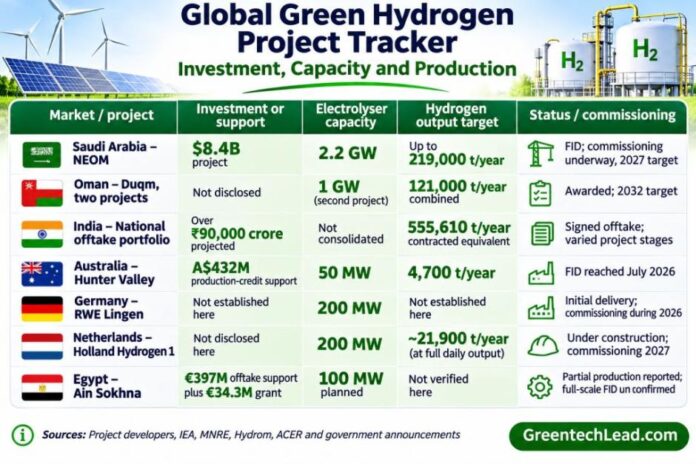
Saudi Arabia’s NEOM Green Hydrogen Project is among the most advanced large-scale developments.
The $8.4 billion project, developed by ACWA Power, Air Products and NEOM, includes approximately 2.2 GW of electrolysers supported by 4 GW of wind and solar generation.
The facility targets up to 600 tonnes of hydrogen daily, equivalent to approximately 219,000 tonnes annually at full-year operation, with planned green ammonia production of approximately 1.2 million tonnes annually.
The project reached FID in 2023, and Air Products has a 30-year ammonia offtake agreement. Construction was reported complete in August 2026, with commissioning underway and commercial operations targeted for 2027.
NEOM is therefore substantially more advanced than projects that have only secured land or announced investment plans. However, commercial output and sustained deliveries remain to be demonstrated.
Oman: COP31 Agreements Target 121,000 Tonnes of Hydrogen Annually
Oman announced two new green hydrogen projects in Duqm during COP31, targeting combined annual production of approximately 121,000 tonnes by 2032.
According to Oman’s Ministry of Foreign Affairs, the projects were awarded under Hydrom’s third auction round on November 13, 2026.
The first project, involving Petrogas E&P and Bio3Energy, targets 625,000 tonnes of green ammonium nitrate annually, using approximately 50,000 tonnes of green hydrogen and 1.16 GW of renewable energy capacity.
The second project, involving PLN Indonesia Power Renewables, Alawi Enterprises and HBA Offshore International, targets 400,000 tonnes of green ammonia annually using 1.45 GW of solar capacity and 1 GW of electrolysers.
Hydrom’s COP31 project announcement also details incentives including a 90 percent reduction in land lease fees during development and potential corporate tax exemptions of up to ten years.
These are project awards, not confirmed final investment decisions. Project-specific financing, construction commencement and binding offtake contracts remain important milestones.
India: ₹90,000 Crore Investment Pipeline Backed by Hydrogen Offtake Contracts
India has made measurable progress in securing demand for green hydrogen and its derivatives.
The Ministry of New and Renewable Energy’s October 29, 2026 disclosure confirms 23 signed offtake contracts covering 555,610 tonnes of green hydrogen equivalent annually.
These agreements could support more than ₹90,000 crore, approximately $9.5 billion, in investment.
Major agreements include ACME’s 488,000-tonne annual green ammonia contract with Japan’s IHI, L&T and ITOCHU’s planned 300,000-tonne annual ammonia supply arrangement starting in December 2029, and Reliance Industries’ green ammonia supply agreement with Samsung C&T valued at more than $3 billion.
Under the National Green Hydrogen Mission, 670,000 tonnes of annual green ammonia supply have also been awarded to 11 fertilizer units, while 30,000 tonnes of annual hydrogen supply have been awarded to refineries. These procurement volumes should not be added to the 555,610-tonne total without checking for overlapping contracts.
India’s target remains 5 million tonnes of green hydrogen production annually by 2030. Signed offtake commitments represent approximately 11 percent of that ambition, but do not establish that corresponding production capacity is already financed or operational.
Australia: 50 MW Hunter Valley Project Reaches FID as Larger Projects Face Setbacks
Australia demonstrates the difference between large announced projects and commercially sanctioned facilities.
Orica’s Hunter Valley Hydrogen Hub reached FID in July 2026. The project includes 50 MW of electrolysers supplied by Plug Power and targets approximately 4,700 tonnes of renewable hydrogen annually.
It has received A$432 million in Hydrogen Headstart production-credit support and will supply hydrogen to Orica’s existing ammonia manufacturing operations.
Meanwhile, Australia’s Murchison Green Hydrogen Project envisages 6 GW of renewable hydrogen production infrastructure and has been awarded A$814 million under Hydrogen Headstart. An FID was targeted for 2026, but a completed investment decision was not verified in the reviewed sources.
Not every large Australian proposal has survived. Stanwell discontinued its involvement in the Central Queensland Hydrogen Project in June 2025, while the separate A$4.7 billion H2-Hub Gladstone project’s coordinated-project declaration lapsed in August 2026.
Australian Renewable Energy Agency (ARENA)+1
Europe: 3.3 GW Reaches FID, but Industrial Demand Remains a Constraint
The European Union’s 2026 Clean Hydrogen Valleys assessment identifies more than 600 MW of operational electrolyser capacity across Europe, with approximately 3.3 GW having passed FID.
More than 800 MW reached FID during 2025 alone.
Germany’s GET H2 Nukleus project provides evidence of physical delivery. In August 2026, renewable hydrogen produced at RWE’s Lingen electrolysers reached Evonik’s Marl Chemical Park through approximately 120 kilometres of pipeline infrastructure. RWE is commissioning 200 MW of electrolysis capacity by the end of 2026.
In the Netherlands, Shell’s 200 MW Holland Hydrogen 1 project targets approximately 60 tonnes of hydrogen daily for its Pernis refinery, with commissioning now expected to begin in 2027.
The EU energy regulator ACER’s 2026 hydrogen market report finds that all 15 of the EU’s largest electrolyser projects reaching FID relied on some form of public support.
North Africa: Egypt Secures Long-Term Offtake, but Commercial Scale-Up Is Slow
Egypt’s Ain Sokhna green hydrogen project, developed by Scatec and partners, includes a planned 100 MW electrolyser facility.
The project secured a 20-year green ammonia offtake agreement involving Fertiglobe following an H2Global auction award. The arrangement is linked to approximately €397 million in support for ammonia purchases, while the European Commission awarded an additional €34.3 million grant in 2026.
Egypt’s government reported partial hydrogen production in January 2026, but a full-scale FID and commercial production milestone for the expanded project were not confirmed in the reviewed disclosures.
The IEA estimates that only one of Africa’s 31 low-emissions hydrogen projects announced for 2030 had reached FID at the time of its 2026 assessment.
COP31 Green Hydrogen: Which Projects Are Most Likely to Reach Production?
The evidence points to three categories.
Advanced projects: NEOM, RWE Lingen and Australia’s Hunter Valley have achieved major construction, financing or operational milestones. NEOM has a long-term offtake arrangement, Lingen has demonstrated physical hydrogen delivery, and Hunter Valley has reached FID with an identified industrial customer.
Projects with contracted demand but execution risk: India’s green ammonia and hydrogen portfolio and Egypt’s Ain Sokhna project have secured significant offtake commitments, but full-scale commissioning and financing remain project-specific challenges.
Early-stage developments: Oman’s newly awarded Duqm projects have identified developers, capacity targets and potential industrial markets, but must still demonstrate bankable financing, construction progress and firm demand.
The IEA reports that only about 20 percent of newly signed low-emissions hydrogen offtake volumes in 2025 were backed by firm contractual commitments. This explains why announced production capacity continues to exceed projects reaching investment decisions.
The decisive COP31 finding is that green hydrogen investment is advancing, but operational production remains far below announced ambitions. Projects with secured buyers, government support, financing and access to renewable electricity are better positioned to reach commercial production than those relying primarily on export projections.
For investors, the most useful indicators are FID completion, installed electrolyser MW, verified production, binding offtake volumes and actual commissioning dates—not the headline value of proposed hydrogen investments.
BABURAJAN KIZHAKEDATH
