
COP31 negotiations in Antalya, Turkiye, have intensified scrutiny of the world’s largest oil and gas companies as governments debate how quickly fossil fuels should be replaced by renewable energy. A comparison of capital expenditure, renewable power capacity and investment commitments shows that traditional oil and gas production continues to dominate corporate spending, even as several energy majors expand into solar, wind, battery storage and low-carbon electricity.
Brazil presented its voluntary fossil-fuel transition roadmap at COP31 on November 10, proposing country-specific measures to reduce dependence on coal, oil and natural gas.
The United Nations’ COP31 energy transition report confirms that the roadmap addresses fossil-fuel demand, production, supply and the economic consequences of transitioning away from conventional energy.
However, Saudi Arabia, Russia and other fossil-fuel-producing countries have resisted stronger commitments to restrict oil and gas production. The Reuters report on COP31 negotiations highlights continuing divisions over binding transition commitments.
Corporate investment figures provide a more measurable indication of how energy companies are responding to the transition.
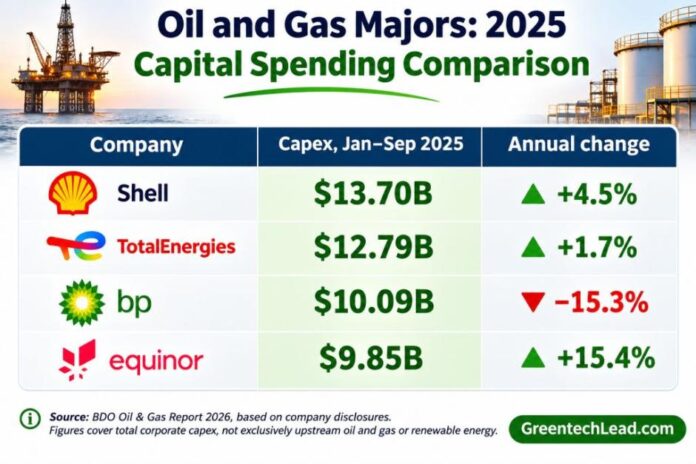
Oil and Gas Majors: 2025 Capital Spending Comparison
A comparison of capital expenditure in the first nine months of 2025 illustrates the scale of investment by four European energy companies.
The BDO Oil & Gas Report 2026 found that capital expenditure among 17 major European oil and gas companies increased 2.1 percent during the first nine months of 2025.
The four companies above collectively invested approximately $46.43 billion during the period. However, this total includes different business activities and cannot be classified entirely as fossil-fuel investment.
Shell: $9.3 Billion Upstream Capex Versus $2 Billion Low-Carbon Investment
Shell’s 2025 annual report reveals total cash capital expenditure of $20.9 billion.
Of this, $9.3 billion was allocated directly to its Upstream segment, while $2 billion was classified as low-carbon energy solutions. The low-carbon category includes renewable power, EV charging, green hydrogen, carbon capture and nature-based solutions, so renewable electricity spending alone was lower than $2 billion.
Shell also invested $4.6 billion in LNG, gas and power marketing and trading and $12.3 billion in its oil, oil products and other category, which includes upstream investment. These classifications overlap with business segments and should not be added together.
For 2026, Shell expects approximately $12–14 billion of combined Integrated Gas and Upstream capex.
In August 2026, Shell agreed to sell a European onshore renewable-energy portfolio to TotalEnergies, covering approximately 0.5 GW of operational and development-stage capacity plus additional projects. The transaction remains subject to regulatory approvals.
BP: $10 Billion Annual Oil and Gas Investment, Less Than $800 Million for Low Carbon
BP provides one of the clearest comparisons between fossil-fuel and low-carbon investment.
According to BP’s official investment guidance, the company expects to invest approximately $10 billion annually in oil and gas through 2027, compared with less than $800 million annually in low-carbon energy, including renewables, hydrogen and carbon capture.
Its transition investment guidance of $1.5–2 billion annually includes bioenergy and EV charging.
BP plans to start three additional major upstream projects by the end of 2027 and eight to ten more by the end of 2030, following seven project start-ups in 2025.
This indicates that BP’s capital allocation is substantially weighted toward oil and gas, even though it retains renewable-energy investments and partnerships.
TotalEnergies: 19 GW of Net Renewable Capacity and $4 Billion Annual Power Investment Strategy
TotalEnergies has built a larger renewable-power generation business than several European oil majors.
Its 2025 Universal Registration Document reports 19 GW of net installed renewable generation capacity at year-end 2025, compared with 15.1 GW in 2024.
Renewable electricity production increased to 31.4 TWh from 26 TWh, while the company’s total net installed power capacity reached 26 GW, including 7 GW of flexible gas generation.
Its gross renewable portfolio reached 108.7 GW, including 34.1 GW of installed capacity. The larger portfolio figure includes projects not yet operational and interests held through associated companies.
TotalEnergies has outlined an approximately $4 billion annual Integrated Power investment strategy covering renewables, flexible gas generation, storage and related electricity activities. This is not equivalent to $4 billion of renewable-only capex.
Equinor: Maintains $10 Billion Annual Oil and Gas Spending While Cutting Power Investment
Equinor reported $13.1 billion of organic capital expenditure in 2025.
In its 2025 full-year financial results, Equinor announced a $4 billion reduction in its combined 2026–2027 organic capex outlook, mainly affecting power and low-carbon activities.
Meanwhile, the company plans to maintain approximately $10 billion in annual oil and gas investment.
Equinor expects oil and gas production to increase approximately 3 percent in 2026. Its renewable capital spending is focused primarily on offshore wind projects already under execution.
The spending reduction demonstrates that offshore wind development remains exposed to project economics, financing costs and capital allocation decisions.
Saudi Aramco: $50–55 Billion Capex Planned for 2026, With Upstream Dominating
Saudi Aramco reported $52.2 billion in capital investment during 2025 and expects to invest $50–55 billion in 2026.
According to Saudi Aramco’s 2025 financial results presentation, its medium-term capital allocation framework assigns:
65–70 percent to upstream projects.
20–25 percent to downstream activities.
5–10 percent to new energies and other businesses.
The 5–10 percent category includes activities beyond renewable energy and cannot be interpreted as renewable-only investment.
Applying the medium-term upstream allocation to the 2026 capex range gives an indicative $32.5–38.5 billion, but this is an illustration rather than company-issued 2026 upstream guidance.
ADNOC: $150 Billion Capex Plan and Masdar’s 100 GW Ambition
ADNOC’s board approved a $150 billion capital expenditure programme for 2026–2030, covering existing operations and business expansion.
The ADNOC board announcement also confirmed investments supporting the company’s oil and gas production strategy.
ADNOC has allocated $23 billion to decarbonization and lower-carbon solutions, although this is not a renewable-only capex figure and should not be added to the five-year programme without checking its accounting scope.
Through its shareholding in Masdar, ADNOC participates in a renewable-energy platform reporting approximately 65 GW of capacity in operation or development, with a target of 100 GW by 2030. The 65 GW figure is not exclusively operating capacity and is not attributable entirely to ADNOC.
Which Oil Majors Are Investing Most in Renewable Energy?
| Company | Oil and gas investment indicator | Renewable/low-carbon indicator |
| Shell | $9.3B upstream capex, 2025 | $2B low-carbon solutions, 2025 |
| BP | ~$10B/year oil and gas guidance | Under $800M/year low-carbon guidance |
| TotalEnergies | Upstream-only capex not verified here | 19 GW net operating renewables, 2025 |
| Equinor | ~$10B/year oil and gas guidance | $4B reduction in 2026–27 capex outlook, mainly power and low carbon |
| Saudi Aramco | 65–70% medium-term upstream allocation | 5–10% new energies and other businesses |
| ADNOC | $150B total capex plan, 2026–30 | Masdar’s 65 GW operating/development portfolio |
Sources: Company annual reports and capital-allocation disclosures. Periods and accounting definitions differ; this is not a like-for-like renewable capex ranking.
COP31 Fossil Fuel Transition: Corporate Spending Remains the Key Test
The investment disclosures indicate three different corporate approaches.
BP, Shell and Equinor are prioritizing upstream investment and tighter capital discipline in lower-carbon businesses. TotalEnergies has established a substantial operating renewable-electricity portfolio while continuing oil and gas development. Saudi Aramco and ADNOC are maintaining large hydrocarbon investment programmes alongside investments in lower-carbon technologies and renewable-energy platforms.
The most important distinction is between renewable capacity already operating, projects sanctioned for construction, development pipelines and investment commitments that have not yet resulted in expenditure.
TotalEnergies demonstrates measurable renewable generation at scale, while BP’s published guidance shows a particularly large imbalance between oil and gas and low-carbon spending. However, a definitive ranking of all six companies by renewable capex would require comparable, separately disclosed 2025 and 2026 renewable-only investment figures, which are not available across all six.
For COP31, the decisive measure of the fossil-fuel transition will be whether future corporate capital expenditure shifts toward commissioned renewable generation, storage and electricity infrastructure—or continues to support expanding oil and gas production.
BABURAJAN KIZHAKEDATH
