
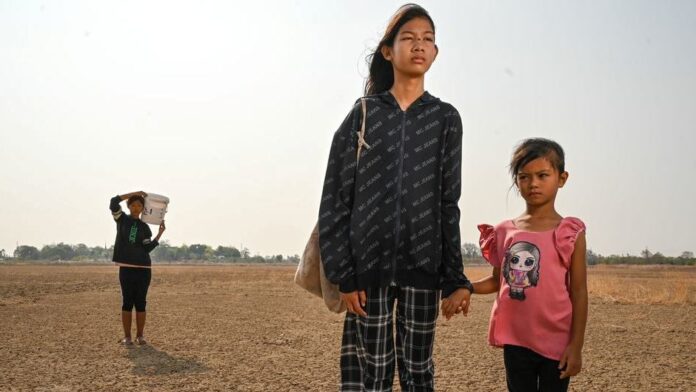
The World Meteorological Organization (WMO) has warned that rising global temperatures, record ocean heat, accelerating sea-level rise and a potentially exceptionally strong El Nino could intensify climate-related disasters through 2027.
According to the WMO State of the Climate Update 2026, the global average surface temperature during January–September 2026 was approximately 1.47°C above the 1850–1900 pre-industrial average.
The report, released ahead of the COP31 climate summit in Turkiye, indicates that the past 12 years have been the warmest on record, with the most recent four years occupying the highest positions.
The emerging El Nino event could push global temperatures higher toward the end of 2026 and increase the risks of heatwaves, extreme rainfall, tropical cyclones and agricultural disruption during 2027.
India Heatwave Exposes 146.5 Million People to Extreme Temperatures
India experienced one of the year’s major extreme-weather events in April 2026, when approximately 146.5 million people were exposed to severe heat, with temperatures reaching 47°C in affected areas.
Extreme heat increases electricity demand for cooling, places additional pressure on power distribution networks and raises health risks for outdoor workers and vulnerable populations.
Europe also experienced devastating heatwaves during the summer of 2026. Provisional estimates cited in the climate update suggest more than 30,000 excess deaths across Europe during the summer, including approximately 16,000 during the June 22–28 heatwave.
The figures demonstrate the growing importance of heatwave early-warning systems, urban cooling infrastructure, climate-resilient electricity networks and public-health preparedness.
Ocean Heat Reaches New Records as El Nino Strengthens
The WMO estimates that oceans absorb approximately 90 percent of the excess heat trapped in Earth’s climate system by greenhouse gases.
Ocean heat content reached a record high in 2025 and continued increasing during 2026, putting the world on course for a tenth consecutive year of record ocean warmth.
WMO Secretary-General Celeste Saulo explained that El Nino does not create additional planetary heat but redistributes existing ocean heat into the atmosphere.
The development is significant because unusually warm oceans can influence rainfall patterns, marine heatwaves, tropical cyclone intensity and global temperature anomalies.
The NOAA El Nino and La Nina monitoring programme provides additional information about the El Nino–Southern Oscillation, which influences seasonal weather conditions across the Pacific and other regions.
Global Sea Levels Rise as Glaciers Lose Over 400 Gigatons of Ice
Global mean sea level reached a record high in 2026, according to the WMO update, continuing a long-term acceleration driven by ocean warming and melting land ice.
Glaciers worldwide lost more than 400 gigatons of ice during 2025, equivalent to approximately 1 millimetre of global sea-level rise.
Antarctic sea ice recorded its third-lowest winter maximum, while Arctic sea ice reached its lowest or second-lowest level in the observational record.
The NASA sea-level monitoring programme tracks changes in global sea level using satellite observations and scientific measurements.
Glacier retreat also increases risks in high-mountain regions. Rapid ice loss, unstable slopes and glacial lakes can contribute to destructive floods and landslides, threatening communities, hydropower infrastructure and transportation networks.
The WMO update highlighted a catastrophic ice-and-rock collapse and subsequent flash flooding in Nepal during August 2026, illustrating the compound hazards associated with warming Himalayan environments.
Greenhouse Gas Concentrations Continue Rising
Atmospheric concentrations of carbon dioxide, methane and nitrous oxide reached new records in 2025 and continued increasing during 2026.
Compared with pre-industrial concentrations around 1750, the WMO reported the following increases:
| Greenhouse gas | Increase since 1750 |
| Carbon dioxide (CO₂) | 53% |
| Methane (CH₄) | 167% |
| Nitrous oxide (N₂O) | 26% |
The continued accumulation of greenhouse gases is the principal driver of long-term global warming, independent of short-term natural climate fluctuations such as El Nino.
The WMO Greenhouse Gas Bulletin provides additional scientific data on atmospheric greenhouse gas concentrations and their long-term trends.
Global Freshwater Storage Declines Across 42 Percent of Assessed Areas
The WMO reported that terrestrial freshwater storage has declined globally since 2014, affecting groundwater, rivers, reservoirs, soil moisture, snow and glaciers.
In 2025, 42 percent of the assessed global area recorded below-normal terrestrial water storage, compared with a long-term average of 25 percent.
The decline has implications for drinking-water availability, irrigation, hydropower generation and industrial water consumption.
El Nino is also increasing agricultural risks in regions dependent on rainfall, particularly countries already experiencing food insecurity.
El Nino Could Push Global Temperatures to New Records in 2027
The WMO expects the developing El Nino to remain influential into early 2027, with the potential to raise global temperatures and intensify extreme-weather risks.
El Nino events typically increase annual global mean temperatures by approximately 0.1°C–0.2°C. The strongest temperature impact often occurs in the year following the event’s development.
The WMO said tropical Pacific sea-surface temperature anomalies could approach 2°C during November 2026–January 2027, indicating an exceptionally strong event.
The organization also reported that 2024 remains the warmest year on record, at approximately 1.55°C above the pre-industrial average, compared with 1.43°C in 2025.
These figures indicate that 2027 could challenge existing temperature records, although the final outcome will depend on the evolution of El Nino and other climate conditions.
Climate Early-Warning Systems Expand to 136 Countries
The number of countries reporting multi-hazard early-warning systems increased from 56 in 2015 to 136 in 2025, according to the WMO.
These systems support forecasts and alerts for heatwaves, floods, storms and other weather-related hazards.
At COP31 in Antalya, Turkiye, taking place November 9–20, 2026, governments are discussing climate adaptation, emissions reductions, financing and investments in weather observation and early-warning infrastructure.
The WMO’s final State of the Global Climate 2026 report is scheduled for publication in March 2027, incorporating additional climate observations and assessments of extreme-weather impacts.
BABURAJAN KIZHAKEDATH
