
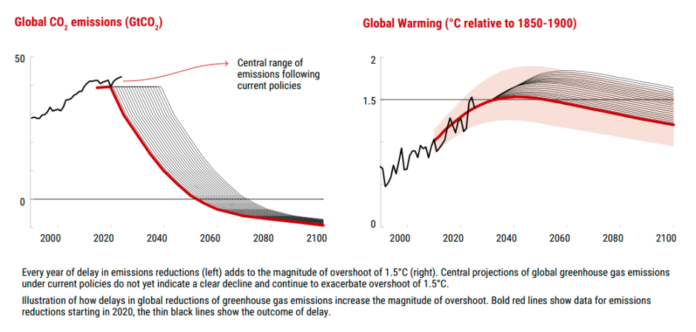
The world is approaching a critical new phase of climate change in which global warming is likely to cross 1.5°C above pre-industrial levels within the next few years, according to the United Nations Environment Programme (UNEP).
UNEP’s 2026 report, Limiting Overshoot: Navigating Exceedance of 1.5°C and Pathways Towards Return, indicates existing climate action has not reduced greenhouse gas emissions fast enough to prevent an overshoot. Even an optimistic scenario in which governments fully implement national climate plans and additional net-zero commitments points to peak warming of around 1.8°C.
UNEP stresses that exceeding 1.5°C should not be regarded as an acceptable new target. The priority is to minimise how far temperatures rise above 1.5°C, shorten the duration of the overshoot and eventually bring warming back down, while dramatically strengthening climate adaptation.
Here are 10 key findings and figures from the UNEP climate overshoot report.
1. Global Warming Is Likely to Cross 1.5°C Within Years
The central warning is that the world has effectively entered an era in which climate policy must prepare for an overshoot of the Paris Agreement’s 1.5°C temperature goal.
UNEP says global efforts have made progress, but emissions reductions have been insufficient to prevent global warming from exceeding 1.5°C within the next few years. Even if current national climate plans and additional net-zero pledges are fully implemented, expected peak warming is still approximately 1.8°C.
The strategy therefore changes from simply avoiding 1.5°C to approaching the target “from above”: limiting peak warming and subsequently reducing temperatures.
2. Every 0.1°C of Avoided Warming Has Major Economic and Human Value
UNEP’s message is that the difference between 1.5°C, 1.6°C, 1.7°C and higher warming levels cannot be dismissed as marginal.
Every additional fraction of a degree avoided — and every year by which the period above 1.5°C can be shortened — can save lives, protect ecosystems and reduce economic losses.
This makes faster deployment of renewable energy, energy efficiency, electrification, methane reduction and other emissions-cutting technologies increasingly important even if a temporary 1.5°C overshoot becomes unavoidable.
3. Glaciers Could Lose More Than 25% of Their Mass by 2100
The consequences of overshoot are particularly serious for the world’s cryosphere.
UNEP says glaciers could lose more than one-quarter of their mass by 2100. Under warming of up to or below 3°C, this could contribute approximately 9 to 12.5 centimetres of sea-level rise.
Such losses would also permanently alter water availability in many regions dependent on glaciers for freshwater.
The report also highlights growing risks surrounding the Greenland and West Antarctic ice sheets, permafrost, sea ice and other climate-sensitive systems.
4. Climate Change Could Cut Global Food Production by Up to 14% by 2050
Food security emerges as another major economic and social risk.
Projections cited by UNEP indicate that global food production could decline by as much as 14 percent by 2050 without effective adaptation.
Agriculture faces interconnected pressures from extreme heat, drought, changing rainfall, flooding and shifting ecosystems. Water security is also expected to deteriorate in vulnerable regions.
The impact goes beyond food supply. UNEP expects more intense heatwaves, nutrition-related diseases and pathogen spillover risks to increase illness and mortality.
5. Small Islands and Coastal Cities Face Potential Submersion
Some of the greatest risks will fall on Small Island Developing States and low-lying coastal cities.
UNEP warns that some locations could face partial or complete submersion as sea levels continue rising.
The consequences extend to housing, transport infrastructure, water supplies, livelihoods and national economies. Insurance costs and financial-system stress could also rise as climate-related losses become more frequent.
Crucially, falling global temperatures after an overshoot would not automatically reverse sea-level rise or restore communities already displaced.
6. Returning to 1.5°C Requires Net-Negative CO₂ Emissions
UNEP describes an “overshoot, peak and decline” pathway in which temperatures first exceed 1.5°C, reach a peak and then decline toward the Paris target.
The global response would require three overlapping phases. Immediate action focuses on deep emissions reductions, particularly CO₂, methane and other short-lived climate pollutants. As temperatures peak, the world needs sustained decarbonisation reaching at least net-zero emissions. The longer-term phase requires sustained net-negative CO₂ emissions, alongside continuing adaptation and resilience investment.
Net zero, therefore, becomes a milestone rather than the endpoint of climate policy.
7. Carbon Removal Cannot Replace Rapid Emissions Cuts
Carbon dioxide removal (CDR) will be required to bring temperatures down, but UNEP warns against treating carbon removal as an alternative to emissions reductions.
Both conventional approaches such as afforestation and ecosystem restoration and emerging technologies including bioenergy with carbon capture and storage and direct-air carbon capture could contribute.
However, the numbers demonstrate the scale of the challenge. At today’s scale, UNEP estimates it would take more than 100 years of afforestation and forest management — combined with zero residual CO₂ emissions — to reduce warming by just 0.1°C.
Even optimistic expansion of carbon removal is unlikely to reverse warming by more than a few tenths of a degree during this century.
8. Keeping Peak Warming Below 1.8°C Could Be Critical
The feasibility of returning to 1.5°C deteriorates as peak warming increases.
UNEP says carbon removal can credibly contribute to bringing temperatures below 1.5°C during this century only if peak warming remains well below 2°C and residual emissions of CO₂, methane and other greenhouse gases are substantially reduced.
Once warming moves beyond around 1.8°C, returning to 1.5°C during the 21st century becomes increasingly challenging.
This finding puts greater emphasis on near-term investment because delaying emissions cuts increases both peak warming and dependence on future carbon-removal technologies.
9. Net Zero Could Eventually Put Huge Pressure on CO₂ Storage
Carbon capture and geological storage face physical constraints as well as cost and deployment challenges.
UNEP says that simply maintaining net-zero CO₂ emissions could exhaust currently estimated geological storage capacity in sedimentary basins by 2200.
This reinforces the report’s argument against assuming that large future carbon-removal projects can compensate indefinitely for continued fossil-fuel emissions.
CDR expansion also creates potential competition for land, energy, water and other resources, requiring stronger governance and careful consideration of development and equity.
10. Returning Below 1.5°C Will Not Reverse All Climate Damage
Perhaps the most important warning is that temperature reversal does not equal climate restoration.
Even if global warming eventually falls below 1.5°C, some impacts could be permanent. UNEP highlights continued sea-level rise, species extinction and ecosystem regime shifts among consequences that may persist long after peak warming.
Communities may already have relocated, livelihoods could have changed and agricultural systems may have been redesigned for a warmer climate. Infrastructure constructed for more extreme conditions could later require another transition.
This makes adaptation and mitigation inseparable. UNEP says mitigation limits future damage, while adaptation protects societies against warming that has already occurred or can no longer be prevented.
Climate Investment Must Shift From Net Zero to Overshoot Management
The UNEP report fundamentally changes the climate investment discussion. The challenge is increasingly not simply reaching net zero, but managing an extended pathway of overshoot, peak warming, net zero, net-negative emissions and potentially declining temperatures.
The diagram on page 4 of the report’s executive section illustrates this transition particularly clearly: immediate emissions reduction and adaptation are followed by deep decarbonisation toward net zero, and ultimately sustained net-negative CO₂ emissions designed to reverse warming.
That pathway increases the importance of investment in renewable energy, grids, storage, electrification, energy efficiency, methane reduction, resilient infrastructure, ecosystem restoration and credible carbon-removal technologies.
But UNEP’s strongest message is that technology deployed decades from now cannot compensate easily for insufficient action today. The magnitude and duration of the 1.5°C overshoot will largely be determined by how quickly emissions fall now.
The 1.5°C objective therefore remains relevant even if the threshold is exceeded. The economic and environmental priority becomes keeping peak warming as low as possible, spending as little time as possible above 1.5°C and preserving a realistic pathway to eventually bring global temperatures back down.
BABURAJAN KIZHAKEDATH
