
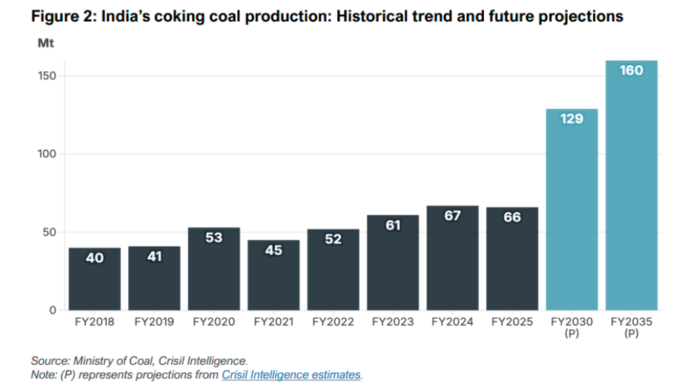
India’s push to become a global steel manufacturing hub is accelerating domestic coking coal production, but expanding underground mining is also increasing methane emissions. A new report from the Institute for Energy Economics and Financial Analysis (IEEFA) concludes that most of these emissions can be reduced using commercially proven and affordable technologies, enabling India to strengthen energy security while advancing its climate goals.
According to the IEEFA report, Methane Abatement in India’s Coking Coal Push: Opportunities and Costs, methane emissions are concentrated in a small number of underground mines, making targeted mitigation both technically feasible and economically attractive. Focused investments could significantly reduce greenhouse gas emissions while improving mine safety, operational efficiency and energy utilization.
India’s growing steel industry is expected to increase demand for domestic coking coal, driving greater reliance on underground mining. Unlike surface mining, underground coking coal extraction encounters methane-rich geological formations, resulting in substantially higher methane emissions.
Data from the International Energy Agency’s Global Methane Tracker 2026 shows that India’s coking coal mining operations emitted approximately 234.7 kilotonnes of methane in 2025. The report estimates methane intensity from coking coal mining at 5.1 kilograms of methane per tonne of coal equivalent, around 50 percent higher than steam coal mining, which records 3.4 kilograms per tonne of coal equivalent.
One of the report’s key findings is the concentration of emissions. Of India’s 30 operating coking coal mines, only seven mines account for 81 percent of total methane emissions. Nearly all of these high-emitting mines are located in Jharkhand, making the state the country’s primary hotspot for methane reduction efforts. This concentration allows policymakers and mining companies to prioritize high-impact projects instead of implementing costly nationwide mitigation programs.
The analysis also highlights the strong economics of methane reduction. Approximately 87 percent of India’s abatable coal mine methane emissions can be reduced for less than USD 20 per tonne of carbon dioxide equivalent, a cost level that aligns with International Energy Agency assessments of global methane reduction opportunities. According to IEEFA, financing is not the principal barrier, with policy support, faster project execution and wider deployment of proven technologies expected to deliver the largest gains.
Coal mine methane utilization represents the single largest opportunity for emissions reduction. The report estimates that methane utilization accounts for 33 percent of India’s total methane abatement potential. Capturing methane before it escapes into the atmosphere allows it to be used as an industrial energy source rather than being released as a potent greenhouse gas.
Additional mitigation options include methane drainage systems, dedicated methane abatement facilities, flaring excess methane, improving combustion efficiency and deploying ventilation air methane oxidation technologies. Together, these solutions provide a practical pathway to reduce emissions while improving resource efficiency.
The report emphasizes methane’s significant impact on climate change. Scientific assessments indicate methane has contributed approximately 30 percent of global warming since the Industrial Revolution, making it the second-largest contributor after carbon dioxide. According to the Intergovernmental Panel on Climate Change (IPCC), methane has a Global Warming Potential of 84 to 87 over 20 years and 27 to 30 over 100 years, highlighting the importance of rapid mitigation.
Without stronger action, global human-caused methane emissions could increase by up to 13 percent between 2020 and 2030. In contrast, pathways aligned with limiting global warming to 1.5 degrees Celsius require methane emissions to decline by 30 percent to 60 percent below 2020 levels by 2030.
The report also places India’s challenge in a global context. In 2024, the energy sector generated more than 40 percent of global human-caused methane emissions, totaling approximately 375 million tonnes. Oil and gas operations accounted for 56 percent of these emissions, while coal production contributed 29 percent, equivalent to approximately 39 million tonnes.
India’s steel and mining companies are already advancing cleaner coal utilization initiatives. Tata Steel has completed a pioneering industrial pilot involving the continuous injection of Coal Bed Methane into a blast furnace at its Jamshedpur steel plant, demonstrating how captured methane can partially replace coking coal while reducing emissions. Bharat Coking Coal Limited (BCCL), a subsidiary of Coal India Limited, remains India’s largest producer of prime coking coal and operates several underground mines in Jharkhand, positioning it at the center of future methane mitigation efforts.
Meanwhile, Steel Authority of India (SAIL) is developing the 4 million tonnes per annum Tasra coking coal block to strengthen domestic raw material security, while JSW Steel continues progressing toward its target of 38 million tonnes per annum of steelmaking capacity by 2030, increasing the strategic importance of reliable domestic coking coal supplies.
The report — prepared by Purva Jain, Lead Energy Specialist – Gas & International Advocacy, South Asia at IEEFA, and Saumya Nautiyal, Energy Finance Analyst – Steel Sector, South Asia — recommends a phased methane reduction strategy focused on Jharkhand’s highest-emitting underground mines, noting that 87 percent of abatable methane emissions can be reduced for less than USD 20 per tonne of carbon dioxide equivalent, making cost-effective mitigation immediately achievable.
As India expands its steel industry, prioritizing methane reduction at the country’s seven highest-emitting mines, increasing coal mine methane utilization and deploying proven abatement technologies can lower greenhouse gas emissions, improve mine safety, enhance energy efficiency and support the long-term competitiveness of the domestic steel sector while advancing national climate objectives.
SHAFANA FAZAL
