
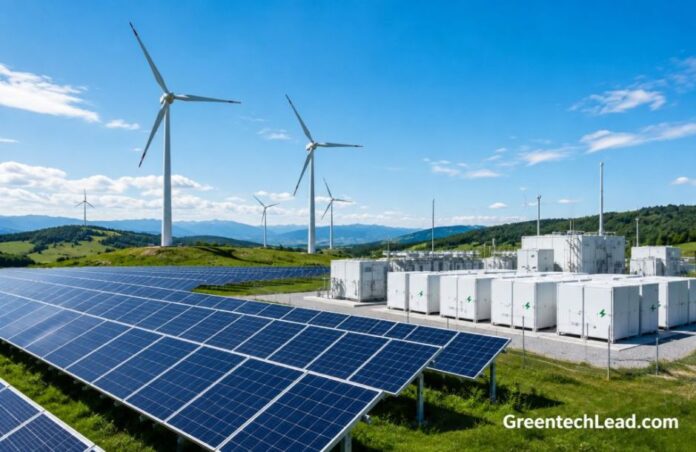
India’s energy transition has reached a critical stage at COP31 as the country balances rapid renewable energy expansion with rising electricity demand, coal-fired power development and growing investment requirements for transmission networks and battery storage. Government data shows that India had 147.72 GW of renewable capacity under construction and 47.55 GW of thermal capacity under construction as of June 2026, highlighting its dual strategy of expanding clean electricity while retaining conventional generation for energy security.
India’s position at COP31 in Antalya, Turkiye, reflects the challenge of meeting climate commitments without restricting industrial development, electricity access and economic growth.
According to a Reuters report on COP31 negotiations, major fossil-fuel producers and consumers have resisted binding targets for transitioning away from oil, gas and coal. India has opposed measures that could constrain its development and energy choices.
Turkey’s COP31 presidency is promoting a target to increase electricity’s share of global final energy consumption to 35 percent by 2035. However, the proposal does not require all additional electricity to come from renewable sources, leaving countries flexibility over their generation mix.
India’s Renewable Capacity Reaches 299 GW, Including Large Hydro
The NITI Aayog India Climate and Energy Dashboard, drawing on Ministry of New and Renewable Energy (MNRE) and Central Electricity Authority (CEA) data, reports that India’s renewable energy capacity, including large hydro, reached 299.25 GW by September 2026.
Renewable capacity excluding large hydro stood at 247.18 GW, while total installed electricity generation capacity reached 558.90 GW.
India’s electricity infrastructure, September 2026
Total installed power capacity
558.90 GW
Renewables including large hydro
299.25 GW
Renewables excluding large hydro
247.18 GW
Electricity generated, Apr–Sep 2026
1,055.72 BU
Source: NITI Aayog India Climate and Energy Dashboard. BU = billion units, equivalent to TWh.
India’s CEA September 2026 renewable energy progress report also identifies 42.11 GW of solar park and ultra-mega renewable energy project capacity envisaged as of June 2026. Of this, 21.70 GW had been commissioned, 8.67 GW was under construction and 11.16 GW was under award or tendering.
These figures demonstrate the size of India’s solar development pipeline, although planned capacity cannot be counted as operating generation.
Coal Capacity Could Reach 315 GW by 2035–36
Despite renewable expansion, India expects coal and lignite power plants to remain important for electricity reliability.
The Ministry of Power’s August 2026 parliamentary disclosure estimates that India will require approximately 315 GW of coal and lignite generation capacity by 2035–36.
As of June 30, 2026, the country had:
47.55 GW of thermal capacity under construction, including stressed projects.
16 GW of thermal capacity awarded but not yet under construction.
21.08 GW of thermal capacity commissioned since April 2023.
The government envisages adding at least 105 GW of coal and lignite capacity to meet its longer-term requirements.
In September, senior Indian power officials indicated that coal could still account for approximately half of national electricity generation in 2035–36, even with a substantial increase in renewable capacity.
This distinction is important: renewable energy may represent a growing majority of installed generating capacity without producing a corresponding majority of electricity, because coal plants generally operate for more hours than solar installations.
India’s Solar Capacity Adds 20.79 GW in Six Months
India’s solar capacity increased from 150.26 GW in March 2026 to 171.05 GW in September 2026, representing an addition of approximately 20.79 GW during the first half of FY2026–27.
Wind capacity increased from 56.09 GW to 59.20 GW, an addition of approximately 3.11 GW.
The MNRE’s FY2025–26 performance report confirms that India added a record 55.29 GW of non-fossil generation capacity in the previous financial year, including 44.61 GW of solar and 6.05 GW of wind.
Actual Electricity Generation Shows Why Coal Remains Important
Installed capacity alone does not reflect the electricity available to consumers.
According to the CEA’s September 2026 renewable generation report, India generated 304.24 billion units of renewable electricity, including large hydro, between April and September 2026.
Solar generation reached 119.68 billion units, increasing 47.1 percent year over year, while wind generation increased 9.7 percent to 79.81 billion units.
Renewable electricity generation excluding large hydro reached 210.24 billion units, an increase of 26 percent.
| Electricity indicator | April–September 2026 |
| Total electricity generation | 1,055.72 BU |
| Solar generation | 119.68 BU |
| Wind generation | 79.81 BU |
| Renewable generation including large hydro | 304.24 BU |
| Renewable share of total generation | 28.8% |
The comparison demonstrates that renewable sources represented 53.5 percent of installed capacity in September but supplied approximately 28.8 percent of electricity during April–September.
The capacity and generation figures cover different measurement periods, but they illustrate why dispatchable power, storage and grid flexibility remain necessary.
Power Grid Plans ₹37,000 Crore Capex in FY2026–27
The CEA’s Annual Report 2025–26 estimates that India requires approximately ₹9.16 lakh crore in transmission investment during FY2022–23 to FY2031–32.
This corresponds to an average planning requirement of ₹91,600 crore annually over ten years, although actual expenditure will vary by project and commissioning schedule.
The national transmission plan envisages approximately 1.91 lakh circuit kilometres of additional lines, 1,274 GVA of transformation capacity and 33.25 GW of HVDC links.
Meanwhile, Power Grid Corporation of India’s FY2026–27 investor presentation provides capex guidance of ₹37,000 crore, compared with ₹7,765 crore invested during the first quarter.
Power Grid’s guidance is only one component of India’s total transmission investment, which also includes state utilities and private developers. Therefore, the difference between ₹91,600 crore and ₹37,000 crore cannot be classified as a national funding shortfall.
Battery Storage Pipeline Reaches 148.5 GWh
India’s storage programme is expanding alongside renewable capacity.
The Ministry of Power reported the following battery energy storage pipeline as of June 30, 2026:
| Battery storage stage | Capacity |
| Under construction | 42.53 GWh |
| Awarded, not yet under construction | 38.43 GWh |
| Under tendering | 67.57 GWh |
| Total pipeline | 148.53 GWh |
The same disclosure identifies 95.22 GWh of pumped storage capacity under construction and another 39.48 GWh approved but awaiting construction.
Can India Finance Its Energy Transition Without Compromising Reliability?
India’s investment requirements extend beyond renewable generation. Transmission alone requires ₹9.16 lakh crore under the national plan, while battery storage, pumped hydro, distribution modernization and additional generation require separate financing.
The Ministry of Power’s July 2026 grid assessment projects transmission network expansion to 6.48 lakh circuit kilometres by 2032, from 5.09 lakh circuit kilometres in June 2026. Interregional transmission capacity is expected to increase from 120 GW to 168 GW.
India’s challenge at COP31 is therefore measurable: it must convert a large renewable project pipeline into operational electricity supply while financing coal capacity for reliability, accelerating storage commissioning and strengthening the transmission network.
The central finding is that India’s renewable capacity is expanding rapidly, but its electricity system still depends heavily on coal. The success of its energy transition will depend on whether grid investment, storage deployment and renewable electricity generation grow fast enough to meet demand without increasing supply risks or electricity costs.
BABURAJAN KIZHAKEDATH
