
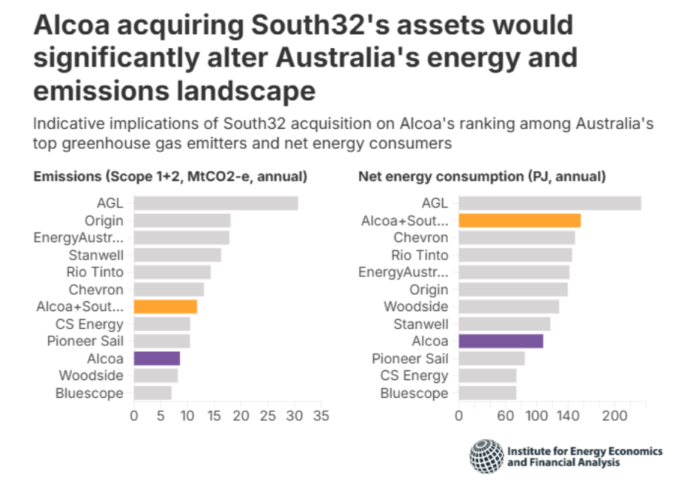
Alcoa’s proposed acquisition of South32’s Western Australian alumina and bauxite assets is set to reshape Australia’s mining, metals and energy sectors. Valued at up to US$5.6 billion (AU$8.1 billion), the transaction includes South32’s controlling interest in the Worsley alumina refinery and the Boddington bauxite mine, expanding Alcoa’s upstream aluminium business while increasing its energy consumption and greenhouse gas emissions.
The IEEFA report said the acquisition could transform Alcoa into Australia’s second-largest corporate net energy consumer, behind only AGL, while elevating it among the country’s largest industrial greenhouse gas emitters.
Alcoa Expands Market Leadership in Bauxite and Alumina
Alcoa’s share of Australian bauxite production will increase from 30 percent to 50 percent, while its share of national alumina production will rise from 40 percent to 60 percent.
The acquisition strengthens Alcoa’s position in the global aluminium supply chain by securing access to premium bauxite and alumina assets used in renewable energy infrastructure, electric vehicles, construction, aerospace and advanced manufacturing.
Acquisition Nearly Doubles Alcoa’s Industrial Emissions
While strategically attractive, the transaction significantly increases Alcoa’s environmental footprint.
Alumina refining accounts for approximately 3 percent of Australia’s total energy consumption and generates roughly 3 percent of the country’s greenhouse gas emissions, making it one of the nation’s most energy-intensive industrial activities.
Unlike aluminium smelting, where electricity dominates energy use, alumina refining relies heavily on thermal energy, with approximately 90 percent of emissions originating from direct Scope 1 fuel combustion.
IEEFA said incorporating Worsley under current operating conditions would nearly double Alcoa’s annual Safeguard Mechanism emissions from approximately 3.3 million tonnes of carbon dioxide equivalent, moving the company from Australia’s 15th-largest Scope 1 emitter to eighth place. Its combined Scope 1 and Scope 2 emissions ranking would rise from ninth to seventh nationally.
Worsley Becomes Alcoa’s Largest Decarbonization Challenge
The Worsley alumina refinery is expected to become the centrepiece of Alcoa’s decarbonization strategy.
Unlike Alcoa’s Pinjarra and Wagerup refineries, which primarily use natural gas, Worsley still relies heavily on coal, with approximately 40 percent of its thermal energy supplied by coal-fired systems.
According to South32’s Sustainability Databook 2025, Worsley consumes annually:
19.4 petajoules of coal.
19.4 petajoules of natural gas.
1.4 petajoules of distillate fuel and gasoline.
1.4 petajoules of purchased electricity.
Smaller quantities of other energy sources.
This energy mix produces approximately 3.2 million tonnes of carbon dioxide equivalent each year, making Worsley the seventh-largest facility regulated under Australia’s Safeguard Mechanism.
During FY2024-25, South32 surrendered more than 130,000 safeguard credits and carbon offsets to comply with Australia’s emissions regulations, highlighting the growing financial cost of carbon compliance.
Low-Carbon Reputation Faces New Pressure
Alcoa has built its reputation as one of the world’s lowest-carbon aluminium producers, maintaining an average global Scope 1 and Scope 2 carbon intensity below 0.6 tonnes of carbon dioxide equivalent per tonne of product.
By comparison, Worsley’s carbon intensity is approximately 0.8 tonnes of carbon dioxide equivalent per tonne of alumina produced.
Integrating Worsley without substantial emissions reductions could weaken Alcoa’s environmental leadership and increase pressure from investors, governments and customers demanding lower-carbon industrial materials.
Rising Energy Costs Increase Decarbonization Urgency
Energy represents approximately 25 percent to 30 percent of alumina refining costs, making fuel selection a major profitability factor.
Western Australia’s plan to phase out coal-fired power generation by 2031 increases the urgency of replacing coal with lower-carbon energy sources.
Natural gas is expected to serve as an interim solution, but Australia’s gas market presents new risks. Domestic gas prices have more than doubled since 2020, while supply shortages are forecast to emerge from 2029, creating uncertainty over future operating costs.
These market conditions reinforce the need for greater investment in renewable electricity, industrial electrification, hydrogen and other low-carbon technologies.
New Technologies Will Determine Future Competitiveness
The aluminium industry continues exploring technologies to reduce emissions from alumina refining.
Alcoa previously evaluated Mechanical Vapour Recompression technology at its Wagerup refinery, but determined the project was commercially unviable in 2023. Other initiatives, including electric calcination at Pinjarra and steam electrification trials at Worsley, remain under development as the industry searches for scalable low-carbon refining solutions.
Competitors Pursue Different Decarbonization Strategies
The acquisition also highlights contrasting strategies among Australia’s major aluminium producers.
Rio Tinto has secured some of Australia’s largest renewable power purchase agreements to decarbonize its Queensland alumina refineries and aluminium smelters.
South32 has chosen to exit its aluminium portfolio by selling Worsley and Boddington, significantly reducing its future exposure to carbon-intensive refining and associated decarbonization costs.
Alcoa, meanwhile, is pursuing production growth despite taking on substantially higher emissions and energy consumption.
The analysis, prepared by James Bowen, Lead Analyst for Australian Industrial Decarbonisation at IEEFA, concludes that the transaction fundamentally changes Australia’s industrial emissions profile and energy demand.
Wood Mackenzie notes that the acquisition effectively transfers a significant share of South32’s future decarbonization obligations to Alcoa.
With a transaction valued at up to US$5.6 billion (AU$8.1 billion), Alcoa is set to increase its Australian bauxite market share from 30 percent to 50 percent and alumina production share from 40 percent to 60 percent. However, it will also inherit a refinery emitting approximately 3.2 million tonnes of carbon dioxide equivalent annually, consuming 19.4 petajoules each of coal and natural gas, while moving from the 15th to the eighth-largest Scope 1 emitter in Australia and becoming the country’s second-largest corporate net energy consumer. According to IEEFA, decarbonizing Worsley will be critical to preserving Alcoa’s low-carbon leadership and ensuring the long-term value of this landmark acquisition.
SHAFANA FAZAL
