
Australia could strengthen its energy security and reduce fuel costs by cutting diesel consumption in the road freight sector by 10 percent to 20 percent, saving up to AU$6 billion annually, according to a new report from the Institute for Energy Economics and Financial Analysis (IEEFA).
The IEEFA report argues that Efficiency First strategy focused on fleet modernization, smarter logistics, operational improvements and targeted policy reforms offers the fastest and most cost-effective way to reduce the country’s dependence on imported diesel.
The briefing, authored by James Bowen, Lead Analyst for Australian Industrial Decarbonisation at IEEFA, comes as geopolitical tensions and global oil supply disruptions continue to expose Australia’s heavy reliance on imported fuel.
Australia Imports More Diesel Than Any Other Country
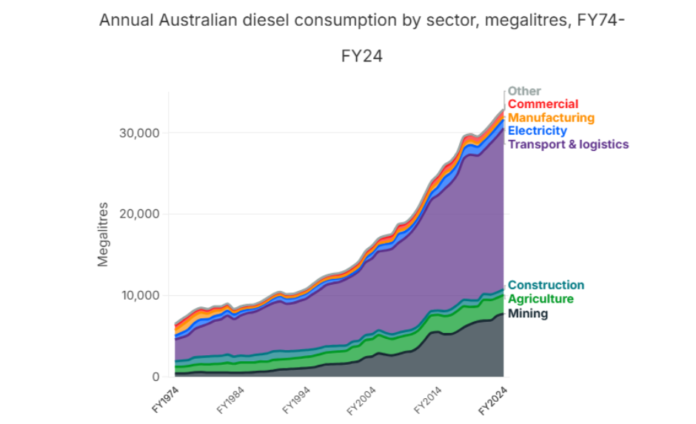
Diesel is Australia’s most important transport and industrial fuel, accounting for approximately one-fifth of the nation’s total energy consumption — more than electricity. National diesel demand has increased steadily since 2000, with annual consumption reaching 32,898 megalitres.
Australia now imports more diesel than any other country, representing approximately 10 percent of global seaborne diesel trade while ranking among the world’s highest per-capita diesel consumers. Recent disruptions linked to tensions involving Iran highlighted the country’s vulnerability to international fuel supply shocks. Although a June 2026 agreement between the United States and Iran eased immediate concerns, Shell CEO Wael Sawan warned it could take at least one year for global oil markets to fully stabilize.
Freight Sector Uses 45 Percent of Australia’s Diesel
Road freight remains the largest diesel-consuming sector in Australia. The freight and logistics industry contributes approximately 8.6 percent of Australia’s gross domestic product and employs nearly 200,000 truck drivers.
Freight operations consume 14,895 megalitres of diesel annually, accounting for 45 percent of national diesel demand. Outside freight, non-freight sectors consume 18,184 megalitres, including:
Mining: 7,762 megalitres
Passenger road transport: 4,052 megalitres
Agriculture: 2,301 megalitres
Electricity generation: 1,092 megalitres
Road transport carries approximately 75 percent of Australia’s non-bulk freight while consuming 13,548 megalitres of diesel each year. Heavy rigid and articulated trucks transport 96 percent of road freight, with more than 99 percent powered by diesel engines. These heavy vehicles account for approximately 60 percent of road freight diesel consumption.
Aging Fleet and Industry Structure Limit Efficiency
The report identifies several structural barriers to improving fuel efficiency.
Fuel represents 30 percent or more of operating costs for many trucking companies, while average profit margins remain between 4 percent and 5 percent, limiting investment in newer vehicles and technologies.
Australia’s freight industry is also highly fragmented:
Owner-drivers: approximately 80 percent of freight businesses but only 20 percent of market activity.
Largest operators: 1 percent of businesses controlling around 30 percent of the market.
Small fleet operators: 15 percent of businesses with 25 percent market share.
Medium-sized fleets: 4 percent of businesses representing another 25 percent of market activity.
Australia’s truck fleet is considerably older than many developed markets. The average truck remains in service for approximately 15 years, compared with:
Germany: 9.5 years
United Kingdom: 9.8 years
Japan: 12 years
United States: 12.1 years
Many smaller operators continue using trucks for more than 20 years.
The sector also faces a shortage of approximately 28,000 truck drivers, while 47 percent of Australian truck drivers are over the age of 55, compared with the global average of 31.6 percent.
Efficiency Measures Could Save Up to 2.7 Gigalitres of Diesel
According to IEEFA, reducing road freight diesel consumption by 10 percent to 20 percent would eliminate between 1.3 gigalitres and 2.7 gigalitres of diesel demand annually. These savings are roughly equivalent to Australia’s combined diesel consumption for electricity generation and agriculture.
Driver behavior alone offers significant opportunities. Eco-driving techniques can reduce fuel use by 20 percent to 30 percent, while lowering highway speeds from 110 kilometres per hour to 90 kilometres per hour cuts diesel consumption by between 10 percent and 23 percent.
Routine maintenance can improve fuel efficiency by approximately 10 percent through correct tyre pressure, wheel alignment and regular servicing.
Vehicle upgrades also deliver measurable savings:
Low rolling-resistance tyres: 7 percent to 8 percent lower fuel use.
Aerodynamic roof spoilers: approximately 5 percent savings.
Side fairings: around 1 percent savings.
Side skirts: around 1 percent savings.
Reducing vehicle weight by 10 percent: 5 percent to 10 percent lower fuel consumption.
Removing bull bars: approximately 1 percent improvement.
Removing air horns: approximately 1 percent improvement.
Artificial Intelligence Can Improve Freight Efficiency
The report identifies logistics optimization as one of Australia’s largest untapped opportunities.
Approximately 40 percent of truck capacity remains unused, while around 25 percent of truck journeys return empty. Artificial intelligence-powered freight matching, digital logistics platforms and improved load consolidation could reduce fuel consumption by approximately 25 percent by increasing vehicle utilization.
The report cites BC Sands as an example of successful operational change. By introducing higher charges for urgent deliveries, the company encouraged customers to consolidate shipments, reducing fuel consumption by 18 percent.
Although around 75 percent of freight operators already use telematics systems, many are not fully utilizing the technology for route optimization, preventive maintenance and driver performance management.
Fleet Modernization and Rail Shift Can Deliver Additional Savings
Modern trucks also improve fuel efficiency. Euro VI trucks consume approximately 10 percent less fuel than Euro V models, while high-productivity vehicles can reduce diesel consumption by around 20 percent through improved load consolidation.
Battery-electric truck adoption remains limited, with fewer than 1,000 electric trucks currently operating across Australia.
Rail freight offers another immediate opportunity. Rail consumes less than one-third of the diesel required by road freight per tonne-kilometre. Shifting just 1 percent to 2 percent of non-bulk freight from road to rail could save approximately 43 megalitres to 86 megalitres of diesel annually.
The Melbourne-Sydney freight corridor illustrates the challenge, with rail’s share of non-bulk freight falling from 40 percent historically to just 2 percent today.
In contrast, Western Australia’s AU$50 per TEU container subsidy helped rail increase its share of container traffic through Fremantle’s Inner Harbour to 23.5 percent during FY2025, exceeding the state’s 20 percent target.
Coastal shipping currently carries only around 6 percent of Australia’s non-bulk freight despite being more fuel-efficient than rail and using heavy fuel oil instead of diesel.
IEEFA Calls for National Diesel Reduction Target
IEEFA recommends embedding an “Efficiency First” strategy into Australia’s transport and energy policies by setting a national road freight diesel reduction target of 10 percent to 20 percent, with measurable progress expected within six months.
The report also recommends expanded telematics benchmarking, AI-powered freight matching, tax incentives, direct subsidies, contract-for-difference funding, nationally consistent road access rules, reforms to Australian Competition and Consumer Commission regulations, support for high-productivity and battery-electric vehicles, and revised Road User Charges to encourage freight consolidation and greater use of rail.
With annual diesel consumption of 32,898 megalitres, freight accounting for 45 percent of national demand and imports supplying approximately 10 percent of global seaborne diesel trade, Australia faces growing energy security risks. According to IEEFA, improving freight efficiency could cut diesel demand by up to 20 percent, eliminate 2.7 gigalitres of annual fuel consumption, save as much as AU$6 billion each year, reduce import dependence and strengthen the resilience of Australia’s transport and logistics sector.
SHAFANA FAZAL
