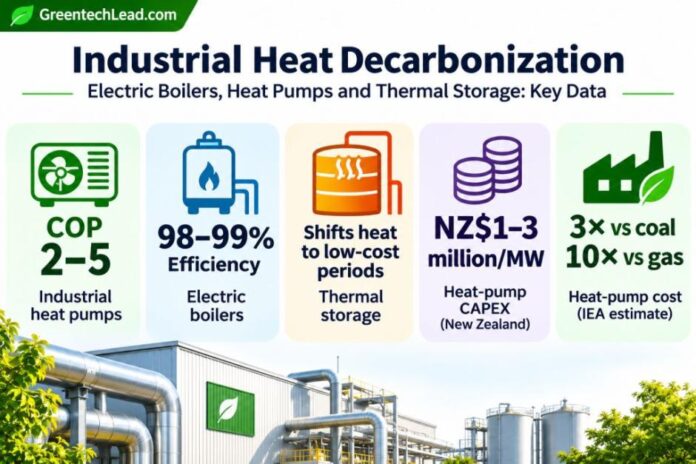
Industrial heat decarbonization is creating investment opportunities for manufacturers, energy technology companies and infrastructure investors as industries seek alternatives to coal, natural gas and oil-fired heating systems. Electric boilers, industrial heat pumps and thermal energy storage are emerging as important technologies for reducing industrial energy costs and carbon emissions.
According to the International Energy Agency’s Renewables for Industry analysis, industrial electrification technologies can replace fossil-fuel heating across a range of manufacturing applications, particularly where process temperatures, electricity prices and operating conditions support commercial deployment.
Investment returns depend on capital expenditure (CAPEX), electricity tariffs, equipment efficiency, plant utilization, waste-heat availability and the cost of grid connections.
Industrial heat projects are also attracting investment in food processing, dairy, chemicals, pharmaceuticals, pulp and paper, textiles and other energy-intensive manufacturing sectors.
Industrial Heat Technology Costs: Electric Boilers vs Heat Pumps vs Thermal Storage
Industrial heat pumps, electric boilers and thermal energy storage have different operating characteristics and investment requirements.
| Technology | Efficiency or performance | Main economic advantage |
| Industrial heat pumps | COP of 2–5, depending on application | Lower electricity consumption per unit of heat |
| Electric boilers | Approximately 98–99 percent efficiency | Steam generation and operational flexibility |
| Thermal energy storage | Depends on storage technology and heat losses | Shifts electricity consumption to lower-cost periods |
Heat pumps can deliver several units of useful heat for every unit of electricity consumed. A coefficient of performance (COP) of 3.5 means 1 MWh of electricity produces 3.5 MWh of useful heat by upgrading energy from another heat source.
Electric boilers convert electricity directly into heat and can provide reliable steam generation. However, electricity consumption is substantially higher than for heat pumps delivering the same quantity of useful heat.
Thermal energy storage enables factories to purchase electricity during cheaper periods, store heat and use it during peak-price hours.
CAPEX Requirements for Industrial Heat Electrification
The investment required for industrial heat pumps varies according to operating temperature, plant size, heat exchangers, piping, electrical infrastructure and integration complexity.
New Zealand’s Energy Efficiency and Conservation Authority reported industrial heat-pump project capital costs of approximately NZ$1 million–3 million per MW of heating capacity in co-funding applications during 2021–2023.
The IEA’s Energy Technology Perspectives 2026 estimates that industrial heat pumps can cost approximately three times as much as coal boilers and up to ten times as much as natural-gas boilers.
These are broad capital-cost comparisons rather than directly comparable installed project quotations.
Electric boilers can have lower equipment costs, but electricity network upgrades, transformers, switchgear and peak-demand charges can significantly affect total investment.
Thermal storage projects require additional expenditure on storage media, insulation, charging equipment and heat delivery infrastructure.
The IEA’s analysis of industrial heat electrification competitiveness highlights the importance of electricity-to-gas price ratios, heat-pump efficiency and local energy-market conditions.
Major Industrial Heat Decarbonization Projects and Investments
Several commercial projects demonstrate how manufacturers are investing in electric boilers, industrial heat pumps and thermal batteries.
Heineken – Manchester, United Kingdom: Heineken invested £28.2 million in large-scale industrial heat pumps at its Manchester brewery. In September 2026, the company reported a 33 percent reduction in on-site natural gas consumption and a 42 percent reduction in CO₂ emissions intensity. The heat-pump network was commissioned in June 2025, demonstrating measurable operating benefits from industrial electrification.
Heineken and Eneco – Zoeterwoude, Netherlands: Heineken introduced a 12 MW electric boiler to supply steam for brewing and packaging. The system is expected to produce approximately 43,000 MWh of steam annually once output stabilizes after 2029. The project illustrates how electric boilers can supplement existing industrial steam infrastructure.
Rondo Energy – California, United States: Rondo commissioned a 100 MWh industrial heat battery in 2025, using solar electricity to supply continuous steam to an industrial fuel-production facility. The company reported thermal storage temperatures above 1,000°C and round-trip efficiency exceeding 97 percent.
Heineken, Rondo Energy and EDP – Portugal: The companies contracted a 100 MWh thermal battery designed to supply approximately 7 MW of steam to a brewery near Lisbon. The project uses a heat-as-a-service commercial model, allowing Heineken to purchase industrial steam without directly financing the thermal battery. Commercial operation is targeted for 2027.
ANZCO Foods – Canterbury, New Zealand: ANZCO commissioned a 1 MW high-temperature heat pump in March 2022 with NZ$400,000 of government co-funding. The project was expected to reduce annual CO₂ emissions by approximately 3,080 tonnes by replacing coal-fired process heating.
Kaisec – Netherlands: A brewery in Twente commissioned a 4 MW electric boiler integrated with 15 MWh of high-temperature thermal storage in July 2026. The system combines electricity-based steam generation with storage to improve operational flexibility.
Kyoto Group – Hungary: Kyoto Group inaugurated an industrial Heatcube thermal storage installation in 2025. The molten-salt system stores electricity as heat for subsequent steam generation, offering an alternative to continuous fossil-fuel boiler operation.
Gulpener Brewery – Netherlands: Gulpener installed industrial heat pumps that recover excess heat from fermentation processes. Danfoss reported a 75 percent reduction in energy use associated with the heating solution, highlighting the potential benefits of integrating industrial cooling and heating systems.
Operating Costs: Natural Gas Boilers vs Electric Boilers vs Heat Pumps
Electricity prices and system efficiency determine whether industrial heat electrification can reduce operating expenditure.
Consider an illustrative factory paying $40/MWh for natural gas and $100/MWh for electricity.
| Heating technology | Cost per MWh of useful heat |
| Gas boiler, 90 percent efficiency | $44.44 |
| Electric boiler, 99 percent efficiency | $101.01 |
| Heat pump, COP 3.5 | $28.57 |
Under these assumptions, a heat pump reduces energy expenditure by approximately 36 percent compared with a gas boiler.
An electric boiler would be more expensive to operate continuously unless the manufacturer secures cheaper electricity, uses surplus renewable generation or benefits from flexible electricity tariffs.
The heat pump’s break-even COP is 2.25 before considering CAPEX, maintenance and electricity demand charges.
Thermal Energy Storage Economics and Electricity Savings
Thermal storage can improve project economics by shifting electricity consumption to periods with lower tariffs.
For example, a storage system charging 10 MWh at €30/MWh and delivering 8.2 MWh after losses achieves an electricity-input cost of approximately €36.59 per MWh of useful heat.
Generating the same heat directly through a 99 percent efficient electric boiler at €100/MWh would cost approximately €828, compared with €300 for the storage charging electricity.
The gross difference of €528 per cycle excludes storage CAPEX, maintenance, network charges and other operating costs.
Commercial returns depend on the number of profitable charging cycles, electricity-price spreads, storage efficiency and the value of reducing peak electricity demand.
India’s Industrial Heat Electrification Investment Opportunity
India offers opportunities for industrial heat electrification in textiles, food processing, chemicals, pharmaceuticals, paper, cement and steel.
The Energy Innovation analysis of industrial heat electrification in India estimates utility-scale solar electricity costs of approximately $30/MWh and solar-plus-battery electricity costs of $43/MWh.
Its modelling indicates that electrified heat can compete with gas, biomass and petroleum across assessed temperature ranges, while offering lower costs than coal in three temperature bands representing approximately 55 percent of industrial combustion heat.
However, these are modelled electricity costs rather than delivered factory tariffs.
Indian manufacturers must account for open-access charges, transmission expenses, grid upgrades, electricity duties and the availability of renewable power.
Investment Returns: Payback Period, IRR and NPV
Consider a factory requiring 10,000 MWh of useful heat annually.
At $40/MWh gas prices and 90 percent boiler efficiency, annual fuel expenditure reaches approximately $444,444.
Replacing the boiler with a COP-3.5 heat pump using electricity priced at $100/MWh reduces annual energy expenditure to approximately $285,714.
Annual savings would reach approximately $158,730.
With incremental CAPEX of $1 million, simple payback would be approximately 6.3 years. Over 20 years, assuming constant savings and an 8 percent discount rate, the project generates an illustrative net present value of approximately $683,000 and an internal rate of return of 14.9 percent.
These calculations exclude financing, taxes, maintenance differences, equipment degradation and grid-connection costs.
Investment Outlook for Industrial Heat Decarbonization
The projects undertaken by Heineken, Rondo Energy, ANZCO Foods, Kyoto Group, Kaisec and Gulpener Brewery demonstrate growing commercial adoption of industrial heat electrification.
Heat pumps offer strong economics where manufacturers have recoverable waste heat and continuous thermal demand. Electric boilers provide operational flexibility and steam generation, while thermal storage enables factories to benefit from lower electricity prices.
For investors, the most important indicators are installed CAPEX per MW, useful-heat cost per MWh, annual energy savings, equipment utilization, payback period, IRR and NPV.
Successful industrial heat decarbonization projects will combine efficient technology, competitive electricity procurement, reliable grid access and measurable operating savings rather than relying exclusively on emissions-reduction targets.
SHAFANA FAZAL