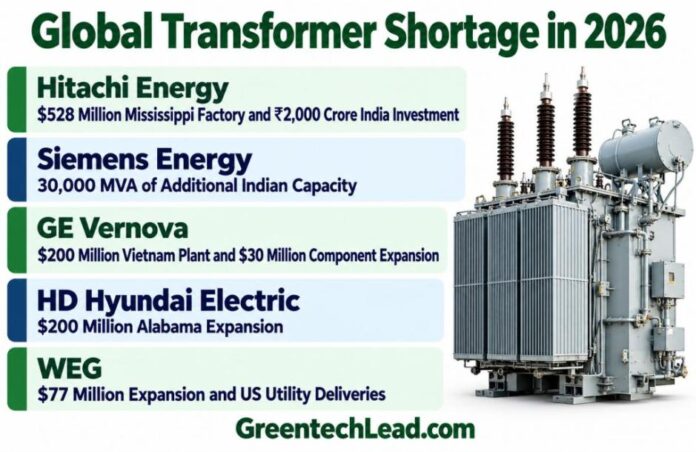
The global transformer shortage is increasing procurement costs and complicating schedules for renewable energy, transmission networks, AI data centers and industrial projects. Demand for new equipment is rising alongside replacement requirements, while manufacturers need years to expand production.
The International Energy Agency’s transmission equipment assessment found that large power transformers could take up to four years to procure. Its price analysis showed an approximately 75 percent increase in real terms between 2019 and 2024. These historical figures illustrate the supply pressure; actual quotations depend on equipment specifications and delivery schedules.
Investments by Hitachi Energy, Siemens Energy, GE Vernova, HD Hyundai Electric and WEG show how suppliers are responding. However, announced factories will improve availability only after construction, qualification and production ramp-up.
Why Transformer Demand Is Outrunning Supply
Three investment cycles are overlapping: electricity demand growth, renewable energy integration and replacement of ageing grid equipment.
AI data centers require substantial power connections and dedicated electrical infrastructure. Solar, wind and battery projects add connection points, while utilities need transformers for new substations and network reinforcement.
McKinsey’s report on global transformer demand will grow approximately 3.5 percent annually through 2035. In Europe and North America, domestic power transformer demand reached an estimated 914 GVA in 2025, compared with domestic supply of 566 GVA. Imports covered part of the difference, but accumulated unserved demand remained.
Transformer categories also serve different applications. Distribution transformers cannot automatically substitute for large transmission transformers, and HVDC projects require specialised equipment. Additional capacity must match the voltage, design and qualification requirements of buyers.
Five Transformer Vendors Expanding Supply
Hitachi Energy: $528 Million Mississippi Factory and ₹2,000 Crore India Investment
Hitachi Energy announced a $528 million transformer factory in Gallman, Mississippi, in September 2026. Production is scheduled to begin in 2029, with more than 700 jobs planned.
The company says the factory will more than double the capacity of its existing Crystal Springs operation. Production will transition to Gallman, so the expansion should be measured against the existing facility rather than counting both plants as separate permanent capacity.
In India, Hitachi Energy’s ₹2,000 crore transformer manufacturing expansion covers a new large power transformer factory in Karjan, Vadodara.
Scheduled for completion in FY2027–28, the factory will serve high-voltage transmission, HVDC, generation, AI data centers and industrial applications. The announcement did not disclose a numerical annual production capacity.
Siemens Energy: 30,000 MVA of Additional Indian Capacity
Siemens Energy India approved approximately ₹2,060 crore in February 2026 to add around 30,000 MVA of large power transformer capacity.
The Siemens Energy India capacity announcement places the expected start of operations between 2030 and 2032. This timeline demonstrates how slowly major manufacturing investments can translate into equipment deliveries.
Siemens Energy is also expanding specialised production in Europe. Its February 2026 shareholder letter reported the opening of an offshore wind transformer plant in Wollsdorf, Austria, following investment exceeding €100 million, creating approximately 100 jobs. This addresses a specific equipment segment rather than every transformer shortage.
GE Vernova: $200 Million Vietnam Plant and $30 Million Component Expansion
GE Vernova announced approximately $200 million for a new factory in Hai Phong, Vietnam, in March 2026.
The GE Vernova HVDC transformer factory investment will primarily support large power transformers for HVDC transmission projects. Full operations are expected in 2028, subject to regulatory approvals, with approximately 450 jobs by 2030.
The company separately announced approximately $30 million to expand its Sesto San Giovanni facility in Italy. The investment increases production of transformer bushings and is expected to create around 50 manufacturing jobs.
Bushings provide insulated electrical connections through transformer enclosures. Expanding their supply matters because component shortages can restrict finished transformer output even when assembly capacity is available.
HD Hyundai Electric: $200 Million Alabama Expansion
HD Hyundai Electric plans to invest approximately $200 million in a second factory at its Alabama manufacturing site.
The company expects the facility to increase extra-high-voltage transformer production capacity by approximately 50 percent. Its published update schedules completion for April 2027 and includes new 765 kV manufacturing and testing facilities.
HD Hyundai Electric plans approximately 200 additional employees and about $150 million in additional annual revenue following completion from HD Hyundai Electric’s Alabama manufacturing site. These are company targets, dependent on commissioning, production and deliveries.
WEG: $77 Million Expansion and US Utility Deliveries
WEG announced a $77 million investment in September 2025 to expand transformer production in the United States. The investment broadens the manufacturing response beyond the largest European and Asian suppliers.
A January 2026 customer announcement provides evidence of demand for its output: Avangrid committed $7 million to purchase five power transformers manufactured by WEG in Washington, Missouri.
That purchase demonstrates actual utility procurement, although the contract value should not be treated as a standard transformer price because equipment ratings and specifications differ.
Why New Factories Cannot Immediately End the Shortage
Transformer manufacturing requires skilled workers, winding equipment, insulation systems, testing facilities and qualified component suppliers. Copper and grain-oriented electrical steel are important inputs, while bushings and tap changers can become separate bottlenecks.
New factories must also complete customer qualification and production testing. Nameplate manufacturing capacity therefore differs from dependable annual deliveries.
The IEA identified 1,650 GW of solar and wind projects awaiting grid connections in 2024. Transformers were one constraint among several, including permitting and transmission availability. Resolving equipment shortages alone will not clear every connection queue.
What Utilities and Developers Should Do
Buyers should secure transformer specifications and manufacturing slots early, aligning delivery commitments with substation construction and commissioning.
Long-term agreements can improve supply visibility, while standardised designs may broaden the qualified supplier pool. Procurement assessments should examine component availability, testing capacity and demonstrated delivery performance.
The vendor investment pipeline extends from 2027 to 2032, indicating a gradual supply response. Shortage relief will depend on completed factories, higher actual output and declining backlogs. For project developers, transformer delivery dates remain a critical part of investment planning and revenue schedules.
SHAFANA FAZAL