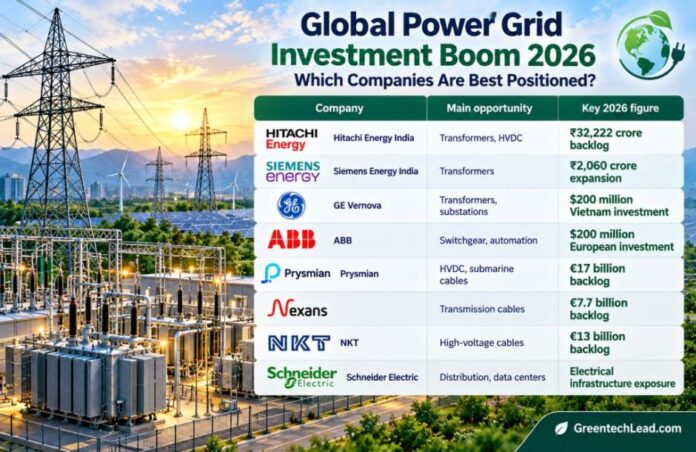
Global power grid investment is creating major growth opportunities for Hitachi Energy, Siemens Energy, GE Vernova, ABB, Schneider Electric, Prysmian, Nexans and Indian transmission contractors. Rising electricity demand from AI data centers, renewable energy projects, electric vehicles and industrial electrification is accelerating investment in transformers, high-voltage cables, switchgear and grid automation.
The International Energy Agency (IEA) estimates that annual global grid investment needs to increase approximately 50 percent, from $400 billion to $600 billion by 2030. More than 2,500 gigawatts (GW) of renewable energy, storage and large electricity-consuming projects are waiting in grid connection queues worldwide.
For equipment manufacturers and engineering companies, the opportunity extends beyond new power lines to include factory expansion, digital substations, high-voltage direct-current (HVDC) technology and replacement of ageing infrastructure.
Why Global Grid Investment Is Rising Toward $600 Billion
Electricity networks are struggling to keep pace with new generation capacity and growing demand.
The IEA expects solar and wind to increase their combined share of global electricity generation from approximately 17 percent to 27 percent by 2030.
Transmission infrastructure can take five to 15 years to plan, permit and construct, creating bottlenecks for renewable energy and data center investments.
The IEA’s Electricity 2026 grid analysis highlights the need for faster infrastructure development, grid modernization and technologies that increase existing network capacity.
Companies benefiting most directly fall into five categories: transformer manufacturers, cable suppliers, switchgear producers, transmission contractors and digital grid technology providers.
Hitachi Energy: ₹32,222 Crore Order Backlog in India
Hitachi Energy is among the strongest beneficiaries of demand for power transformers, HVDC systems and substations.
Hitachi Energy India reported a record order backlog of ₹32,222.1 crore for the quarter ended June 30, 2026.
Quarterly revenue increased 68.6 percent year over year to ₹2,493.7 crore, while operational EBITDA margin reached 16 percent.
The company also started construction of its 20th manufacturing unit at Karjan, Gujarat, in June 2026.
Globally, Hitachi Energy has announced a $528 million transformer manufacturing facility in Mississippi and an investment program of approximately ₹2,000 crore in India.
Its Q1 FY2027 financial results demonstrate how rising electricity infrastructure spending is translating into orders, revenue growth and additional manufacturing capacity.
Siemens Energy: ₹2,060 Crore Transformer Expansion
Siemens Energy is expanding transformer manufacturing capacity to address rising demand from utilities, renewable developers and industrial customers.
Siemens Energy India approved investment of approximately ₹2,060 crore to add 30,000 MVA of transformer manufacturing capacity.
Commissioning is planned between fiscal 2030 and fiscal 2032.
The investment positions Siemens Energy to compete for additional high-voltage transformer and transmission projects as India expands its electricity network.
Its global portfolio also includes HVDC transmission technology, grid stabilization equipment and high-voltage substations.
GE Vernova: Transformers, HVDC and Grid Modernization
GE Vernova is positioned to benefit from electricity transmission investment through its Electrification business.
Its portfolio includes power transformers, HVDC converters, gas-insulated switchgear, substations and grid automation software.
GE Vernova has announced a $200 million transformer manufacturing investment in Vietnam and a separate $30 million component manufacturing expansion.
In India, GE Vernova T&D India has secured a POWERGRID package valued at approximately ₹701 crore, demonstrating its participation in transmission infrastructure expansion.
GE Vernova’s opportunities extend across North America, Europe, India and other regions investing in electricity networks and renewable integration.
ABB: $200 Million European Manufacturing Investment
ABB is expanding medium-voltage equipment manufacturing to serve utilities, factories and data centers.
In May 2026, ABB announced a $200 million European investment program, including approximately $100 million for Italy and manufacturing upgrades in Bulgaria, Finland, Germany, Norway and Poland.
The investment supports production of medium-voltage switchgear, grid automation equipment and electrical distribution technologies.
ABB’s European manufacturing expansion announcement demonstrates how electricity demand is driving capacity additions across multiple countries.
ABB also benefits from demand for electrification systems in AI data centers, industrial facilities and commercial buildings.
Schneider Electric: Data Centers and Digital Electrical Distribution
Schneider Electric has substantial exposure to the intersection of electricity networks, industrial electrification and AI infrastructure.
Its technologies include medium-voltage switchgear, power distribution systems, protection equipment, energy management software and data center electrical infrastructure.
The company’s EcoStruxure platform supports monitoring, automation and optimization of electrical assets.
Unlike companies focused mainly on transmission equipment, Schneider Electric can benefit from spending inside data centers and industrial facilities as well as utility network upgrades.
Its competitive advantage includes integrating electrical hardware, digital controls and services.
Prysmian: €17 Billion Transmission Order Backlog
Prysmian is a major beneficiary of demand for submarine cables, offshore wind connections and HVDC transmission systems.
Its transmission order backlog reached approximately €17 billion at June 30, 2026, including €12.9 billion in submarine power projects and approximately €3.8 billion in HVDC orders.
Major projects include DolWin4, BorWin4, NeuConnect, Biscay Bay and the Cook Strait HVDC upgrade. The company also reported approximately €2.2 billion in awarded contracts not yet included in its transmission backlog.
Nexans and NKT: €20.7 Billion Combined Cable Backlog
Nexans reported a €7.7 billion transmission backlog at June 30, 2026, including €1.2 billion associated with the rescheduled Great Sea Interconnector project.
Its transmission business is supported by European interconnectors, offshore wind projects and its third cable-laying vessel, Nexans Electra, which entered service in the second quarter of 2026.
NKT reported a €13 billion transmission backlog at the end of Q2 2026. The company also had five TenneT framework projects worth more than €2.5 billion excluded from that backlog.
Its projects include Eastern Green Link 3 and Scottish transmission upgrades.
India: ₹9.15 Lakh Crore Transmission Investment Opportunity
India’s National Electricity Plan envisages approximately ₹9.15 lakh crore in transmission investment between 2023 and 2032.
| Grid infrastructure | June 2026 | 2032 target |
| Transmission lines | 5.09 lakh circuit-km | 6.48 lakh circuit-km |
| Transformation capacity | 1,478 GVA | 2,345 GVA |
The planned expansion creates opportunities for Larsen & Toubro, KEC International, Kalpataru Projects International and equipment manufacturers.
The government’s transmission expansion update outlines the infrastructure requirements supporting renewable energy integration and electricity demand growth.
Digital Grid Technologies: 450–700 GW Potential
Grid-enhancing technologies could unlock connection capacity for an estimated 450–700 GW of queued projects, according to the IEA.
GE Vernova, Siemens, ABB, Schneider Electric and Hitachi Energy offer grid automation and digital monitoring systems, while Neara specializes in network modelling.
These technologies can improve existing network utilization without waiting for every new transmission line to be completed.
Outlook: Grid Equipment Suppliers Face a Multiyear Growth Opportunity
The global grid investment boom offers measurable opportunities across transformers, cables, substations, switchgear and digital technologies.
Prysmian, NKT and Nexans demonstrate substantial contracted demand through their transmission backlogs, while Hitachi Energy, Siemens Energy and ABB are expanding manufacturing capacity.
India’s ₹9.15 lakh crore transmission program provides another significant opportunity for domestic equipment suppliers and EPC contractors.
However, order backlogs do not automatically translate into profits. Manufacturing capacity, project execution, commodity costs, cash flow and contract margins will determine which companies benefit most from the potential $600 billion annual grid investment market by 2030.
SHAFANA FAZAL