The electric vehicle (EV) battery recycling industry is emerging as a major investment opportunity as demand for lithium, nickel, cobalt and other critical minerals increases. However, profitability depends on battery chemistry, recycling costs, metal recovery rates, plant utilization, capital expenditure (CAPEX) and revenue from recovered materials.
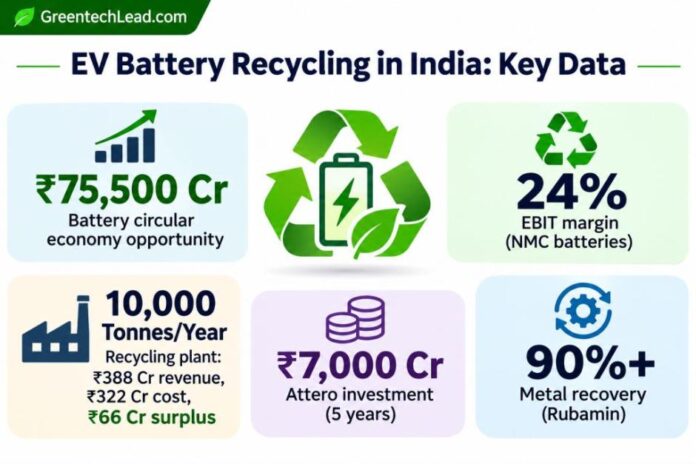
India’s battery circular economy, including reuse, repurposing and recycling, represents a potential ₹75,500 crore market, according to RMI’s Charting a Circular Battery Future in India report, published in November 2025.
Battery recycling companies are investing in mechanical processing, black-mass production, hydrometallurgical refining and lithium recovery technologies. The commercial challenge is converting announced recycling capacity into profitable operations supported by reliable battery supplies and long-term material sales contracts.
EV Battery Recycling Revenue and Cost Per Tonne
A 2026 study by The Energy and Resources Institute (TERI), prepared with support from NITI Aayog, highlights significant differences in recycling profitability across battery chemistries.
| Battery chemistry | Revenue per tonne | Cost per tonne | Modelled EBIT margin |
| NMC | ₹4.60–5.00 lakh | ₹3.36–3.90 lakh | 24 percent |
| LCO | ₹4.30–4.70 lakh | ₹3.46–3.94 lakh | 17 percent |
| LFP | ₹1.40–1.80 lakh | ₹1.52–2.11 lakh | -13 percent |
NMC batteries generate higher recovery revenue because they contain valuable nickel and cobalt alongside lithium. LCO batteries benefit from cobalt recovery, while lithium-iron-phosphate (LFP) batteries present more difficult economics because they contain neither nickel nor cobalt.
The study’s figures include material sales and extended producer responsibility (EPR) revenue. They are modelled estimates rather than audited commercial results.
As LFP adoption expands, recyclers will increasingly depend on lower processing costs, improved lithium recovery, EPR income and long-term feedstock contracts.
Economics of a 10,000-Tonne Battery Recycling Plant
The TERI model estimates total recycling costs of ₹294–350 per kilogram, compared with revenue of ₹368–408 per kilogram.
For a facility processing 10,000 tonnes annually, this translates into:
Annual revenue of ₹368–408 crore.
Annual costs of ₹294–350 crore.
Midpoint revenue of ₹388 crore.
Midpoint costs of ₹322 crore.
Modelled midpoint surplus of approximately ₹66 crore.
The estimated surplus equals ₹66,000 per tonne, but it is not equivalent to net profit or free cash flow. The cost model includes a capital allowance, while actual financing costs, taxes and working capital requirements may change returns.
Battery procurement represents the largest cost component at ₹130–151 per kilogram. Processing adds ₹95–122, logistics ₹12–15 and dismantling approximately ₹35 per kilogram.
Material sales contribute ₹256–283 per kilogram, while EPR income adds ₹112–125 per kilogram in the model.
These figures demonstrate why securing battery supplies at competitive prices can be as important as achieving high metal recovery rates.
Major EV Battery Recycling Projects and Investments in India
Gravita India – Mundra, Gujarat: Gravita announced an investment of approximately ₹14 crore in January 2026 for a lithium-ion battery recycling facility with 6,000 tonnes of annual capacity. The initial investment represents approximately ₹23,300 per annual tonne of nameplate capacity. The project began with black-mass processing, with downstream refining planned separately. This makes the investment unsuitable as a benchmark for fully integrated lithium refining.
Attero Recycling – India: Attero announced plans in 2026 to invest approximately ₹7,000 crore over five years in critical-mineral refining and processing facilities. Its broader expansion plans include increasing lithium-ion battery recycling capacity toward 300,000 tonnes annually. The proposed investment covers multiple critical minerals and cannot be attributed entirely to battery recycling.
Rubamin – Halol, Gujarat: Rubamin operates a lithium-ion battery recycling facility with 10,000 tonnes of annual shredding capacity and 7,500 tonnes of black-mass processing capacity. Commissioned in 2025, the facility uses hydrometallurgical processing to recover lithium, nickel, cobalt and manganese compounds. Rubamin reports recovery rates exceeding 90 percent for key metals.
LOHUM – Greater Noida: LOHUM combines lithium-ion battery recycling, critical-mineral recovery and battery repurposing. Its activities illustrate a business model that can generate revenue from recycling and second-life battery applications. However, recycling capacity and battery repurposing capacity must be evaluated separately.
RecycleKaro – Maharashtra: RecycleKaro has developed recycling and metal recovery operations targeting lithium-ion batteries, including nickel recovery. Its business model emphasizes recovering valuable metals rather than relying exclusively on black-mass sales.
LICO Materials – Karnataka: LICO Materials has pursued hydrometallurgical recycling and expansion of battery-processing infrastructure. The economics depend on achieving sufficient throughput, maintaining metal recovery efficiency and securing buyers for refined products.
These projects demonstrate different investment requirements. Mechanical recycling generally requires less initial capital, while integrated refining offers greater potential revenue per tonne but involves higher processing costs and technical risks.
Global Battery Recycling Projects: Redwood Materials, CATL and Primobius
Redwood Materials – United States: Redwood Materials operates a major battery recycling and refining campus in Nevada. The company reported producing 60,000 metric tonnes of critical minerals in 2025 and announced a $350 million Series E funding round. Its integrated operations demonstrate how recycling businesses can expand into battery-material manufacturing and other applications.
CATL – China: CATL reported recycling 210,000 tonnes of spent batteries in 2025 and regenerating approximately 24,000 tonnes of lithium salts. Its operations illustrate the scale achievable through integration with battery manufacturing and materials supply chains.
Primobius – Europe: Primobius’ engineering study estimated €274 million in CAPEX for a hydrometallurgical facility processing 12,000 tonnes of black mass annually, with annual operating expenditure of €56 million. A combined shredding and refining configuration was estimated at €377 million in CAPEX and €83 million in annual operating costs. These are engineering estimates rather than actual completed-project costs.
R3 Lithium – Georgia, United States: R3 Lithium acquired the former Ascend Elements recycling facility in Covington in July 2026 and announced the restart of operations in September. The company reported $15 million in Series A funding and approximately $1 billion in signed offtake agreements. Its experience highlights the importance of financing, customer contracts and continuous commercial production.
Lithium Recovery Efficiency and Black-Mass Revenue
Lithium recovery efficiency directly affects revenue from recycled batteries.
For example, one tonne of battery material containing 14 kilograms of elemental lithium could yield approximately 12.6 kilograms at a 90 percent extraction rate. This is equivalent to around 67 kilograms of lithium carbonate before further processing losses.
Actual revenue depends on lithium concentration, recovery efficiency, product purity, commodity prices and refining expenses.
Mechanical recyclers sell black mass containing lithium, nickel, cobalt, manganese and graphite. Integrated recyclers can generate additional value by converting these materials into higher-purity products.
However, refiners must finance chemical processing, purification equipment, environmental controls and additional working capital.
India Faces a Battery Recycling Capacity Utilization Challenge
India’s battery recycling expansion faces a potential mismatch between announced capacity and available end-of-life batteries.
A NITI Aayog assessment of battery recycling capacity estimates that available end-of-life lithium-ion battery feedstock could reach approximately 60,000 tonnes in 2030, compared with announced processing capacity of 115,000 tonnes.
This imbalance creates risks for plants that depend on high utilization to recover fixed operating costs and capital investment.
Battery manufacturing scrap, imports where permitted and long-term supply agreements may help improve utilization, but investors must verify actual feedstock availability.
EPR Revenue, Profitability and Investment Returns
India’s Battery Waste Management Rules, 2022 establish extended producer responsibility (EPR) requirements and a regulatory framework supporting battery recycling, material recovery and recycled-content obligations.
EPR certificate revenue is an important component of the TERI financial model, contributing ₹112–125 per kilogram. However, certificate prices, eligibility and payment timing can affect cash flow.
A 10 percent increase in battery procurement costs and a simultaneous 10 percent reduction in material sales revenue would reduce the illustrative midpoint surplus from ₹66,000 to approximately ₹25,000 per tonne, assuming other variables remain unchanged.
Investors should prioritize projects with contracted battery supplies, proven recovery technology, qualified material buyers and demonstrated plant utilization.
The economics of Gravita, Attero, Rubamin, LOHUM, Redwood Materials and CATL show that commercial success depends not simply on recycling capacity but on the cost of securing batteries, the value of recovered minerals and the ability to produce saleable materials consistently.
For the EV battery recycling industry, the most important investment indicators remain revenue per tonne, recovery cost per tonne, actual throughput, CAPEX, EPR cash receipts and risk-adjusted returns.
SHAFANA FAZAL