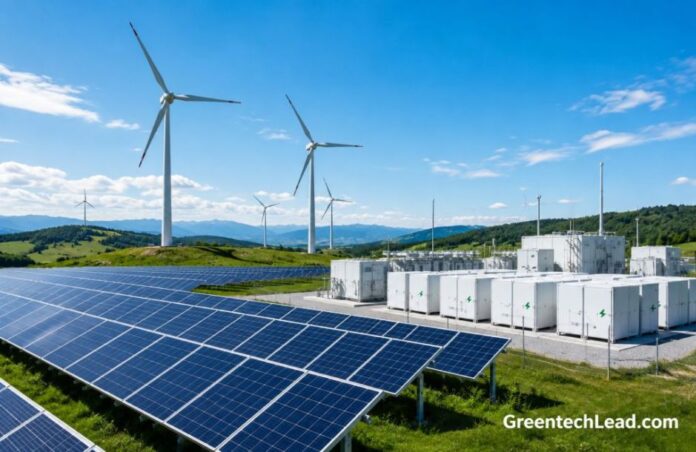
Global renewable energy investment is entering a new phase in 2026 as capital shifts beyond simply building more solar farms and wind projects toward the infrastructure required to integrate clean electricity.
The International Energy Agency (IEA) expects investment in renewable power projects to reach around $665 billion in 2026, including approximately $365 billion for solar. But renewable generation represents only one part of a much larger electricity investment boom.
IEA’s report on investment in renewable power projects indicated that total global energy investment is projected to increase 5 percent to a record $3.4 trillion in 2026. Around $2.2 trillion will flow into renewables, nuclear power, electricity grids, battery storage, low-emissions fuels, energy efficiency and electrification, compared with about $1.2 trillion for oil, natural gas and coal.
Electricity supply and infrastructure investment alone is approaching $1.6 trillion, while spending on grids is expected to reach nearly $550 billion and battery-storage investment to exceed $100 billion.
The numbers show that the renewable-energy investment opportunity is expanding from generation toward an integrated ecosystem of solar + wind + batteries + grids + electricity demand.
Solar Attracts $365 Billion — Nearly $1 Billion Every Day
Solar remains the largest renewable investment destination.
The IEA expects approximately $365 billion to flow into solar power in 2026 — equivalent to about $1 billion per day.
The sector benefits from large manufacturing scale, relatively short construction periods and the ability to deploy projects ranging from residential rooftops to multi-gigawatt utility developments.
Solar is also the dominant source of new renewable capacity. Global renewable additions reached a record 800 GW in 2025, according to the IEA, with solar representing approximately 75 percent. Solar generation increased by around 600 TWh, the largest annual increase ever recorded for an electricity source outside post-crisis rebound periods.
But rapidly growing solar deployment is creating a new investment challenge.
BloombergNEF’s report on financing for standalone utility-scale solar indicated funding fell 20 percent to $75.4 billion in H1 2026, the lowest level since the recent solar investment boom began in 2021.
Curtailment, grid congestion and electricity-price cannibalization affected investment in markets including China, Brazil and parts of Europe.
For investors following the global solar energy market, this is an important shift: the cheapest solar project is no longer automatically the most attractive. Grid access, curtailment exposure and the timing of electricity sales increasingly determine project value.
Solar-Plus-Storage Investment Hits Record $25 Billion
The strongest evidence of changing investor priorities is the boom in solar-plus-storage.
BloombergNEF reports that investment in co-located renewable energy and storage projects reached a record $25 billion during H1 2026. That was nearly twice the level recorded in H2 2025 and around three times H1 2025 investment. The United States and Australia are leading this market.
The contrast is striking.
Standalone utility-scale solar investment fell 20 percent, while capital poured into projects capable of storing electricity and selling it when electricity is more valuable.
IEA’s report on battery-storage indicates that investment will exceed $100 billion in 2026. Battery-storage capacity additions reached almost 110 GW in 2025, up approximately 40 percent.
Storage changes the economics of renewable power because it provides time flexibility. Instead of selling solar electricity primarily during midday production peaks, developers can store part of the output and deliver it during evening demand.
This means the emerging investment model is moving from:
Solar → Grid
toward:
Solar → Battery → Grid → Customer
That transition is creating investment opportunities across battery cells, battery energy storage systems, inverters, power-conversion systems, software and energy management.
$550 Billion Grid Investment Becomes Critical to Renewable Growth
If batteries provide time flexibility, electricity grids provide geographic flexibility.
The IEA expects global grid investment to approach $550 billion in 2026, nearly 20 percent higher year over year. Overall electricity supply and infrastructure spending is heading toward $1.6 trillion.
This makes transmission and distribution one of the biggest infrastructure opportunities associated with the global renewable energy transition.
Renewable projects increasingly face grid-connection queues, congestion, curtailment and network reinforcement costs. Consequently, excellent solar irradiation or wind resources alone do not guarantee an attractive project.
Developers must also consider available transmission capacity, connection timelines, congestion exposure and the cost of network upgrades.
This investment cycle creates opportunities beyond renewable developers and turbine or solar-module manufacturers. Demand is growing for transformers, switchgear, substations, HVDC equipment, underground cables, subsea cables and digital grid technology.
Companies supplying this infrastructure could therefore capture a substantial share of renewable-related capital expenditure through the rest of the decade.
Wind Investment Reaches $92.3 Billion in H1 — But Offshore Slumps
Wind presents a more mixed investment picture.
BloombergNEF says global wind investment reached $92.3 billion in H1 2026, down 27 percent year over year.
Onshore wind accounted for $80.7 billion, declining just 4 percent. Offshore wind investment, however, plunged 72 percent as higher construction costs, financing pressure and disappointing auction results reduced the number of projects reaching financial close.
The divergence demonstrates how financing costs can dramatically influence renewable investment.
Offshore projects require huge upfront capital for turbines, foundations, subsea cables, offshore substations, installation vessels and grid connections. Delays or increases in borrowing costs can therefore have a much larger impact than on smaller renewable projects.
The opportunity nevertheless extends across a substantial industrial supply chain, including turbines, steel, foundations, ports, specialized vessels, subsea cables and transmission infrastructure.
US Renewable Investment Jumps 54% as Data Centers Drive Electricity Demand
One of the biggest regional changes in 2026 is occurring in the United States.
BloombergNEF reports that U.S. renewable investment increased 54 percent year over year during H1 2026, making the country the world’s second-largest investment market behind China.
U.S. solar investment surged 41 percent to a record $45.8 billion, while wind investment more than doubled to $13.8 billion.
Tax-credit deadlines contributed to the investment surge, but another structural factor is emerging: data centers.
Artificial intelligence and cloud infrastructure are creating enormous electricity requirements, encouraging technology companies and utilities to secure new generation.
Big Tech is already an important renewable-energy buyer. BloombergNEF says Meta, Amazon, Google and Microsoft accounted for 49 percent of global corporate clean-power purchasing activity in 2025.
The investment chain increasingly looks like:
AI and data centers → electricity demand → PPAs → renewable generation → batteries → transmission
This creates an important new source of demand for renewable energy investment.
The most valuable projects may increasingly be those capable of providing predictable power rather than simply producing electricity whenever the sun shines or wind blows.
China Leads, But Renewable Capital Is Becoming More Global
China remains the world’s largest renewable investment market, but capital flows are becoming more geographically diverse.
BloombergNEF says China represented only around one-quarter of global renewable investment in H1 2026, compared with more than half in 2022. China’s changing electricity-market rules have made developers more sensitive to project revenue and merchant-power exposure.
Southeast Asia is emerging rapidly. Renewable investment across the region exceeded $12 billion during H1 2026, with Vietnam recording a fourfold increase. Malaysia and the Philippines also expanded investment.
The Middle East and North Africa represents another growth market. BloombergNEF says MENA renewable investment reached a record $22 billion in 2025, while solar and wind capacity additions are expected to increase 37 percent in 2026. Solar installations alone are forecast to reach a record 18 GW.
India is simultaneously expanding solar, wind, battery storage, transmission and domestic clean-energy manufacturing, positioning the country as another major destination for capital.
Financing Costs Decide Which Renewable Projects Get Built
Renewable projects are particularly sensitive to financing because most capital expenditure occurs before an asset begins generating revenue.
The IEA says more than two-thirds of energy investment in 2025 came from corporations and households, while around three-quarters was financed commercially, primarily through banks.
But access to finance remains unequal.
Commercial financing supported around 85 percent of energy projects in advanced economies, compared with only 67 percent in emerging and developing economies.
Interest rates, currency risk, policy stability, PPA structures and offtaker credit quality can therefore determine whether an otherwise competitive solar, wind or storage project reaches financial close.
This explains why investors increasingly distinguish between announced renewable pipelines and projects that have secured financing.
Renewable Energy Investment 2026: The Opportunity Moves Beyond Generation
The $665 billion expected to flow into renewable power during 2026 remains an extraordinary investment figure.
But the larger opportunity sits around it.
Renewable generation investment is increasingly creating additional capital requirements across batteries, transmission, distribution, manufacturing, digital energy and industrial electricity demand.
Three figures illustrate the scale:
Renewable power: ~$665 billion
Electricity grids: ~$550 billion
Battery storage: >$100 billion
At the same time, total electricity supply and infrastructure investment is approaching $1.6 trillion, while total global energy investment reaches a record $3.4 trillion.
The investment story is therefore shifting from simply installing more megawatts toward building an electricity system capable of absorbing and monetizing them.
The biggest winners in the next renewable investment cycle may not necessarily be companies developing the largest solar or wind pipelines. They could be developers and suppliers solving the industry’s most important constraints — storage, transmission, grid connections and reliable electricity delivery.
In 2026, renewable investment is increasingly about not just how much clean electricity can be generated, but when, where and at what value that electricity can be delivered.
SHAFANA FAZAL