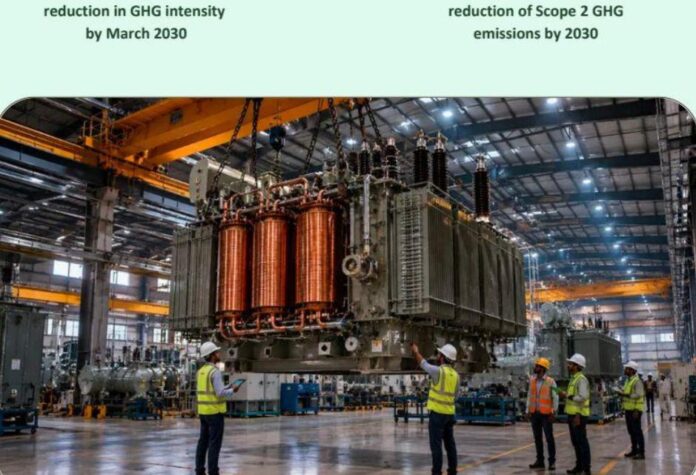
Transformers and Rectifiers India (TARIL) is strengthening its sustainability strategy as India’s rapid expansion of renewable energy, transmission networks and power infrastructure creates new demand for transformers. The company is targeting a 60 percent reduction in greenhouse gas intensity and a 100 percent reduction in Scope 2 emissions by March 2030.
TARIL’s FY2025-26 environmental performance shows progress toward these targets. Clean and solar energy initiatives helped the transformer manufacturer avoid 793 tonnes of CO2 equivalent (tCO2e), while renewable energy generation increased 16.8 percent to 4,023.04 GJ.
The decarbonisation programme has strategic significance because transformers are critical infrastructure for connecting new solar, wind, energy storage and conventional generation projects with India’s electricity grid. As transformer manufacturing expands to meet power-sector demand, controlling the energy and carbon intensity of production will become increasingly important.
Renewable Energy Generation Rises 16.8 Percent to 4,023 GJ
TARIL generated 4,023.04 GJ of renewable energy during FY2025-26, compared with 3,444.54 GJ in FY2024-25, representing an increase of approximately 16.8 percent.
Total energy consumption, however, increased from 59,931.42 GJ to 70,785.52 GJ, or approximately 18.1 percent year on year.
Renewable generation was equivalent to around 5.7 percent of total reported energy consumption during FY2025-26.
The figures highlight the challenge facing industrial manufacturers participating in India’s energy transition. Expanding power infrastructure creates opportunities for equipment suppliers, but higher manufacturing activity can simultaneously increase their own electricity consumption and emissions.
For TARIL, increasing the proportion of renewable electricity will therefore be critical to achieving its 100 percent Scope 2 emissions reduction target by March 2030.
1 MW Rooftop Solar Supports Transformer Manufacturing
TARIL has installed a 1 MW rooftop solar power system at its Moraiya manufacturing facility, strengthening its captive renewable-energy capacity.
On-site solar allows part of the electricity required for transformer manufacturing to be generated from renewable sources and reduces reliance on conventional grid electricity.
The initiative is particularly relevant to TARIL’s 2030 sustainability strategy because purchased electricity is a major lever for addressing Scope 2 emissions. Further rooftop solar installations, renewable power procurement and improvements in manufacturing energy efficiency could increase the share of clean electricity within TARIL’s overall energy mix.
TARIL Avoids 793 tCO2e Through Clean Energy
Clean and solar energy initiatives helped TARIL avoid 793 tCO2e of greenhouse gas emissions in FY2025-26.
The figure provides a measurable indication of the carbon benefits being generated by the company’s transition toward cleaner electricity.
TARIL’s longer-term target is to achieve a 60 percent reduction in GHG intensity by March 2030. The intensity-based target will be particularly important if transformer production continues expanding because it measures the company’s ability to reduce emissions relative to its level of business activity.
The company is simultaneously targeting a 100 percent reduction in Scope 2 emissions, placing renewable electricity at the centre of its operational decarbonisation programme.
Renewable Energy Expansion Creates Transformer Growth Opportunity
TARIL’s sustainability strategy is unfolding during a major transformation of India’s electricity system.
Large additions of solar and wind generation require corresponding investment in transmission lines, substations and transformers to move renewable electricity from generation centres to industrial and residential consumers.
Battery energy storage systems and pumped-storage projects can add another layer of grid infrastructure requirements as India integrates greater quantities of intermittent renewable generation.
Transformers consequently occupy a critical position in the energy transition. They are required at renewable power plants, substations and transmission and distribution networks to manage voltage levels and enable electricity to move efficiently across the grid.
This creates a direct connection between India’s renewable-energy investment cycle and demand for transformer manufacturers such as TARIL.
Grid Modernisation Adds Another Demand Driver
India’s electricity transition extends beyond building solar and wind projects. Transmission infrastructure needs to expand rapidly to connect new generation capacity, while existing networks require modernisation to handle changing electricity flows.
High-voltage transformers are among the essential components of this infrastructure.
Growth in data centres, industrial electrification, electric mobility and other electricity-intensive industries can further increase power demand, reinforcing the requirement for generation and transmission investment.
For TARIL, these trends provide a significant market opportunity. They also create an environmental challenge: higher transformer production can increase electricity, water and material consumption unless manufacturing efficiency and renewable-energy utilisation improve simultaneously.
TARIL’s 18.1 percent increase in energy consumption during FY2025-26 demonstrates why decarbonising manufacturing needs to accompany capacity expansion.
Waste Recycling Jumps 50.5 Percent to 2,970 Tonnes
Resource efficiency is another important part of TARIL’s sustainability programme.
The company recycled 2,970.48 tonnes of waste during FY2025-26, compared with 1,973.16 tonnes during FY2024-25. The increase of approximately 50.5 percent represents a substantial improvement in material recovery.
Circularity has particular relevance for electrical-equipment manufacturers because transformers use significant quantities of metals and other industrial materials.
Improving waste recovery can reduce disposal requirements while enabling valuable materials generated during manufacturing processes to be returned to productive use.
TARIL Reuses 8,199 kL of Wastewater
Water management also produced measurable results during FY2025-26.
TARIL treated and reused 8,199 kL of wastewater through Sewage Treatment Plants. The recycled water was used for landscaping and greenbelt development rather than relying on additional freshwater for these applications.
Total water withdrawal reached 21,112 kL, compared with 14,541 kL in FY2024-25. The amount of wastewater reused was equivalent to approximately 38.8 percent of FY2025-26 water withdrawal.
However, total water withdrawal increased approximately 45.2 percent year on year, making water efficiency another important indicator to monitor as manufacturing operations grow.
₹2.26 Crore CSR Investment Supports Social Sustainability
TARIL invested ₹2.26 crore in CSR programmes during FY2025-26, including initiatives focused on education and skill development.
Women accounted for 33.33 percent of the company’s Board of Directors, representing two of its six directors.
TARIL also reported zero employee fatalities during FY2025-26.
Permanent worker turnover declined from 4.36 percent to 2.45 percent, representing an improvement of approximately 43.8 percent, while permanent employee turnover stood at 25.15 percent.
TARIL Faces Twin Challenge of Growth and Decarbonisation
TARIL’s sustainability performance highlights a broader challenge facing companies supplying India’s renewable-energy and power infrastructure: manufacturers need to expand production while reducing the environmental footprint of that growth.
The company generated 4,023.04 GJ of renewable energy, avoided 793 tCO2e of emissions, recycled 2,970.48 tonnes of waste and reused 8,199 kL of wastewater during FY2025-26.
At the same time, energy consumption increased 18.1 percent to 70,785.52 GJ and water withdrawal reached 21,112 kL.
TARIL’s 1 MW rooftop solar installation provides a foundation for increasing renewable electricity utilisation, but the company’s March 2030 goals — a 60 percent reduction in GHG intensity and complete elimination of Scope 2 emissions — will require clean-energy adoption and operational efficiency to accelerate as manufacturing grows.
The opportunity is significant. India’s expansion of renewable generation, transmission infrastructure, energy storage and electricity-intensive industries is increasing the requirement for transformers and associated grid equipment. TARIL’s ability to capture that growth while lowering the carbon and resource intensity of its manufacturing operations will determine how closely its business expansion aligns with the clean-energy transition it helps enable.
SHAFANA FAZAL