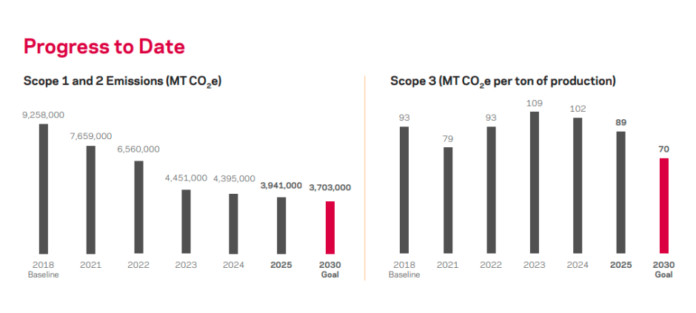
Chemours reduced combined Scope 1 and Scope 2 greenhouse gas emissions by 57 percent from its 2018 baseline, placing the chemicals company within three percentage points of its 60 percent reduction target for 2030.
The result means Chemours has completed 95 percent of its targeted percentage-point reduction. If its 2018 emissions are represented as 100 units, current emissions stand at 43 units and must fall to 40 units by 2030. This requires an additional reduction of approximately 7 percent from the present emissions level.
The progress supports Chemours’ longer-term ambition to achieve net-zero greenhouse gas emissions from its operations by 2050. However, net zero will require substantially deeper reductions after the company reaches its 2030 milestone.
Scope 3 Emissions Decline 30% from 2018
Chemours Sustainability Report 2025 indicated that it reported 30 percent absolute reduction in Scope 3 greenhouse gas emissions compared with the 2018 baseline, extending its decarbonisation programme beyond emissions generated by company facilities and purchased energy.
The Science Based Targets initiative has approved Chemours’ target to reduce Scope 3 emissions intensity per tonne of production by 25 percent by 2030. This target covers purchased goods and services and the use of sold products.
The reported 30 percent absolute reduction and the 25 percent intensity target cannot be compared directly. Absolute emissions measure the total value-chain footprint, while emissions intensity measures greenhouse gases relative to production volumes. Chemours will need to control both indicators to demonstrate that reductions are being driven by decarbonisation rather than changes in output.
The SBTi has also approved the company’s target to cut absolute Scope 1 and Scope 2 emissions by 60 percent by 2030.
Opteon Products Help Avoid 350 Million Tonnes of CO2e
Chemours estimates that customer adoption of its lower-global-warming-potential products has avoided more than 350 million metric tonnes of carbon dioxide equivalent emissions cumulatively.
Opteon refrigerant alternatives are currently estimated to help customers avoid more than 80 million metric tonnes of CO2e annually by replacing higher-global-warming-potential refrigerants in cooling and refrigeration applications.
The annual avoided-emissions figure is equivalent to nearly 23 percent of the cumulative total, illustrating how adoption has accelerated as governments and industries phase down high-GWP refrigerants.
Avoided emissions are different from reductions in Chemours’ own Scope 1, Scope 2 and Scope 3 footprint. They represent the company’s estimate of emissions that customers may avoid by using lower-GWP products instead of conventional alternatives.
Fluorinated Organic Chemical Emissions Fall 80%
Chemours reduced air and water process emissions of fluorinated organic chemicals by 80 percent from its 2018 baseline. The company aims to achieve a reduction of at least 99 percent globally by 2030.
Although Chemours has completed approximately 81 percent of the percentage-point journey from zero to a 99 percent reduction, the remaining task is significant. Using the 2018 level as 100 units, current process emissions are approximately 20 units, while the 2030 target allows no more than one unit.
Chemours must therefore eliminate at least 95 percent of its remaining process emissions to reach the 99 percent target. This distinction shows why the final phase will require substantial investment in emissions detection, capture, abatement and process redesign.
The commitment applies to fluorinated organic chemical emissions from the company’s manufacturing operations. Chemours describes itself as the first chemical manufacturer to establish a voluntary global goal of this scale.
PFAS Settlement Adds Environmental Investment Commitments
Chemours’ sustainability progress comes alongside continuing regulatory and legal scrutiny of PFAS emissions and contamination.
In June 2026, Chemours agreed to a federal settlement valued at approximately $450 million over PFAS releases from facilities in West Virginia, North Carolina and New Jersey. The package included a $22.5 million civil penalty and an estimated $340 million for pollution controls and clean-water projects.
The investment commitments included approximately $60 million for PFAS controls at the company’s West Virginia facility and $280 million for clean-drinking-water measures in West Virginia and New Jersey.
This settlement is separate from Chemours’ voluntary sustainability targets, but it provides important context for assessing the company’s environmental performance and future spending requirements.
Liquid Cooling Can Cut Cooling Energy by Up to 90%
Chemours is targeting the expanding AI data-centre market with Opteon liquid-cooling technologies designed to reduce electricity and water requirements.
Direct-to-chip cooling systems can reduce cooling energy consumption by approximately 25 percent to 35 percent compared with conventional air cooling. Closed-loop operation can also bring water consumption close to zero.
Two-phase immersion cooling can reduce cooling-related energy consumption by as much as 90 percent, while cutting overall data-centre operating energy use by up to 40 percent. The technology can achieve a power usage effectiveness level approaching 1 and reduce the physical data-centre footprint by as much as 60 percent.
These figures are increasingly relevant as artificial intelligence servers generate more heat than conventional computing infrastructure, increasing demand for higher-capacity cooling systems.
Samsung Electronics qualified Chemours’ Opteon two-phase immersion cooling fluid for use with its fourth-generation solid-state drives in 2025. Chemours also entered a manufacturing agreement with India’s Navin Fluorine to expand production of the cooling fluid.
Dry-Electrode Technology Could Cut Battery Production Energy 47%
Chemours’ advanced binder technology for dry-electrode battery manufacturing can potentially reduce production energy consumption by approximately 47 percent.
Conventional electrode manufacturing requires solvent application, drying and solvent-recovery equipment. Dry processing eliminates several of these energy-intensive stages and can reduce the factory space, equipment and emissions associated with battery production.
The technology could support lower-carbon manufacturing of batteries for electric vehicles and energy-storage systems. Actual reductions will depend on battery design, production scale and the manufacturing process used by individual customers.
Zero Tier 1 Process Safety Events Reported
Chemours recorded zero Tier 1 process safety events and zero distribution safety incidents during the reporting period. Tier 1 events are the most serious category of process-safety incidents and can include significant releases, fires or explosions.
The results provide an operational safety indicator alongside the company’s emissions-reduction performance. Maintaining zero serious events will be particularly important as Chemours installs new abatement equipment and modifies production processes to meet its 2030 environmental targets.
Chemours Faces a Steeper Decarbonisation Challenge After 2030
Chemours is close to reaching its near-term operational climate target, with Scope 1 and Scope 2 emissions down 57 percent against a targeted 60 percent reduction. Scope 3 emissions have declined 30 percent in absolute terms, while fluorinated organic chemical process emissions are 80 percent below the 2018 level.
Its products also have a wider potential climate impact. Chemours estimates that lower-GWP technologies have avoided more than 350 million metric tonnes of CO2e, including more than 80 million metric tonnes annually. Liquid cooling can reduce cooling energy by up to 90 percent, while dry-electrode binders could lower battery manufacturing energy by approximately 47 percent.
The immediate challenge is closing the remaining gaps to the 2030 targets. The larger test will come after 2030, when Chemours must move from a 60 percent operational emissions reduction toward net-zero operations by 2050 while addressing its environmental liabilities and remaining manufacturing emissions.
SHAFANA FAZAL