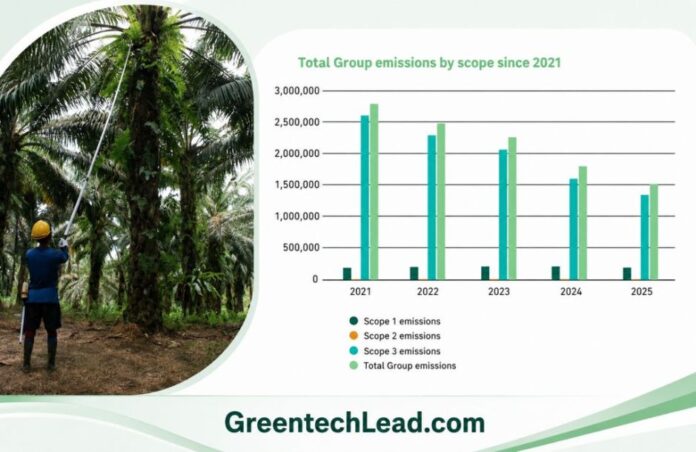
M.P. Evans Group has accelerated its sustainability programme with a 45 percent reduction in greenhouse gas emissions, record renewable electricity generation of 37 million kWh and approximately US$4.2 million in annual operating cost savings from its palm-oil mill effluent (POME) biogas facilities.
The palm oil producer reduced total Scope 1, 2 and 3 greenhouse gas emissions to 1.52 million tonnes of CO₂ equivalent (tCO₂e), compared with its 2021 baseline. GHG emissions intensity dropped to 4.2 tCO₂e per tonne of crude palm oil (CPO) from 4.8 tCO₂e previously and 8.9 tCO₂e at the baseline.
The improvements support M.P. Evans’ ambition to achieve net-zero emissions by 2050, although Scope 3 emissions remain the biggest challenge for future decarbonisation.
M.P. Evans GHG Emissions Fall 45 Percent
M.P. Evans reported total greenhouse gas emissions of 1.52 million tCO₂e, representing a 45 percent reduction from the 2021 baseline across Scopes 1, 2 and 3.
GHG intensity declined to 4.2 tCO₂e per tonne of CPO, versus 4.8 tCO₂e previously and 8.9 tCO₂e at the baseline.
Measured against total palm products, emissions intensity improved to 3.9 tCO₂e per tonne, compared with a baseline of 7.3 tCO₂e per tonne.
However, Scope 3 remains the dominant source of emissions, representing approximately 88-89 percent of the total carbon footprint, compared with around 12 percent from Scopes 1 and 2.
Within Scope 3, Category 10 — processing of sold products — accounts for 74 percent of Scope 3 emissions, highlighting downstream processing as a critical area for achieving deeper carbon reductions.
Net-Zero Targets Aim for Up to 90 Percent Emissions Reduction
M.P. Evans has established interim and long-term targets supporting its 2050 net-zero ambition.
By 2030, the Group aims to achieve a 53 percent reduction in FLAG emissions per tonne of CPO compared with its 2021 baseline. FLAG covers emissions associated with forests, land and agriculture.
The company is also targeting a 28 percent reduction in industrial Scope 1, 2 and 3 emissions by 2030.
By 2050, M.P. Evans aims for a 72 percent absolute reduction in FLAG emissions and a 90 percent reduction in industrial Scope 1, 2 and 3 emissions.
The Group also maintained a “B” rating across the CDP Climate Change, Forests and Water Security categories, providing an additional measure of its environmental disclosure and management performance.
POME Biogas Generates Record 37 Million kWh
Renewable energy is emerging as an important component of M.P. Evans’ emissions-reduction and operating-cost strategy.
The Group generated a record 37 million kWh of renewable electricity from biogas facilities using POME, turning waste from palm-oil processing into an energy resource.
The renewable electricity substitutes fossil diesel and generated approximately US$4.2 million in annual operating cost savings.
M.P. Evans also exported surplus renewable electricity to Indonesia’s national grid.
The programme demonstrates the financial potential of integrating waste management and renewable-energy production. POME that would otherwise represent a waste and emissions challenge can instead support electricity generation, reduce diesel consumption and lower operating expenses.
Energy Intensity Drops to 12.1 GJ per Tonne of CPO
M.P. Evans also improved energy efficiency across its palm-oil operations.
Energy intensity declined to 12.1 GJ per tonne of CPO, compared with 15.2 GJ per tonne previously.
Agricultural productivity improved alongside the reduction in energy intensity. Fresh fruit bunch yield increased to 21.5 tonnes per mature hectare from 20.9 tonnes.
The oil-extraction rate increased to 23.5 percent from 23.2 percent, while the kernel-extraction rate improved to 5.2 percent from 5.1 percent.
The combination of higher agricultural yields, improved extraction rates and lower energy consumption per tonne indicates stronger operational efficiency across the Group’s plantations and processing operations.
Sustainable Palm Oil Production Rises 7 Percent to 275,200 Tonnes
M.P. Evans increased certified sustainable palm oil (CSPO) production by 7 percent to 275,200 tonnes, compared with 256,700 tonnes previously.
Certified sustainable production represented 80 percent of total CPO output.
The Group also recorded a significant increase in higher-traceability RSPO Identity Preserved volumes. More than 55,000 tonnes of CSPO were sold as RSPO Identity Preserved certified material, compared with only 9,000 tonnes previously.
The expansion strengthens the proportion of M.P. Evans production supported by recognised sustainability certification and traceability standards.
RSPO-Certified Smallholder Area Expands to 4,100 Hectares
M.P. Evans is extending its sustainability programme beyond directly managed plantations through support for independent and scheme smallholders.
The area of independent smallholder production supported under RSPO certification increased to 4,100 hectares from 3,300 hectares.
The expansion included another 100 independent smallholders in Bangka.
M.P. Evans also manages 16,600 hectares of oil palm on behalf of local scheme smallholders, with these areas producing nearly 300,000 tonnes of fresh fruit bunches.
Smallholder certification is important to the wider sustainability performance of the palm-oil industry because environmental and traceability improvements need to extend beyond large plantation operators into smaller producers supplying the value chain.
Conservation Area Reaches 8,800 Hectares
M.P. Evans increased its conservation and High Conservation Value areas to 8,800 hectares, compared with 8,000 hectares previously.
The additional protected area strengthens the Group’s biodiversity and land-stewardship activities alongside its climate programme.
Active ecosystem restoration has also expanded substantially at Bangka.
The restoration area increased to 77 hectares from 11 hectares, covering initiatives including riparian reforestation and rehabilitation of former tin-mining land.
These projects provide measurable indicators of M.P. Evans’ efforts to restore degraded ecosystems in addition to protecting existing conservation areas.
M.P. Evans Achieves 91 Percent SPOTT ESG Score
Environmental transparency remains another component of the company’s sustainability strategy.
M.P. Evans achieved a 91 percent SPOTT ESG transparency score, reflecting its disclosure across environmental, social and governance indicators.
The SPOTT performance complements its B ratings across all three CDP categories — Climate Change, Forests and Water Security.
Sustainability oversight is also represented at Board level, with Tanya Ashton serving as the designated non-executive director and sustainability subject matter expert, while Group Chief Executive Matthew Coulson and the executive team oversee implementation.
Scope 3 Is Key Challenge for M.P. Evans Net-Zero Strategy
M.P. Evans has delivered measurable progress across carbon reduction, renewable energy, efficiency, sustainable palm oil and biodiversity.
Total GHG emissions have fallen 45 percent to 1.52 million tCO₂e, while emissions intensity has declined from the 8.9 tCO₂e per tonne of CPO baseline to 4.2 tCO₂e. Energy intensity has improved from 15.2 GJ to 12.1 GJ per tonne of CPO.
Renewable electricity generation has reached a record 37 million kWh, delivering approximately US$4.2 million in annual operating cost savings, while certified sustainable palm oil production has increased 7 percent to 275,200 tonnes, representing 80 percent of CPO production.
The Group has also expanded conservation areas from 8,000 to 8,800 hectares, ecosystem restoration from 11 to 77 hectares, and RSPO-certified independent smallholder areas from 3,300 to 4,100 hectares.
The bigger challenge is now Scope 3. With 88-89 percent of total GHG emissions originating in the value chain and processing of sold products responsible for 74 percent of Scope 3 emissions, deeper downstream decarbonisation will be crucial.
Progress against the 2030 targets of 53 percent lower FLAG emissions intensity and 28 percent lower industrial emissions, followed by 72 percent and 90 percent reductions respectively by 2050, will determine whether M.P. Evans can translate its current sustainability gains into its long-term net-zero ambition.
SHAFANA FAZAL