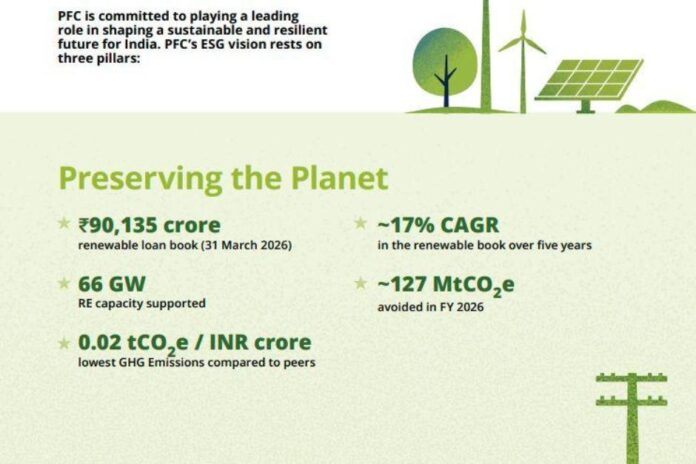
Power Finance Corporation (PFC) is accelerating its clean-energy financing strategy, with renewable energy now accounting for 32 percent of its total generation loan book, nearly double the 17 percent share recorded five years ago.
The 15-percentage-point increase reflects the growing importance of renewable energy in PFC’s lending portfolio as India expands solar, wind, storage, green hydrogen and other low-carbon infrastructure.
PFC aims to support more than 30 GW of generation capacity by 2030, while its sustainability portfolio already includes large pumped-storage projects, battery energy storage systems (BESS), a 5,533 MW clean-energy pipeline in Bhutan and approximately USD 2.5 billion in dedicated international green funding.
An assessment covering PFC’s top 22 renewable-energy projects estimates that they collectively avoid 5.3 million tonnes of CO₂ emissions annually, providing a measurable climate impact from its renewable financing activities.
PFC Renewable Energy Loan Share Rises from 17% to 32%
Power Finance Corporation’s Sustainability Report 2025-26 indicated that renewable energy has emerged as a major component of PFC’s generation financing portfolio.
Its share of the total generation loan book has increased from 17 percent five years ago to 32 percent, indicating a significant shift in capital allocation toward clean-energy infrastructure.
PFC’s sustainability-focused financing extends across solar, onshore wind, offshore wind and hybrid renewable-energy projects. The portfolio also covers pumped-storage projects, BESS, green hydrogen and e-mobility.
Other low-carbon and emissions-management technologies supported by PFC include ammonia co-firing and flue gas desulphurisation.
The broader technology mix means PFC’s green financing exposure is moving beyond renewable generation into energy storage, transport electrification, alternative fuels and technologies supporting lower emissions from the power sector.
22 Renewable Projects Avoid 5.3 Million Tonnes of CO₂ Annually
One of the most significant sustainability indicators is the emissions impact associated with PFC-financed renewable-energy projects.
An assessment of its top 22 renewable projects estimates combined annual emissions avoidance of 5.3 million tonnes of CO₂.
The figure provides a direct link between PFC’s financing activity and measurable greenhouse gas reductions, complementing the increase in renewable energy’s share of its generation loan portfolio.
The financing strategy also supports India’s target of reducing the emissions intensity of GDP by 45 percent by 2030 compared with 2005 levels.
India is separately aiming to reduce projected carbon emissions by 1 billion tonnes between 2021 and 2030, creating significant financing requirements across renewable generation, storage and other low-carbon infrastructure.
PFC Backs 2,800 MW of Pumped Storage
Energy storage is becoming another major component of PFC’s sustainability financing as India adds more variable solar and wind generation.
Two major pumped-storage projects represent a combined 2,800 MW of capacity.
The Bhivpuri Pumped Storage Project has 1,000 MW of capacity, while the Shirwata Pumped Storage Project adds 1,800 MW.
Pumped-storage infrastructure can help integrate renewable electricity by storing energy and supplying it when required, improving the flexibility and reliability of the power system.
PFC is also financing battery energy storage systems, giving the lender exposure to both established pumped-storage technology and rapidly expanding battery-based storage infrastructure.
The portfolio is further strengthened by a 5,533 MW clean-energy pipeline in Bhutan, extending PFC’s clean-energy financing exposure beyond India.
PFC Mobilises USD 2.5 Billion in Green Funding
PFC has mobilised approximately USD 2.5 billion in dedicated green funding from international banks and development financial institutions.
Access to international green capital provides additional funding capacity for renewable energy and environmentally focused infrastructure while diversifying PFC’s sources of finance.
A major component is a JPY 120 billion financial arrangement with the Japan Bank for International Cooperation (JBIC) under its GREEN initiative.
The international funding strategy complements PFC’s domestic clean-energy lending and provides additional capital for projects that meet defined environmental and sustainability criteria.
PFC Targets More Than 30 GW Generation Capacity by 2030
PFC is targeting support for more than 30 GW of generation capacity by 2030, positioning the lender as an important financier of India’s expanding electricity infrastructure.
The clean-energy portfolio covers multiple segments of the energy transition rather than concentrating only on conventional solar and wind projects.
Financing for offshore wind, renewable hybrids, BESS, pumped storage, green hydrogen and e-mobility could become increasingly important as India seeks to expand renewable electricity while maintaining grid reliability.
Green hydrogen adds another potential source of long-term electricity demand because large-scale hydrogen production through electrolysis requires substantial renewable power capacity.
Financing Supports India’s 500 GW Non-Fossil Target
PFC’s renewable and clean-energy lending strategy is aligned with India’s goal of reaching 500 GW of non-fossil electricity capacity by 2030.
India is also targeting a 50 percent share of cumulative installed electricity capacity from non-fossil energy sources.
These objectives form part of the country’s broader decarbonisation pathway toward achieving net-zero emissions by 2070.
PFC’s financing of renewable generation, pumped storage, battery systems, green hydrogen and other low-carbon technologies can support the infrastructure investment required to move toward these targets.
The company’s growing renewable-energy exposure is particularly significant because financing availability will be critical to converting India’s clean-energy capacity targets into operational projects.
PFC Strengthens Green Bond and ESG Framework
PFC has also established sustainability reporting and green-finance frameworks to support its expanding environmental portfolio.
Its ESG disclosures reference the GRI Universal Standards 2021, while material sustainability topics are mapped against the United Nations Sustainable Development Goals.
Non-financial information is independently assured by TUV India Private Limited, adding external assurance to reported sustainability information.
PFC’s Green Bond Framework is aligned with the Climate Bonds Standard Version 3.0 and ICMA Green Bond Principles 2021, establishing recognised criteria for the allocation and reporting of green capital.
These frameworks are increasingly important as PFC raises international funding for projects linked to renewable energy and other environmental objectives.
Renewable Energy and Storage Drive PFC Sustainability Strategy
PFC’s sustainability performance increasingly reflects a shift in its financing portfolio toward renewable generation and supporting energy infrastructure.
Renewable energy’s share of its generation loan book has increased by 15 percentage points, from 17 percent to 32 percent in five years, while an assessment of the top 22 renewable-energy projects indicates annual emissions avoidance of 5.3 million tonnes of CO₂.
Storage is another major focus, with the 1,000 MW Bhivpuri and 1,800 MW Shirwata pumped-storage projects providing a combined 2,800 MW of capacity. The 5,533 MW Bhutan clean-energy pipeline adds further scale.
At the same time, approximately USD 2.5 billion in dedicated international green funding, including the JPY 120 billion JBIC arrangement, strengthens PFC’s ability to finance environmentally focused projects.
With PFC targeting support for more than 30 GW of generation capacity by 2030, its financing strategy is increasingly connected with India’s wider targets of 500 GW of non-fossil electricity capacity, a 50 percent non-fossil share of cumulative installed power capacity, a 45 percent reduction in GDP emissions intensity from 2005 levels and a 1 billion-tonne reduction in projected carbon emissions between 2021 and 2030.
The longer-term benchmark remains India’s 2070 net-zero target. PFC’s ability to continue increasing renewable-energy lending while scaling storage, green hydrogen and other low-carbon technologies will determine the contribution its financing portfolio makes toward that transition.
SHAFANA FAZAL