India’s wind turbine market is entering one of its strongest expansion phases, with 6.05 GW of new wind capacity added in FY2025-26, the highest annual installation in the country’s history and 46 percent above FY2024-25.
Installed wind capacity reached 58.14 GW as of July 31, 2026, while another 28 GW is under implementation. Domestic wind turbine manufacturing capacity has expanded to around 24 GW annually, compared with 10 GW in 2014, creating a major growth opportunity for Suzlon, Inox Wind, Envision Energy, Adani Wind and GE Vernova.
India also has 70-80 percent indigenisation across major turbine components, including blades, towers and gearboxes, strengthening its role as both a wind project market and manufacturing hub.
Suzlon Leads India Wind Turbine Market With 6.1 GW Order Book
Suzlon has emerged as the strongest domestic wind turbine company based on recent deliveries and orders.
The company delivered a record 2,456 MW in FY2026, up from 1,550 MW in FY2025. Those deliveries were equivalent to roughly 41 percent of India’s 6.05 GW FY2026 wind additions, although deliveries and commissioned national capacity are not directly comparable market-share measures.
Suzlon ended FY2026 with an order book of about 5.9 GW, but by the end of Q1 FY2027 this had increased to approximately 6.1 GW. The company also delivered 506 MW during Q1 FY2027, up 14 percent year over year, its highest-ever first-quarter delivery.
Its 2026 order momentum has been particularly strong.
Suzlon secured a 400 MW EPC order from Tata Power, followed by 201.6 MW from Waaree, 105 MW from Sunsure Energy and another 250 MW from Torrent Green Energy.
The Torrent deal took Suzlon’s cumulative partnership with Torrent to 1,306 MW, while Suzlon said it had secured more than 1.1 GW of new FY2027 orders by August 2026.
The company is also moving beyond its established S144 platform. Its new S175 5 MW turbine, equipped with a 175-metre rotor and 160-metre hybrid lattice tower, received its first commercial order from Sunsure Energy for 21 turbines totaling 105 MW. The Suzlon S175 commercial launch and Sunsure order shows how the company is positioning itself for India’s shift toward larger turbines.
Suzlon has also started development of 1,325 MW of wind projects in Andhra Pradesh, representing approximately ₹10,500 crore of investment.
Inox Wind Builds 4.7 GW Order Book With Major PSU Contracts
Inox Wind is strengthening its position as Suzlon’s biggest domestic challenger.
Its order book reached approximately 4.7 GW after securing a 200 MW turnkey wind project from NLC India worth about ₹1,600 crore in July 2026. The project is scheduled for completion within 24 months and covers turbine supply, engineering, procurement, construction and post-commissioning O&M.
In September 2026, Inox added another major public-sector customer by winning a ₹755 crore order from Indian Oil Corporation for a 100 MW wind project.
The NLC and Indian Oil deals are important because they demonstrate Inox Wind’s growing exposure to PSU customers rather than relying entirely on private renewable developers.
Inox has around 2.5 GW of annual manufacturing capacity and is also moving toward a 4.X MW turbine platform, allowing it to participate in the shift toward higher-rated machines.
With a 4.7 GW order pipeline and increasingly large turnkey contracts, execution speed will be one of the biggest factors determining how much market share Inox can gain over the next two to three years.
Envision Energy Targets Scale With 5 MW Turbines
China-based Envision Energy has become an important competitor through local manufacturing and larger turbine technology.
The company has built approximately 3 GW of annual manufacturing capacity in India, including blade production and nacelle and hub assembly.
Its most significant growth opportunity comes from 5 MW-class turbines. Envision has been associated with plans involving 310 turbines of 5 MW each, representing around 1,550 MW, highlighting the increasing acceptance of larger machines among major Indian renewable developers.
This technology strategy puts Envision directly into one of the fastest-changing segments of the Indian market.
As land availability, transmission access and project economics become more important, developers are increasingly looking for turbines capable of producing more power per location.
Adani Wind Builds 2.25 GW Manufacturing Base
Adani Wind is pursuing a different strategy by combining turbine manufacturing with one of India’s largest renewable development platforms.
Its Mundra manufacturing complex has approximately 2.25 GW of annual turbine manufacturing capacity, with a modular design capable of expanding to 5 GW annually.
The company’s flagship 5.2 MW onshore wind turbine has already achieved substantial deployment at Adani Green Energy’s Khavda renewable energy development in Gujarat.
More than 2 GW of 5.2 MW turbines have been commissioned at Khavda. Adani is also developing a 5 MW turbine featuring a 185-metre rotor and 91.5-metre blades, giving it one of India’s largest rotor platforms.
Adani Wind’s 3.3 MW platform has a 750 MW order book scheduled for execution in FY2026-27.
The company benefits from vertical integration because large projects developed by the broader Adani renewable-energy business can provide internal demand for turbines. This reduces dependence on external orders compared with standalone turbine OEMs.
GE Vernova Secures 263.4 MW of Major 2026 India Orders
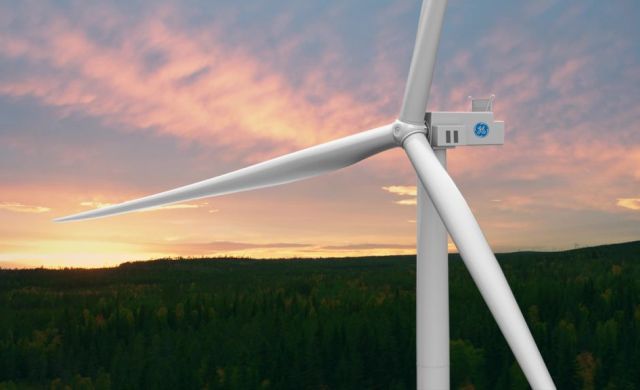
GE Vernova is rebuilding momentum in India around its locally manufactured 3.8 MW-154m turbine.
In June 2026, the company secured a 100 MW order from Powerica for the Botad Wind Farm in Gujarat. The project uses 28 turbines manufactured at GE Vernova’s Pune facility.
GE Vernova followed that contract with a 163.4 MW order from Enfinity Global for the Fatehgarh Wind Farm in Rajasthan.
The project will deploy 43 turbines of 3.8 MW each, with deliveries expected to begin in Q4 2026.
Together, these two announced projects represent 263.4 MW of major 2026 Indian orders.
GE Vernova already has more than 5 GW of installed wind capacity in India, providing it with an established service base alongside its new-equipment business. The GE Vernova India turbine manufacturing and Powerica project illustrates its strategy of combining local production with a turbine designed specifically for Indian wind conditions.
Siemens Gamesa, Vestas and SANY Remain Important Competitors
Siemens Gamesa and Vestas continue to have significant technology, manufacturing and servicing footprints in India, although their publicly announced 2026 India order momentum has been less visible than that of Suzlon, Inox Wind and GE Vernova.
Siemens Gamesa has Indian manufacturing operations covering blades and nacelles, while its SG 3.4-145 platform, with a rotor diameter of around 145 metres, targets low- and medium-wind locations.
Vestas remains important because of its global technology portfolio and Indian manufacturing and servicing capabilities.
China’s SANY Renewable Energy is another company to watch. Its 4 MW turbine with a 168-metre rotor is being deployed in India, including a 52 MW Sembcorp project in Karnataka using 13 turbines of 4 MW each.
However, global order books or installed bases should not be used as substitutes for India-specific market share.
India Moves Rapidly Toward 4 MW and 5 MW Wind Turbines
The most important technology change in India’s turbine industry is the move toward larger machines.
The emerging competitive range now includes:
Adani Wind: 5.2 MW
Suzlon S175: 5 MW
Envision: 5 MW class
SANY: 4 MW
GE Vernova: 3.8 MW-154m
Inox Wind: moving toward 4.X MW
Suzlon’s 5 MW turbine alone uses a 175-metre rotor, while Adani’s next platform increases rotor diameter to 185 metres.
Higher turbine ratings and larger rotors can increase energy capture, particularly in low- and medium-wind conditions, while reducing the number of turbines required for large projects.
Technology competition will therefore increasingly focus on annual energy production, rotor diameter, hub height, reliability, logistics and cost per megawatt-hour, rather than nameplate turbine capacity alone.
India Needs Another 41.86 GW to Reach 100 GW Wind Target
India’s 58.14 GW installed wind base means the country needs another approximately 41.86 GW to reach the government’s 100 GW wind capacity objective for 2030.
The existing 28 GW under implementation already represents around two-thirds of that requirement.
India’s wind manufacturing capacity of 24 GW annually is therefore more than sufficient in theoretical terms to support much faster installation growth. The bigger challenges are project execution, transmission availability, land, financing and converting awarded capacity into commissioned projects.
The government’s latest update on India’s wind capacity and manufacturing expansion confirms that manufacturing capacity has risen from 10 GW in 2014 to about 24 GW in March 2026, while localisation has reached 70-80 percent across major components.
Who Leads India’s Wind Turbine Market in 2026?
Suzlon currently has the strongest overall position, combining 2,456 MW of FY2026 deliveries, a roughly 6.1 GW order book and more than 1.1 GW of new FY2027 orders secured by August.
Inox Wind ranks as the strongest domestic challenger, with a 4.7 GW order book and major contracts from NLC India and Indian Oil.
Envision Energy is positioned strongly in the 5 MW segment, while Adani Wind has the advantage of a 2.25 GW manufacturing base, 5.2 MW technology and captive demand from the Adani renewable portfolio.
GE Vernova has also regained momentum with 263.4 MW of major 2026 announced orders, a Pune manufacturing base and more than 5 GW already installed in India.
India’s wind turbine race is therefore moving beyond simple market share. The next winners will be determined by order-book conversion, manufacturing utilisation, turbine performance, localisation and execution speed as the country attempts to move from 58.14 GW toward 100 GW of wind capacity by 2030.
SHAFANA FAZAL