
The Sustainability Report 2025 from Saudi Aramco outlines how the world’s largest integrated energy and chemicals company is advancing its long-term decarbonisation strategy while ensuring global energy security. Built around the “Aramco Sustainability Ambition,” the report highlights the company’s focus on reducing carbon intensity, scaling low-carbon technologies, and improving operational efficiency across its vast energy portfolio.
Net Zero Targets and Climate Strategy
Saudi Aramco, as part of its sustainability goals, has committed to achieving net zero Scope 1 and Scope 2 greenhouse gas emissions across its wholly owned operated assets by 2050. As part of its interim roadmap, the company aims to reduce upstream carbon intensity to 8.6 kg CO2e per barrel of oil equivalent by 2030 and deliver around a 15 percent reduction in carbon intensity by 2035 compared to 2018 levels.
The company’s strategy prioritises emissions intensity reduction rather than absolute emission cuts, reflecting the scale of its global production and continued demand for hydrocarbons.
Operational Emissions and Carbon Intensity Performance
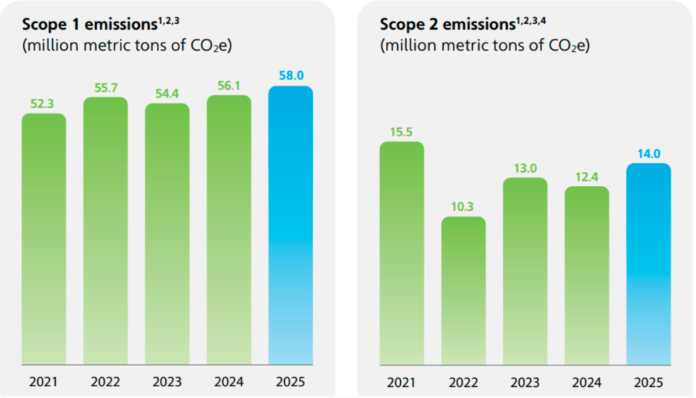
In 2025, Saudi Aramco reported Scope 1 emissions of approximately 56.1 million tons of CO2 equivalent and Scope 2 emissions of about 12.4 million tons. Combined emissions increased by 1.8 percent year-on-year, driven by higher production levels.
Upstream carbon intensity rose slightly to 9.7 kg CO2e per barrel of oil equivalent, compared to 9.6 previously. Despite this increase, Aramco continues to maintain one of the lowest upstream carbon intensities in the global energy industry.
Methane Reduction and Energy Efficiency
Methane emissions performance remains a key strength. Aramco reduced methane emissions by 11.4 percent, achieving a methane intensity of just 0.04 percent, among the lowest globally.
However, energy intensity increased by 5.9 percent, reflecting expanded operational activity. This indicates that while efficiency measures are in place, production growth continues to influence overall energy consumption.
Carbon Management and Offsetting Initiatives
Aramco is actively deploying carbon management strategies to mitigate emissions. In 2025, the company procured 1.1 million tons of CO2 equivalent in carbon credits and retired 0.51 million tons.
It also advanced carbon offset crude initiatives, achieving an average emissions intensity of 7.48 kg CO2e per barrel for these shipments. These efforts complement its broader strategy to scale carbon capture and low-carbon technologies.
Investments in Energy Transition Technologies
The company is expanding its investments in future energy solutions. Its Sustainability Fund, valued at $1.5 billion, invested $107 million in 2025, bringing total investments to $500 million across 36 companies.
Aramco is also developing large-scale carbon capture projects with a planned capacity of up to 9 million tons of CO2 per year by 2027. In parallel, it is advancing hydrogen development and exploring non-metallic materials to reduce lifecycle emissions.
Scope 3 Emissions and Value Chain Impact
Scope 3 emissions remain the largest component of Aramco’s carbon footprint, estimated at around 630 million tons of CO2 equivalent from the use of sold products.
This underscores a major industry-wide challenge, where downstream emissions are influenced by global energy consumption patterns rather than direct operational control.
Energy Efficiency and Renewable Integration
Aramco is improving energy efficiency through its Energy Management Program, which optimises performance across oil and gas processing facilities. The company is also increasing its renewable energy share by integrating large-scale solar projects, with a target to develop up to 12 gigawatts of renewable capacity by 2030.
Advanced digital technologies, including AI-driven operations and high-efficiency data centres, are being deployed to further reduce energy consumption and improve operational performance.
Water Management and Circular Economy Initiatives
Water stewardship is a critical priority, particularly in water-scarce regions. Aramco is expanding the use of treated wastewater and desalinated seawater for industrial processes, reducing reliance on freshwater resources.
In the circular economy space, the company is advancing its crude-to-chemicals strategy, increasing the proportion of oil converted into materials rather than fuels. Recycling initiatives, including plastic reuse and industrial waste management, are helping create a more sustainable materials lifecycle.
Overall Assessment of Targets vs Achievements
Saudi Aramco has delivered measurable progress in methane reduction, carbon management, and low-carbon investments. Its upstream carbon intensity remains among the lowest globally, reinforcing its operational efficiency.
However, total emissions and energy intensity have increased slightly due to higher production, while Scope 3 emissions continue to dominate its overall footprint.
Conclusion
Saudi Aramco’s Sustainability Report 2025 reflects a strategy focused on improving emissions efficiency while maintaining large-scale energy production. The company is making steady progress through methane reduction, carbon capture investments, and renewable integration.
Achieving its 2050 net zero ambition will depend on accelerating carbon capture deployment, expanding low-carbon energy solutions, and addressing the significant impact of Scope 3 emissions across the global energy value chain.
FASNA SHABEER
