
Standard Chartered delivered strong sustainability performance in 2025, generating $1.07 billion in sustainable finance income, surpassing its $1 billion target and recording 9 percent year-on-year growth. The results reflect rising demand for green, social, transition, and sustainability-linked finance solutions across global markets.
The bank accelerated progress toward its commitment to mobilise $300 billion in sustainable finance by 2030. Cumulative sustainable finance mobilisation reached $157 billion by the end of 2025, up from $123 billion in 2024. Supporting this growth is a $23.4 billion sustainable finance portfolio comprising 524 projects across 57 countries, demonstrating the increasing scale of sustainable investment activity across emerging and developed markets.
Marisa Drew, Chief Sustainability Officer at Standard Chartered, said: “We have now mobilised $157 billion in sustainable finance for our clients since January 2021 against our $300 billion target by 2030 and in 2025 issued Standard Chartered PLC’s first social bond.”
The sustainable finance portfolio delivered measurable environmental and social outcomes during 2025. Financed projects contributed to 6.94 million tonnes of avoided and expected greenhouse gas emissions while supporting economic inclusion through 32,580 SME loans and more than 1 million microfinance loans. Water-focused investments helped provide over 18 million cubic meters of water, highlighting the portfolio’s contribution to climate resilience, community development, and financial inclusion.
Standard Chartered expanded its sustainable funding platform through €1 billion in sustainability bonds, €1 billion in social bonds, and $2.3 billion in sustainability and green structured notes. A landmark transaction during the year was the issuance of the bank’s inaugural €1 billion social bond, with proceeds supporting healthcare, education, and financial inclusion initiatives.
Standard Chartered Sustainability Report 2025 indicated that the bank played a key role in the World Bank’s $200 million Clean Cooking Outcome Bond, helping unlock $30.5 million in climate finance and supporting the deployment of 415,000 clean cooking stoves in Ghana. Another significant transaction was a $210 million project finance facility for Chestnut Carbon, which will restore 60,000 acres of land and support the planting of more than 35 million native trees, generating long-term environmental and biodiversity benefits.
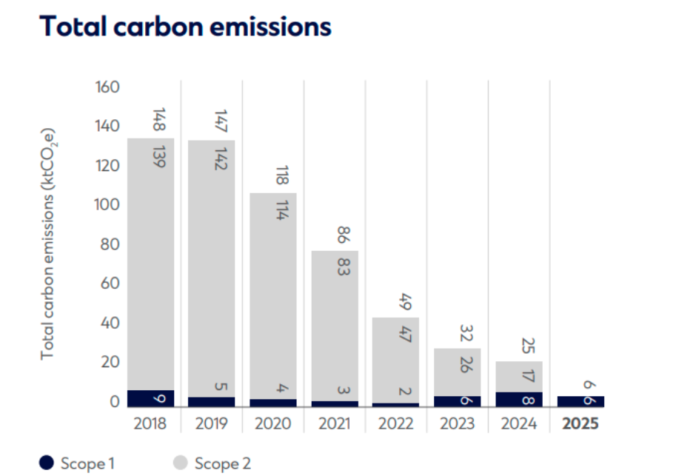
A major sustainability milestone was achieved in 2025 when Standard Chartered reached net zero across its operational footprint. Scope 1 and Scope 2 emissions were reduced by 96 percent from a 2018 baseline of 148 kilotonnes of carbon dioxide equivalent to only 6 kilotonnes of carbon dioxide equivalent. Remaining operational and business travel emissions were addressed through audited carbon credits aligned with ISO IWA 42 standards.
The bank also strengthened value-chain decarbonisation efforts, directing 54 percent of supplier spending toward suppliers that maintain science-based emissions reduction targets. This approach supports broader emissions reductions beyond the bank’s direct operations.
Financed emissions remain the bank’s largest climate challenge, accounting for more than 99 percent of its total carbon footprint. To address this, Standard Chartered has established 2030 emissions reduction pathways across all 12 high-emitting sectors covered by the Net-Zero Banking Alliance.
Within the upstream oil and gas portfolio, financed emissions totaled 7.2 million tonnes of carbon dioxide equivalent, with a target to achieve a 29 percent reduction from the 2020 baseline by 2030. Power generation emissions intensity stood at 0.39 tonnes of carbon dioxide per megawatt-hour, while thermal coal mining financed emissions were reported at 1.1 million tonnes of carbon dioxide equivalent. The bank remains committed to fully exiting thermal coal financing globally by 2030.
Debt capital markets facilitated emissions in the oil and gas sector averaged 3.08 million tonnes of carbon dioxide equivalent over a three-year period. Methane intensity across the upstream oil and gas portfolio measured 0.089 kilograms of methane per barrel of oil equivalent, significantly below the International Energy Agency benchmark of 0.200 kilograms.
Renewable energy procurement remained a critical component of operational decarbonisation. During 2025, Standard Chartered matched 100 percent of its global electricity consumption with renewable energy sources through renewable energy certificates and green procurement programmes, covering more than 100 million kilowatt-hours of electricity demand. The bank expanded onsite solar installations across 52 locations in 17 countries and maintained green building certifications across 130 office and branch locations. Renewable electricity sourcing was further supported through long-term power purchase agreements and green energy programmes in Singapore, Taiwan, and the Philippines.
Nature-related sustainability initiatives gained momentum during the year. Standard Chartered published its first Nature Report, establishing a baseline for assessing biodiversity dependencies, environmental risks, and nature-related impacts across its portfolio. The bank also expanded nature finance activities through ecosystem restoration projects and launched a Circular Economy Innovation Hub, complementing existing innovation hubs focused on adaptation finance, blended finance, carbon markets, and nature finance.
Investor demand for transition finance continued to grow. Research involving 1,600 high-net-worth investors found that 87 percent are interested in transition investing strategies supporting the decarbonisation of high-emitting sectors. Green hydrogen emerged as the most attractive investment theme, attracting interest from 49 percent of respondents, followed by low-emission fuels at 47 percent and carbon capture and storage at 45 percent.
The study also highlighted key barriers to investment. Around 50 percent of investors cited higher perceived risk, 46 percent pointed to a lack of standardised benchmarks, and 44 percent expressed concerns about financial returns, indicating areas where the sustainable finance market can continue to evolve.
Standard Chartered delivered strong sustainability performance in 2025, making significant progress across sustainable finance, climate action, renewable energy, biodiversity, and social inclusion. The bank generated $1.07 billion in sustainable finance income and increased cumulative sustainable finance mobilisation to $157 billion, supported by a $23.4 billion sustainable finance portfolio comprising 524 projects across 57 countries.
The portfolio contributed to the avoidance of 6.94 million tonnes of greenhouse gas emissions, while supporting economic inclusion through 32,580 SME loans and more than 1 million microfinance loans. Water-related investments helped provide over 18 million cubic meters of water, improving access to essential resources in underserved communities.
During the year, Standard Chartered strengthened its sustainable funding platform by issuing €1 billion in sustainability bonds, €1 billion in social bonds, and $2.3 billion in sustainability and green structured notes. The bank also supported the World Bank’s $200 million Clean Cooking Outcome Bond, helping mobilise $30.5 million in climate finance and enabling the deployment of 415,000 clean cooking stoves in Ghana.
The bank further supported nature-based climate solutions through a $210 million financing facility for Chestnut Carbon, which will restore 60,000 acres of land and support the planting of more than 35 million native trees.
Standard Chartered achieved net-zero operations in 2025, reducing Scope 1 and Scope 2 emissions by 96 percent from 148 kilotonnes of carbon dioxide equivalent in 2018 to 6 kilotonnes. The bank also matched 100 percent of its global electricity consumption with renewable energy, covering more than 100 million kilowatt-hours of demand. Renewable energy initiatives included onsite solar installations at 52 locations across 17 countries and green building certifications at 130 office and branch locations.
SHAFANA FAZAL
