
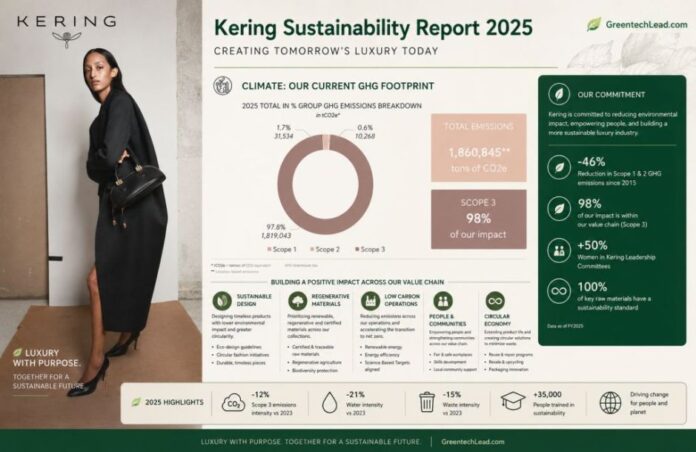
Luxury fashion group Kering has accelerated its sustainability transformation, achieving a 34 percent reduction in greenhouse gas emissions while strengthening investments in renewable energy, regenerative agriculture, biodiversity protection, circular materials, and responsible sourcing across its global value chain.
The company’s sustainability strategy is guided by a Double Materiality Assessment aligned with European Sustainability Reporting Standards and supported by its Environmental Profit & Loss (EP&L) methodology, which helps measure environmental impacts throughout its operations and supply chain, Kering Sustainability Report 2025 indicated.
Kering Achieves 34 Percent Reduction in Carbon Emissions
Kering reported a 34 percent absolute reduction in greenhouse gas emissions across Scope 1, Scope 2, and Scope 3 categories compared with its 2022 baseline. This marks a notable improvement from the 23 percent reduction achieved in 2024.
The company has set ambitious climate targets, including a 50 percent reduction in total carbon emissions by 2033 and achieving net-zero emissions across Scopes 1, 2, and 3 by 2050.
Despite the progress, indirect emissions remain the largest challenge. Scope 3 emissions account for 97.8 percent of Kering’s total greenhouse gas footprint, representing approximately 1.82 million tonnes of carbon dioxide equivalent.
According to Kering’s EP&L analysis, Tier 4 suppliers remain the most significant environmental hotspot, accounting for 45 percent of greenhouse gas emissions, 90 percent of land-use impacts, and 50 percent of total water consumption. These figures highlight the importance of sustainable sourcing, regenerative agriculture, and supplier engagement programs.
Renewable Electricity Reaches 100 Percent
Kering maintained 100 percent renewable electricity coverage across directly operated stores, offices, and warehouses worldwide where local infrastructure allows. The achievement supports the company’s operational decarbonization goals and broader renewable energy transition strategy.
More Than 95 Percent Traceability Across Core Raw Materials
Supply chain transparency continued to improve during 2025. Kering achieved more than 95 percent traceability across its core raw materials, enabling better oversight of sourcing practices and environmental impacts.
The company also maintained its deforestation-free sourcing policy covering key materials including leather, cotton, wool, silk, and cashmere. The initiative aims to protect ecosystems, preserve biodiversity, and reduce environmental risks linked to raw material production.
Water Stewardship Targets High-Risk Regions
Recognizing increasing pressure on freshwater resources, Kering has committed through the Science Based Targets Network to reduce water withdrawals by 21 percent at company-owned facilities and strategic supplier factories located in highly stressed water basins.
The initiative is designed to improve water efficiency, reduce operational risks, and strengthen long-term resilience across sourcing and manufacturing activities.
Regenerative Agriculture Expands to 1 Million Hectares
Kering continues to scale nature-positive sourcing through The Regenerative Fund for Nature, developed in partnership with Conservation International.
The initiative has successfully placed 1 million hectares of land under regenerative management, helping improve soil health, restore ecosystems, increase biodiversity, and strengthen climate resilience.
The company has also committed to reducing its absolute land footprint by 3 percent by 2030 through greater adoption of circular materials, recycled inputs, and sustainable sourcing practices.
Climate Fund for Nature Exceeds €200 Million
Kering’s Climate Fund for Nature remains a key pillar of its sustainability investment strategy. The fund now manages more than €200 million and supports ecosystem conservation projects, certified carbon-credit initiatives, and programs that create economic opportunities for female farm workers and rural communities.
These investments contribute to climate mitigation, biodiversity protection, and social development across important sourcing regions.
Circular Materials Strategy Targets Lower Leather Dependence
Material innovation is becoming increasingly important within Kering’s sustainability roadmap. By 2028, the company aims to reduce its absolute dependence on animal leather by 30 percent.
Looking further ahead, Kering plans to incorporate 40 percent alternative materials across collections by 2035 while increasing regenerative materials to 20 percent of ready-to-wear products.
The company also targets generating 20 percent of group revenue from sustainable innovation, circular business models, repair services, resale activities, and digital product twins, supporting the transition toward a more resource-efficient luxury industry.
Women Hold Majority of Management and Board Positions
Kering continued to strengthen its social sustainability performance, maintaining Universal Fair Pay certification for the third consecutive year across all luxury houses and operations.
Women represent 63 percent of the workforce, 59 percent of management positions, and 55 percent of board membership. Independent directors account for 64 percent of the Board, reinforcing governance oversight, accountability, and diversity objectives.
ESG Recognition Reinforces Sustainability Leadership
Kering remains one of the global leaders in ESG performance and transparency. The company retained its position on the CDP Triple A List for Climate Change, Water Security, and Forests.
Additionally, Kering has maintained inclusion in the Dow Jones Sustainability Index World and Europe for 13 consecutive years, reflecting its long-term commitment to responsible business practices and sustainability reporting.
Long-Term Sustainability Targets
Kering’s sustainability roadmap includes several major targets:
Reduce carbon emissions by 50 percent by 2033
Achieve net-zero emissions across Scopes 1, 2, and 3 by 2050
Reduce water withdrawals by 21 percent in highly stressed basins
Lower absolute land footprint by 3 percent by 2030
Reduce dependence on animal leather by 30 percent by 2028
Integrate 40 percent alternative materials across collections by 2035
Increase regenerative materials to 20 percent of ready-to-wear products by 2035
Generate 20 percent of revenue from circular business models and sustainable innovation
These initiatives demonstrate Kering’s commitment to building a lower-carbon, nature-positive, and resilient luxury supply chain while advancing climate action, biodiversity conservation, responsible sourcing, water stewardship, and circular economy principles.
SHAFANA FAZAL
