
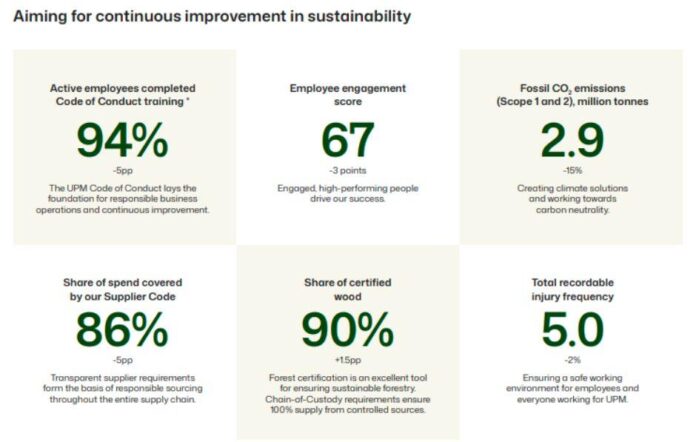
UPM delivered strong sustainability performance in 2025, demonstrating measurable progress across climate action, renewable energy adoption, circular economy initiatives, sustainable forestry, and green finance deployment. The company accelerated its transition toward a low-carbon and bio-based industrial model through significant emissions reductions, increased renewable energy use, improved resource efficiency, and large-scale sustainability investments.
A major highlight of UPM’s 2025 sustainability performance was the reduction in greenhouse gas emissions. Scope 1 emissions declined to 2.08 million tonnes of carbon dioxide, while Scope 2 emissions reached 0.80 million tonnes, bringing combined Scope 1 and Scope 2 emissions to 2.8 million tonnes. This represents a 58 percent reduction compared with the 2015 baseline and a 15 percent decrease year-on-year.
Scope 3 emissions totaled 7.70 million tonnes of carbon dioxide, including 4.8 million tonnes from audited upstream and logistics activities, marking a 22 percent reduction from the 2018 baseline. Carbon intensity in paper production improved substantially to 310 kilograms of carbon dioxide per tonne, compared with 400 kilograms in 2024 and 490 kilograms in 2023, representing a 38 percent improvement from the 2023 baseline.
Renewable energy continued to play a central role in UPM’s decarbonization strategy. Renewable fuel consumption reached 35,100 GWh, accounting for 81 percent of total energy use, while fossil fuel consumption declined to 8,100 GWh. Across its global operations, 86 percent of electricity consumption came from renewable or zero-carbon sources. UPM Energy generated 13,200 GWh of electricity and 820 GWh of thermal heat while maintaining 99 percent carbon dioxide-free generation efficiency. Consumption of coal and peat declined by 5 percent year-on-year, supporting the company’s long-term fossil fuel phase-out objectives.
UPM also advanced its sustainable finance agenda by fully allocating €2,350 million in green bond proceeds to sustainability-related projects. Of the total allocation, €2,048 million supported capital expenditure initiatives, while €302 million funded operational sustainability activities. The company directed €1,427 million toward refinancing existing assets and €923 million toward new sustainability projects. EU Taxonomy-aligned financing represented 44 percent of total allocations. Geographically, investments were distributed across Uruguay with 40 percent, Germany with 38 percent, and Finland with 22 percent.
Circular economy initiatives generated notable improvements in resource efficiency and waste management. Landfill waste declined to 13,000 tonnes, representing a 50 percent reduction compared with the 2015 baseline. Internal recycling systems recovered 90 percent of production waste for reuse in secondary applications. Wastewater chemical oxygen demand decreased by 36 percent compared with the 2008 baseline, while wastewater volume per tonne of product declined by 15 percent. Nutrient circularity reached 41 percent, reflecting improved resource recovery. Certified fiber sourcing under FSC and PEFC standards accounted for 87 percent of total fiber procurement, while the remaining 13 percent originated from controlled and non-controversial sources.
UPM’s managed forests continued to function as a significant natural carbon sink. The company reported a rolling five-year average carbon sequestration rate of negative 1.9 million tonnes of carbon dioxide equivalent annually. Forest assets were valued at €2,605 million, supported by €64 million in regeneration investments and €26 million in maintenance activities. Biodiversity initiatives also progressed, with river ecosystem restoration extending beyond 32 kilometers to enhance ecological connectivity and environmental resilience.
Environmental performance improved further through reductions in air pollutant emissions. Nitrogen oxide emissions totaled 8,800 tonnes, volatile organic compounds reached 1,000 tonnes, particulate matter emissions were 780 tonnes, and sulfur dioxide emissions stood at 760 tonnes. Overall transboundary air pollutants declined by 18 percent compared with the 2015 baseline due to enhanced emissions control technologies and operational improvements.
On the social and governance front, workplace safety improved with a Total Recordable Injury Frequency of 5.6 per million hours worked. Supplier sustainability compliance coverage reached 98 percent, demonstrating strong oversight across the supply chain. Women represented 27 percent of management positions, while UPM’s ESG leadership received external recognition through a Platinum EcoVadis rating of 90 out of 100 and an MSCI AAA ESG rating.
UPM’s 2025 sustainability results highlight significant progress across environmental, social, and governance priorities. With Scope 1 and Scope 2 emissions reduced to 2.8 million tonnes, renewable energy consumption reaching 35,100 GWh, green finance allocations totaling €2.35 billion, landfill waste reduced to 13,000 tonnes, and forest carbon sequestration averaging 1.9 million tonnes annually, the company continues to strengthen its position as a leader in sustainable industrial transformation and the transition to a low-carbon circular economy.
SHAFANA FAZAL
