
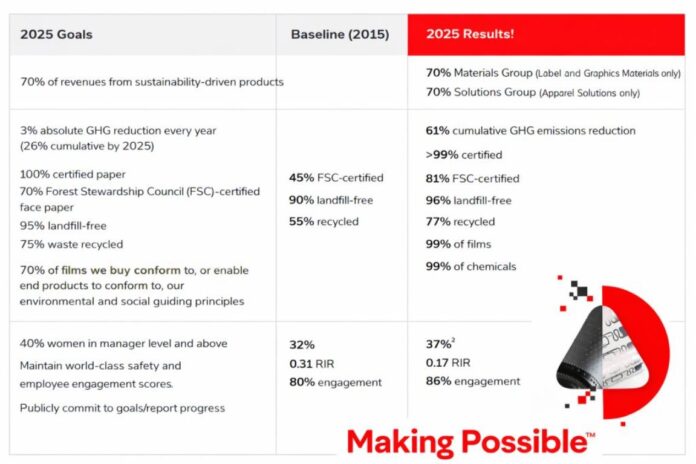
Avery Dennison’s 2025 Sustainability Report highlights significant progress toward its sustainability targets, supported by measurable environmental gains, strategic investments, and a business model increasingly aligned with circular economy principles.
The company has exceeded several of its 2025 environmental targets. Greenhouse gas emissions have been reduced by approximately 54 percent cumulatively against the 2015 baseline, surpassing the original target of 26 percent reduction by 2025. Waste and resource efficiency metrics also show strong performance, with operations reaching 94 percent landfill-free status and 68 percent of waste recycled, moving closer to long-term circularity goals.
Sustainable sourcing targets are nearing completion. Avery Dennison reports 97 percent certified paper sourcing, significantly above earlier baselines, while 80 percent of face paper is FSC-certified, reflecting progress toward responsible materials procurement. In addition, 97 percent of films and chemicals now meet or support the company’s environmental and social standards, demonstrating deep integration of sustainability across the supply chain, Avery Dennison CEO Deon Stander said.
From a product and revenue perspective, sustainability is becoming a core growth driver. Around 69 percent of Materials Group revenue and 66 percent of Solutions Group revenue are now linked to sustainability-driven products, approaching the 70 percent target. This indicates a strong shift toward circular and low-impact product innovation as a key business strategy.
On the social side, workforce diversity and safety metrics show steady improvement. Women represent 37 percent of management-level roles, progressing toward the 40 percent target, while safety performance improved with a Recordable Incident Rate of 0.21, outperforming earlier benchmarks. Employee engagement has also strengthened to 85 percent, reflecting internal alignment with sustainability goals.
Investment strategy is closely tied to sustainability outcomes. Avery Dennison is directing capital toward innovation in sustainable materials, intelligent labeling, and circular solutions, with sustainability embedded in product development and portfolio expansion. The company’s strategy emphasizes increasing the share of revenue from environmentally responsible products while improving operational efficiency and reducing lifecycle impacts.
Avery Dennison embeds sustainability into its core investment strategy by aligning capital spending and R&D with long-term goals such as circular economy innovation, emissions reduction, and sustainable materials development.
The company allocated around $200 million in capital expenditures in 2025, supporting initiatives like energy-efficient manufacturing upgrades, expansion of RFID and intelligent labeling technologies, and capacity growth in key markets including India. Ongoing investments in LED lighting and HVAC optimization are helping lower emissions while improving operational efficiency. In parallel, Avery Dennison invested about $137 million in research and development, focusing on creating sustainable materials with recycled or renewable content, advancing circular product design, and enhancing digital identification solutions to improve supply chain transparency. These investments reinforce sustainability as a key driver of innovation and business growth.
Looking ahead, Avery Dennison’s 2030 roadmap builds on these achievements with more ambitious targets. These include deeper emissions reductions, broader adoption of circular materials, and expanded community and workforce initiatives. Governance structures, including a dedicated Sustainability Council and board-level oversight, ensure that sustainability remains central to decision-making and capital allocation.
Overall, Avery Dennison’s sustainability performance is defined by strong overachievement in emissions reduction, near-completion of sourcing targets, and a clear shift toward sustainability-led revenue growth, supported by disciplined investment and a long-term circular economy strategy.
BABURAJAN KIZHAKEDATH
